
ILLUSTRATION LIST:
(Table 2)
[note 2]
[note 3]
[note 4]
[note 5]
[note 6]
[note 7]
[note 8]
[note 9]
(Figure 1)
(Figure 2)
(Figure 3)
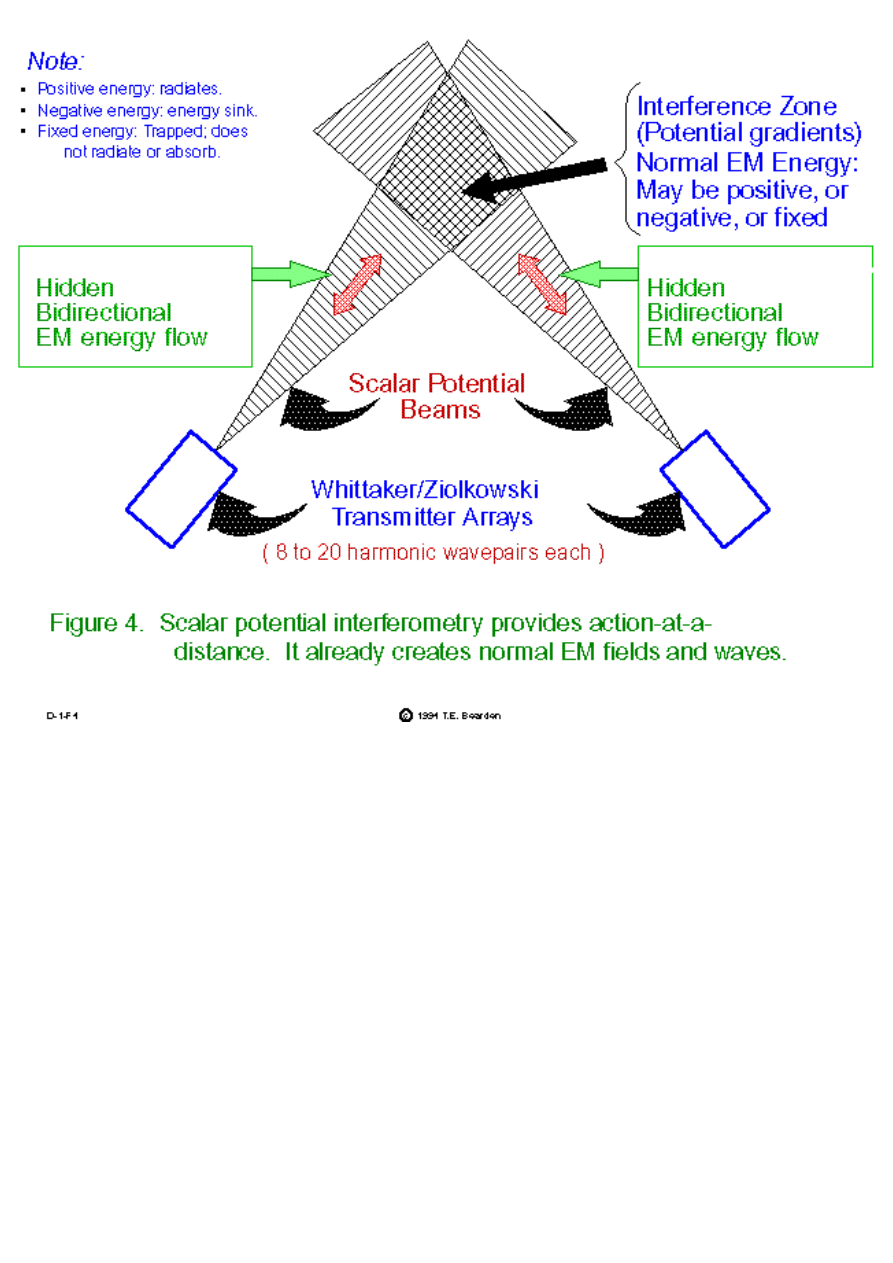
(Figure 4)
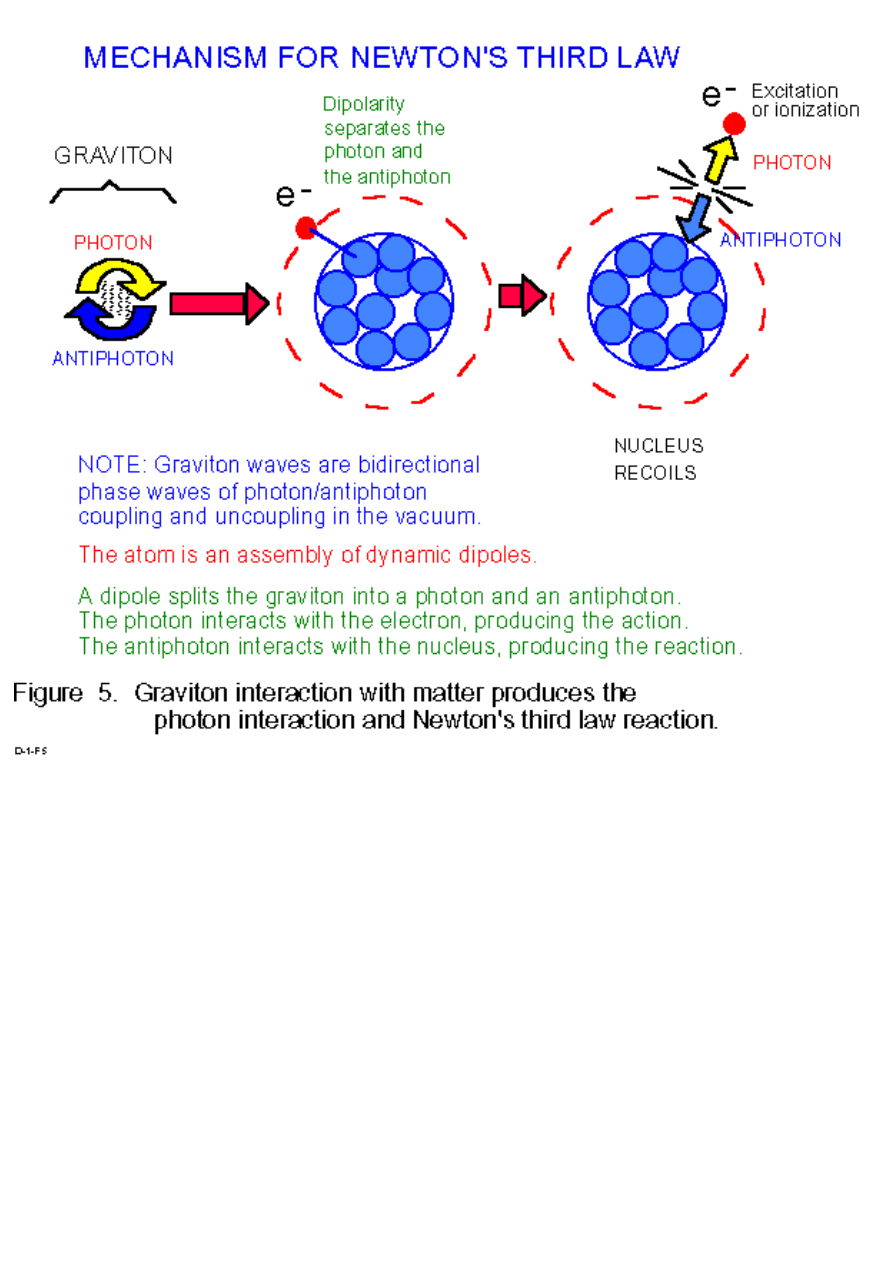
(Figure 5)
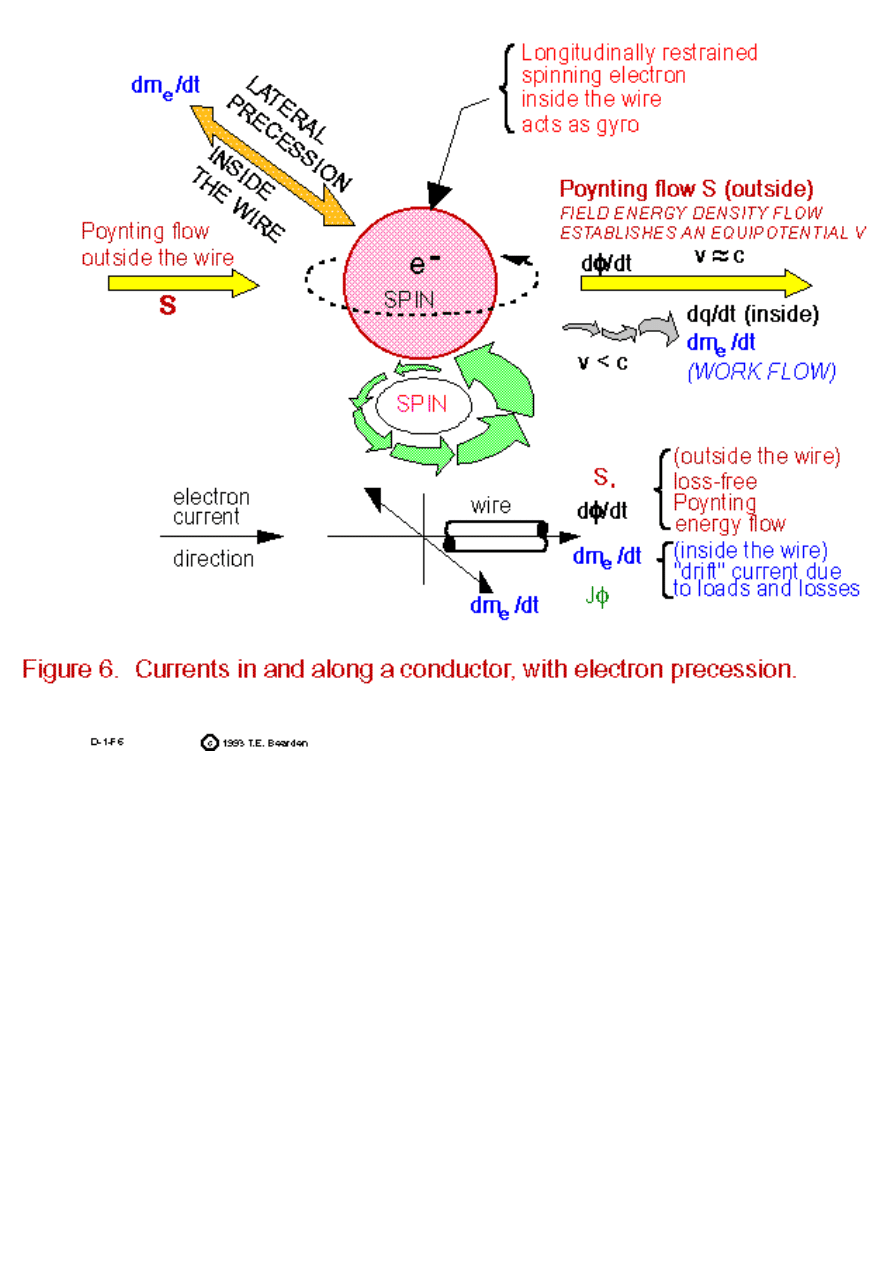
(Figure 6)
[note 10]
[note 11]
[note 12]
[note 13]
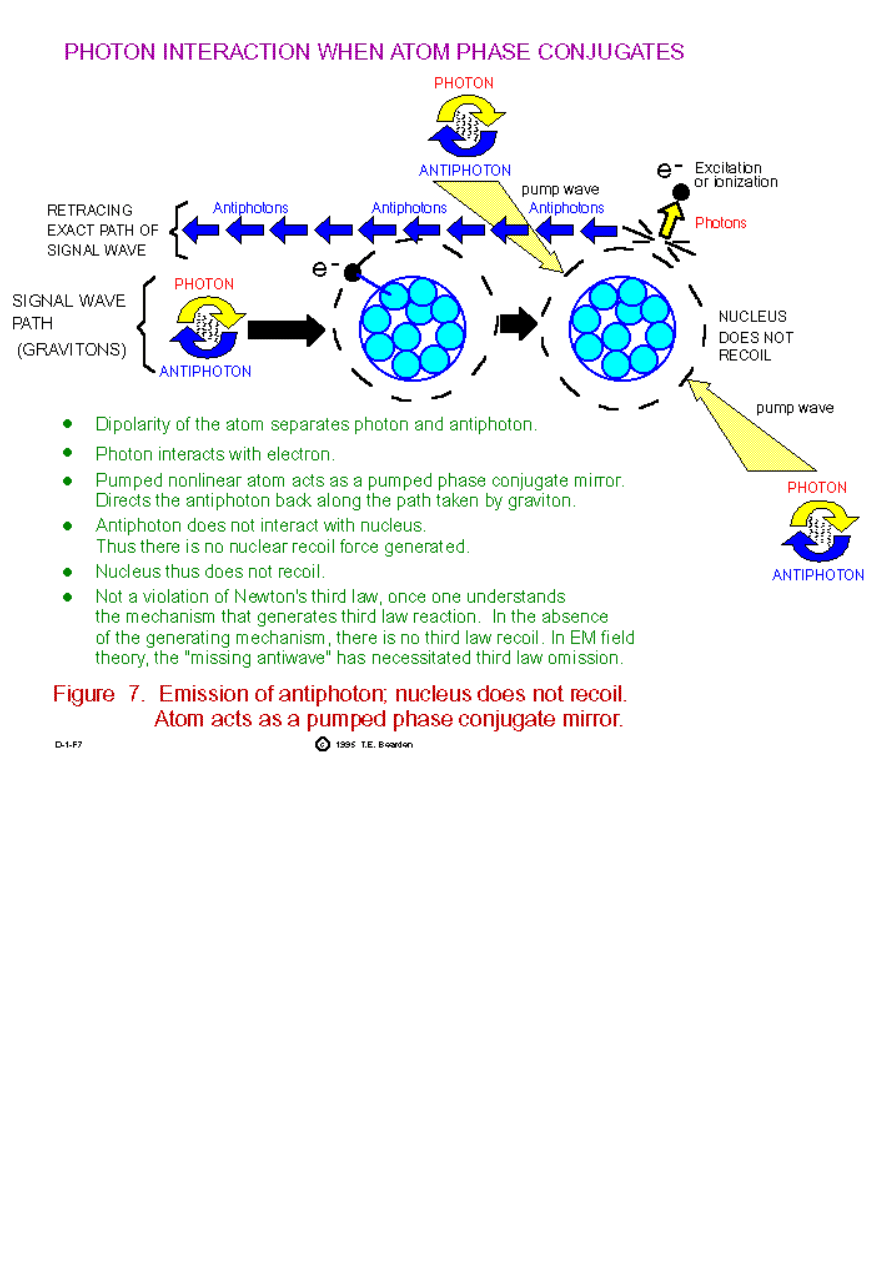
(Figure 7)
(Figure 8)
(Figure 9)
(Figure 10)
[note 14]
[note 15]
Figure 11
Figure 12
[note 16]
[note 17]
(Figure 13)
(Figure 14)
(Figure 15)
[note 13]
[note 18]
[note 19]
[note 20]
(Figure 16)
(Table 3)
[note 22]
(Figure 17)
(Figure 18)
[note 23]
[note 24]
[note 25]
[note 26]
[note 27]
(Figure 19)
(Figure 20)
(Table 4)
[note 28]
[note 29]
[note 30]
(Figure 21)
(Figure 22)
[note 31]
[note 32]
[note 33]
[note 34]
[note 35]
(Figure 23)
http://www.hsv.com/writers/bearden/illist.htm24.11.2003 20:25:47

CHASING THE WILD DRAGON:
CHASING THE WILD DRAGON:
Foundations of a New Science
By T.E. Bearden
November 12, 1995
It is a pleasure to accept the offer of John and Larry to write a column in their new InterNet
magazine. Theirs is a great venture, and with the energy and knowledge they bring to the task, one
can be confident of their success in making this a very interesting and informative publication.
There is a new "rebel" science slowly being born, with most of the work being done outside the
universities and orthodox scientific community. In the months ahead it will be my job to try to
acquaint you with the gist of what's going on, and what all the excitement is about.
This first article is deliberately just introductory, and its purpose is to interest you in the unusual
fields we are going to be covering in more scientific detail, in future columns. We will also be listing
a variety of references from the technical literature, which bear upon the various points addressed.
In this first article a little of my own background experience
is given, so you can decide
whether you will be interested in what we have to say!
The real purpose of the column will just be to present information that you may not be able to readily
obtain any other way. We will not argue or debate with skeptics; nothing productive is to be gained
by that. If the information we present is useful to you, then our purpose has been accomplished. If it
isn't of use to you, then just file it in the old wastebasket. Also, from time to time I may answer a
generic question, constructed from multiple queries. Individual responses to correspondence cannot
be provided.
The work toward a new breakthrough science is going on in a broad spectrum of "fields," most of
which are not yet recognized by academia as even constituting legitimate areas of scientific endeavor
Some of the major areas involved are:
1. theoretical and experimental research in overunity electrical machines,
2. free energy research of other kinds, such as devices utilizing thermodynamics phase changes,
3. rapidly advancing efforts in cold fusion,
4. work on permanent magnet motors,
5. antigravity research, both theoretical and experimental,
6. development and utilization of a "hidden" electrodynamics inside the scalar potential (inside
voltage),
7. the "memory" of space and materials; where this "memory" can be deliberately conditioned so
that space and the materials themselves become causal actants rather than simple inert entities,
http://www.hsv.com/writers/bearden/page001.htm (1 of 2)24.11.2003 20:25:55
CHASING THE WILD DRAGON:
8. direct engineering of quantum change via a new kind of "hidden electrodynamic variables,"
9. the direct engineering of the vacuum's virtual photon flux exchange with matter,
10. action at a distance, including the deliberate formation and usage of quantum potentials,
11. direct engineering of the local curvature of spacetime (yes, the direct engineering of general
relativity, using the new hidden kind of electrodynamics),
12. use of the new "hidden" electromagnetics to engineer body cells including the reversal of
diseased cells, genetics and all, back to a previous healthy state (cellular dedifferentiation, in
biophysical terms, or cellular phase conjugation, in physics terminology),
13. research toward the direct engineering of the mind, including both the conscious and
unconscious minds, long-term memory, and the personality itself, and
14. a ruthless re-examination (and correction where necessary and possible) of the definitions,
concepts, and postulates that present physics is founded upon.
|
Comments may be sent to
the
of The Virtual Times
http://www.hsv.com/writers/bearden/page001.htm (2 of 2)24.11.2003 20:25:55

Notes and References:
[1] For those interested in orthodox qualifications, I have an M.S. in nuclear engineering (1971) from
Georgia Institute of Technology and a BS in mathematics (1953) from what is now Northeast
Louisiana University with a minor in electronic engineering.
http://www.hsv.com/writers/bearden/ref01.htm24.11.2003 20:25:57

Tables:
Table 1. Fourteen Emerging New Science Areas
1. Overunity Electrical Machines and Power Systems
2. Overunity Devices Using Thermodynamical Phase Changes
3. Cold Fusion and Non-Nuclear Transmutation
4. Self-Powered Permanent Magnet Motors
5. Antigravity and Antigravity Engineering
6. Use of the "Inner" EM Inside the Scalar Potential
7. Vacuum Engineering, With Vacuum and Materials Memory
8. Direct Engineering of Quantum Change
9. Engineering and Structuring of Massless Charge Flux
10. Action-At-A-Distance, Including Use of Quantum Potentials
11. Direct Engineering of Local Spacetime Curvature
12. "Inner EM" Time Reversal of Diseased Cells Back to Health
13. Direct Engineering of the Mind, Including Software Loading
14. Unified Field Revision of Foundations Concepts of Science
http://www.hsv.com/writers/bearden/table001.htm24.11.2003 20:25:59

CHASING THE WILD DRAGON:
Each of these "major areas" as yet has no single "experts" in the sense
that individuals exist who possess a "mastery" of the given area. As an example, in spite of multiple
researchers and decades of vigorous research, no one is really an "overall expert" in the overunity
electrical power systems field. The "field" itself is still struggling to be born and is not recognized at
all by orthodoxy; in fact, many orthodox scientists bitterly resent one even attempting to work in this
area. There is as yet no cohesive single "theory" of overunity electrical or magnetic machines,
although our own group is making rapid progress in that respect. But there is still no universal
agreement amongst even the researchers themselves. Literally the field is still being discovered.
This "groping dimly toward a new field" should not be too surprising. After all, the early
electromagnetics researchers went through the same tortuous, agonizing kind of development. They
were playing with cat fur, glass rods, and pith balls for quite an extended period before understanding
progressed to the point where Maxwell could mathematically tie together and model the results of the
experimenters such as Faraday and others. It has taken a century and a half for modern
electromagnetics and electronics to reach its own present development. It is going to take another
decade or so before the overunity researchers can overturn several ill-founded parts of the present
electromagnetics and get the emerging field onto a solid foundations footing and into a solid
theoretical position.
In the effort to produce a theoretical model of electromagnetics, Maxwell and his predecessors
performed a magnificent work. Yet they also made very serious errors
, which persist to this
day.
Let us list just a few of the more blatant errors in classical EM theory today:
First, Franklin guessed wrong on which way electrical current flowed in a circuit. There is no
definition at all of electrical charge in all of physics, and there is no acceptable definition of potential
(that is, there is no rigorous definition of just good old "voltage.") There are no "fields of force" in the
vacuum; there are just potential gradients __ because the vacuum is just one vast potential (virtual
particle flux) in the first place. Force fields actually occur only in and of the matter in a material
system. The primary causative agents of electromagnetics are not the so-called "force fields' at all,
but are the potentials __ as is well-known in quantum mechanics.
Maxwell assumed a
material ether in his equations. The Michelson-Morley experiment destroyed the material ether, but
the Maxwell equations have never been changed accordingly. The electron was not yet discovered
when the Maxwell equations were written; the theory does not address electron spin. Maxwell was
already dead some two decades when Barus' 1898 paper
was published, pointing out the
strange "backwards-traveling" wave (i.e., time-reversed wave) solution to the wave equation. In
addition, Heaviside and Gibbs had already produced their vector truncation __ this truncated theory is
the modern so-called "Maxwell's equations" that universities teach today __ of Maxwell's theory. Not
a single one of them ever appeared in any book or paper by James Clerk Maxwell.
|
Comments may be sent to
the
of The Virtual Times
http://www.hsv.com/writers/bearden/page002.htm24.11.2003 20:26:00

Tables:
Table 2. Some Defects In Electrodynamics
1. Conventional Current Direction Is Reversed
2. No Definition of Charge or Potential
3. Equations Still Assume Material Ether
4. Use of Force Fields in Vacuum is Known to be False
5. Treats Charge as Unitary; lnstead, It is a Coupled System
6. Confuses Massless Potential Gradients as Forces
7. Does Not Utilize Mass as a Component of Force
8. Erroneously Assumes Force Fields as Primary Causes
9. Topology of EM Model Has Been Substantially Reduced
10. Does Not Include Quantum Potential
11. Does Not Include Proven Action At A Distance
12. Does Not Utilize Near Field Coulornb Gauge Effects
13. Does Not Include EM Generatrix for Time Flow
14. Does Not Unify Photon and Wave Aspects
15. Does Not Include Electron Spin and Precession
16. Treats Energy As Existing In "Chunks," instead of as Flow
17. Confuses Energy and Energy Collection
18. Discards Half of Every EM Wave in Vacuum
19. Erroneously Uses Transverse Vacuum Wave; It's Longitudinal
20. Omits Phase Conjugate Optics Effects
21. Does Not Include EM Cause of Newtonjan Reaction Force
22. Erroneously Assumes Separate Force Acting on Separate Mass
http://www.hsv.com/writers/bearden/table002.htm24.11.2003 20:26:02

Notes and References:
[2] For an independent statement that electrodynamics, both classical and quantal, are in serious
disarray, see Mario Bunge, Foundations of Physics, Springer-Verlag, New York, 1967, p. 176.
Quoting: "...it is not usually acknowledged that electrodynamics, both classical and quantal, are in a
sad state." Bunge points out many errors in electrodynamics. See also Terence W. Barrett,
"Electromagnetic Phenomena Not Explained by Maxwell's Equations," in Lakhtakia, A. (ed.): Essays
on the Formal Aspects of Electromaqnetic Theory, World Scientific, Singapore, 1992, p. 6-86. To
find information on what's wrong with EM theory, one must read foundations literature, not the
standard textbooks. One of my own contributions has been to point out that the notion of charge q is
not unitary. In fact, electrical charge should be defined in terms of q ~ m(sub q)~(sub q). In other
words, electric charge q has a massive part m, and a massless part consisting of its potential phi.
Further, the magnitude of phi is just the change in the virtual photon flux of the ambient vacuum, due
to the [quantum field theoretic] virtual photon exchange with the mass of the q. It follows that the
true electrical charge of a particle is just its native potential ~, which is also a dynamic energy
exchange with the surrounding vacuum. It also follows that this massless electrical charge changes
whenever the particle is placed in a potential (in a different ambient virtual photon flux). After all,
potentials superpose; that is their major characteristic. Note that the potential of the test particle is
ignored in classical electromagnetics, whenever one speaks of the "E-field" upon the particle. Further,
the actual structure of this virtual photon flux that comprises massless electrical charge, can itself be
deterministically structured and utilized to generate nonlinear effects that do not appear at all in the
present conventional theory. We will be covering many of these effects in future articles.
http://www.hsv.com/writers/bearden/ref02.htm24.11.2003 20:26:04

Notes and References:
[3] E.g., see Y. Aharonov and D. Bohm, "Significance of Electromagnetic Potentials in the Quantum
Theory," Physical Review, Second Series, 115(3), 1959, p. 485-491. Effects of potentials on charged
particles exist even in the region where all the fields (and therefore the forces on the particles) vanish,
contrary to classical electrodynamics. The quantum effects are due to the phenomenon of
interference. These effects occur in spite of Faraday shielding. The Lorentz force does not appear
anywhere in the fundamental quantum theory, but appears only as an approximation that holds in the
classical limit. In QM, the fundamental physical entities are the potentials, while the fields are
derived from them by differentiation.
http://www.hsv.com/writers/bearden/ref03.htm24.11.2003 20:26:05

Notes and References:
[4] Carl Barus, "A Curious Inversion in the Wave Mechanism of the Electromagnetic Theory of
Light," American Journal of Science, Vol. 5, Fourth Series, 1898, p. 343-348.
http://www.hsv.com/writers/bearden/ref04.htm24.11.2003 20:26:07

Notes and References:
[5] E.g., see Paul J. Nahin, Oliver Heaviside: Saqe in Solitude, IEEE Press, New York. Quoting from
p. 9: "...nowhere in Maxwell's writings do the equations for the electromagnetic field appear as we
write them today. Maxwell used an amalgamation of Cartesian component and quaternion notation,
and it was Heaviside who first wrote the electromagnetic field equations in modern vector form."
Quoting from p. 92: "In actuality , however, the fields were not the primary reality to Maxwell at all
(that is an idea that developed after Maxwell's death and is due to Hertz and Heaviside), but rather it
was Faraday's 'electrotonic state' that he thought to be the real thing. Like Faraday, Maxwell believed
that electromagnetic effects are observable results of an altered state of the ether. The mathematical
formulation of this electrotonic state, for Maxwell, is what we today (as he did) call the vector
potential." And again, from p. 96: "To Maxwell, however, the vector potential had a most definite
physical meaning."
http://www.hsv.com/writers/bearden/ref05.htm24.11.2003 20:26:09

CHASING THE WILD DRAGON:
So the time-reversed EM wave that one finally sees emerging in
nonlinear phase conjugate optics in the early 1970s was omitted from the Maxwellian theory and its
later modification by Heaviside and Gibbs. Maxwell's actual theory is in a higher topology
(quaternion algebra), and involves some 20 quaternion equations. Heaviside and Gibbs created vector
algebra, and seriously curtailed Maxwell's theory when they "translated" it into the much lower
topology of vectors and some four equations. The later addition of tensors as the basis mathematics
did not restore the lost topology provided by the quaternion model.
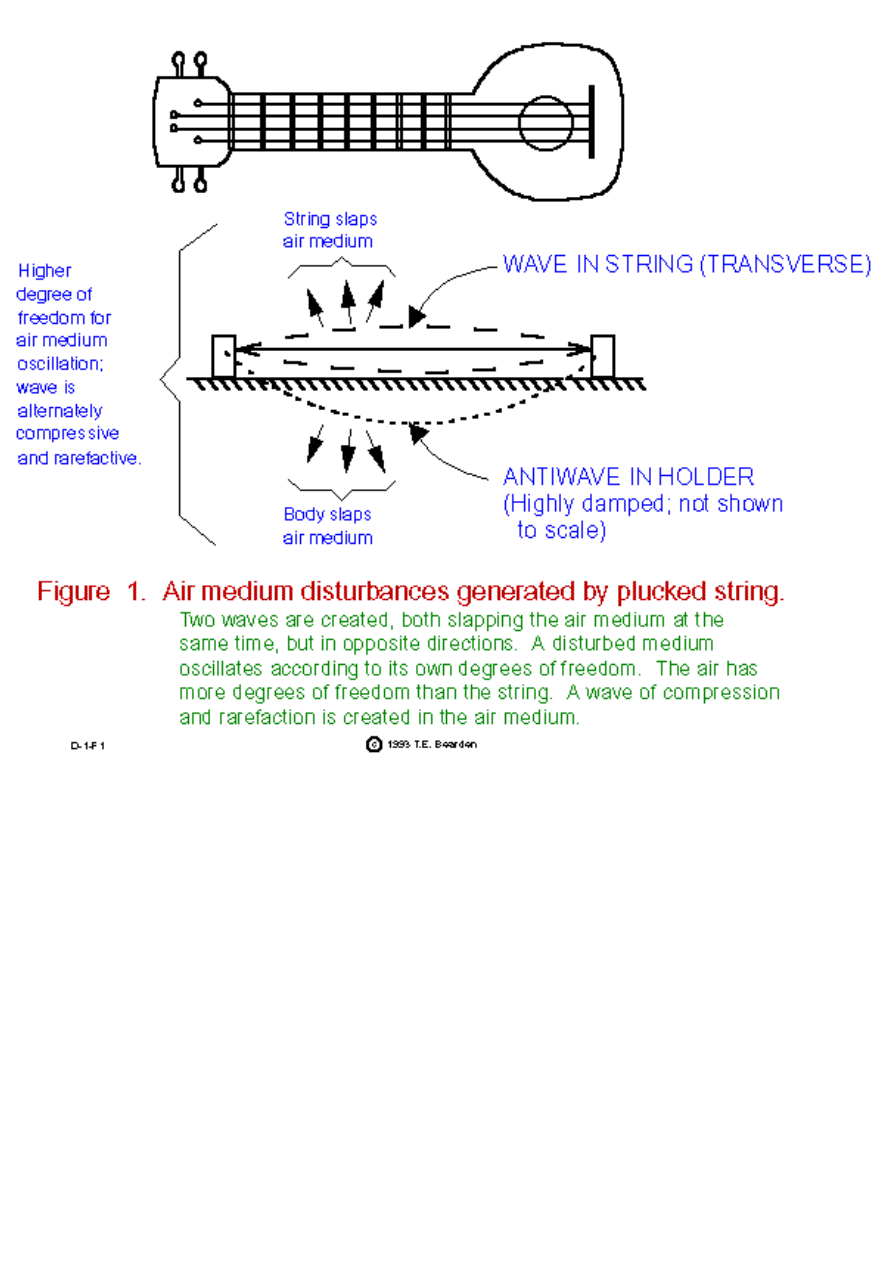
For the EM wave, Maxwell simply assumed the transverse EM wave that had come from the much
earlier derivation of the familiar wave equation from the old "plucked taut string" notions.
Yet when one closely examines and corrects some of the erroneous assumptions
actual mathematical derivation of this "taut string" transverse wave, one finds
that an equal-
energy second antiphased transverse "antiwave" is actually produced by the instrument and added to
the "plucked string's" transverse wave disturbance of the air medium, to produce a longitudinal wave
of compression and rarefaction in the air itself. The "transverse string wave" in fact never leaves the
string. The string wave is not the wave that is launched into the medium.
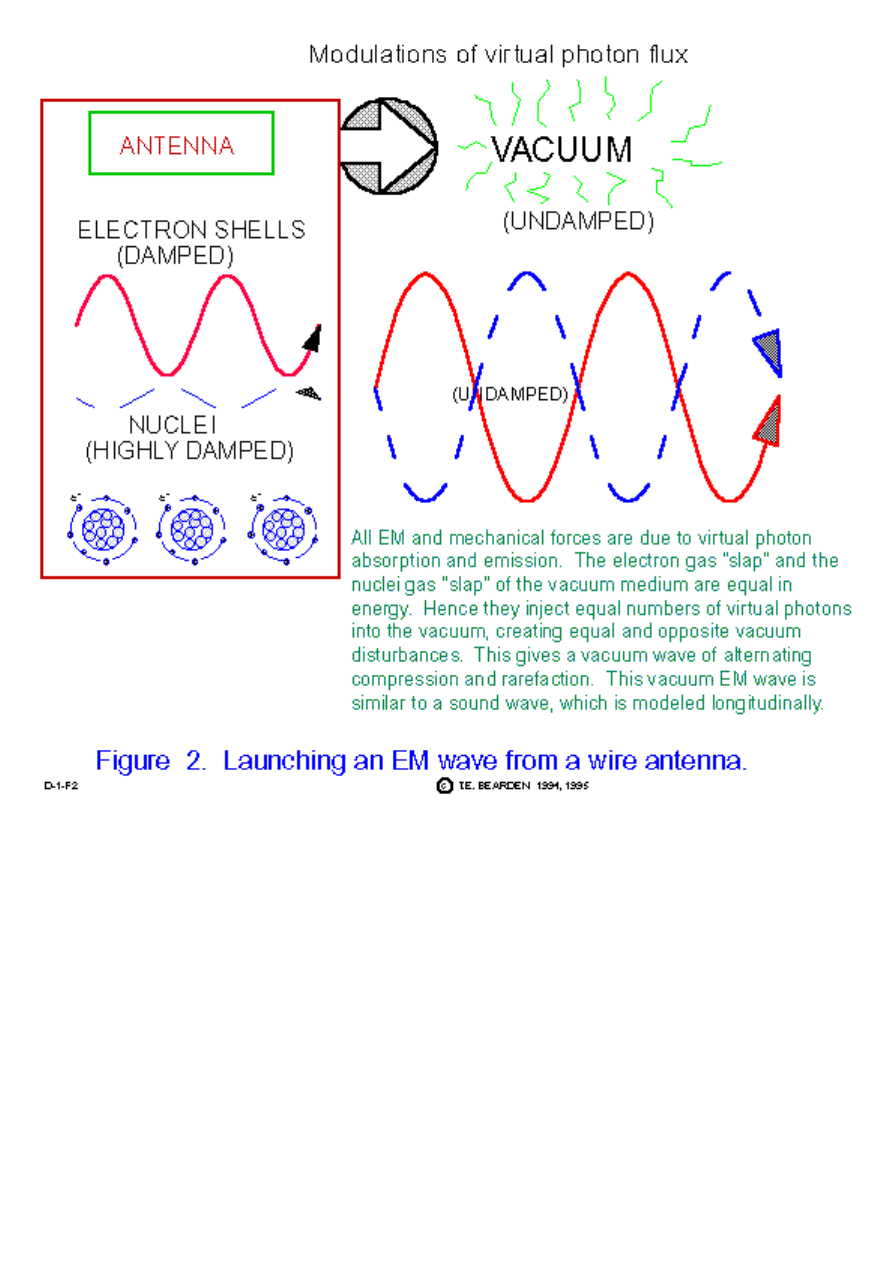
A similar electromagnetic situation exists. In a whip antenna
, the Drude electron gas in the
conductor does exhibit a transverse "string-type" EM wave of electron precession. However, at the
same time, by Newton's third law (which Maxwell neglected because at the time the atom was
regarded as just a blob with no internal structure) the positively charged, phase conjugated atomic
nuclei have equal energy, highly damped transverse recoil waves created in them. Further, these
"nuclei-recoil" waves are phase conjugate replicas of the electron gas waves. The total disturbance
that is launched into the vacuum from the whip antenna is (a) the normal transverse disturbance of the
virtual photon flux of vacuum caused by the electron gas wave, and (b) the coupled equal-energy
transverse antiwave caused by the nuclei-recoil via Newton's third law. The amplitude of the material
antiwaves of nuclei vibration are highly damped because of the massiveness of the nuclei; however,
they are of equal energy to the electron wave. But when launched into the same vacuum, the two
equal-energy wave disturbances experience equal damping because they are in the same medium.
Hence the wave and antiwave are (a) locked together in the vacuum, and (b) of equal energy, and (3)
of equal amplitude once launched into the vacuum. What results is a vacuum EM wave of rarefaction
(reduction in intensity) and compression (increase in intensity) of the virtual photon flux of vacuum
__ just exactly like what is launched into the surrounding gaseous air medium from the "plucked taut
string" and perturbed body of a physical instrument. The EM wave in vacuum is a longitudinal wave
directly analogous to a sound wave __ just as Nikola Tesla stated.
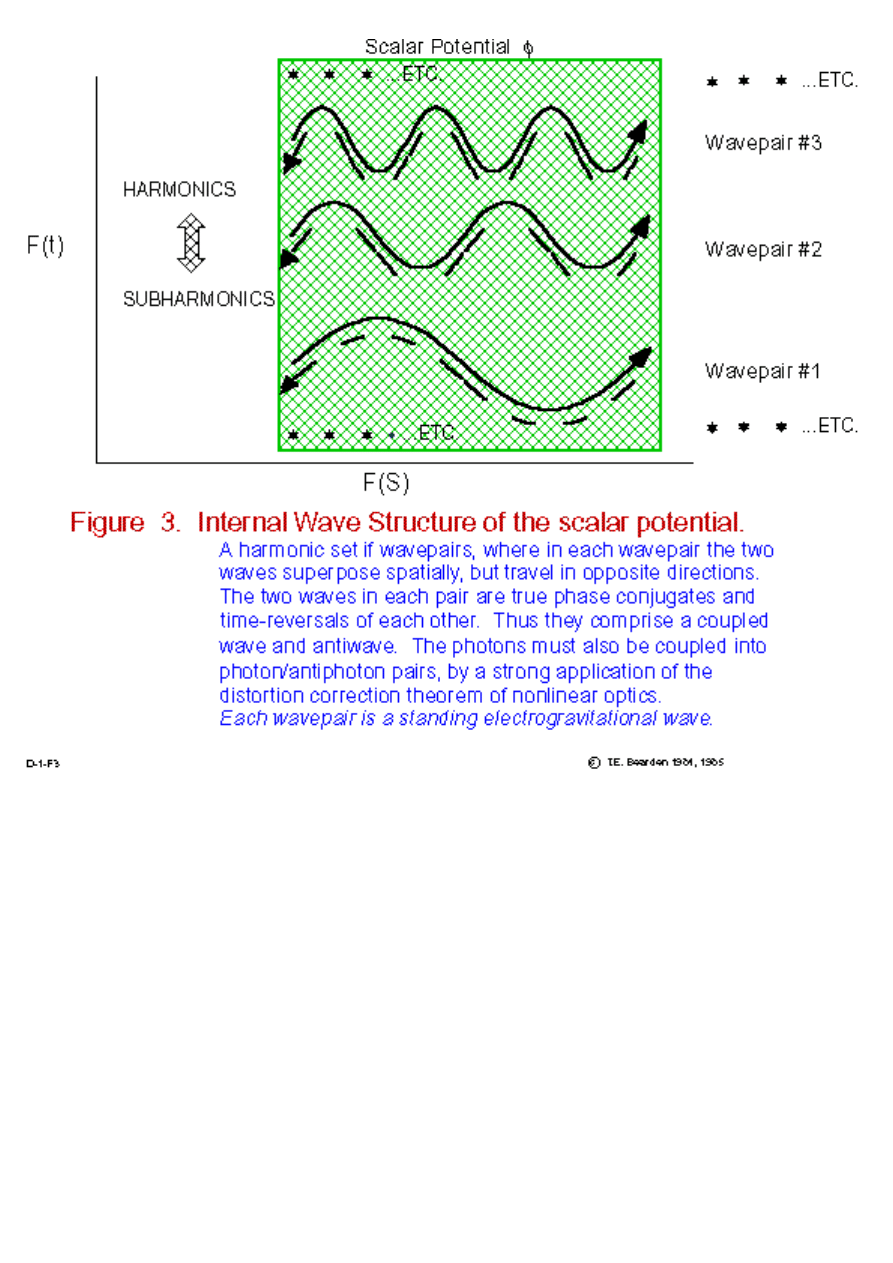
The vacuum may be considered a scalar potential, in which case it has an internal biwave structure
. Interference of two potentials __ i.e., the hidden interference
wave structures __ in fact already creates all EM fields and waves.
When the incoming longitudinal "biwave" from the vacuum strikes the atoms of the receiving
antenna, each atom may be considered a dynamic assembly of multiple dipoles, where each dipole
consists of one of the electrons in the electron shells and one of the positive charges in the nucleus.
The receiving dipole in the interacting atom splits the two waves apart again
. The
negatively charged end of the dipole is time-forward, and the positively charged end is time-reversed.
http://www.hsv.com/writers/bearden/page003.htm (1 of 2)24.11.2003 20:26:11

CHASING THE WILD DRAGON:
Hence the separated normal-wave-half of the biwave interacts with the electron, to give again the
familiar transverse "electron precession" wave that we detect with our "electron wiggle-detecting"
instruments
. This detected electron precession wave is what all our textbooks prescribe
erroneously as the vacuum wave! The separated time-reversed-wave-half of the incoming vacuum
wave is split off and interacts with the positive end of the receiving atomic dipole, in the time-
reversed atomic nucleus, thus generating Newton's third law reaction force to provide the recoil of the
nucleus. Present physics has ignored this second wave altogether, because of the serious error in the
original derivation of the wave equation from plucked strings. Thus physics presently has absolutely
no causative mechanism for Newton's reaction force. Instead, scientists just "mystically invoke the
appearance of this magic force." Describing that something occurs, and naming its occurrence, does
not constitute advancing a causative mechanism!
|
Comments may be sent to
the
of The Virtual Times
http://www.hsv.com/writers/bearden/page003.htm (2 of 2)24.11.2003 20:26:11

Notes and References:
[6] E.g., see T.W. Barrett, "Tesla's Nonlinear Oscillator- Shuttle-Circuit (OSC) Theory," Annales de
la Fondation Louis de Broglie, 16(1), 1991, p. 23-41. Barrett shows that a higher topology EM model
(e.g., quaternions) allows shuttling and storage of potentials in circuits, and also allows additional
EM functioning of a circuit that a conventional EM analysis cannot reveal. Tesla's actual patented
circuits in fact exhibit this higher topology, when a quaternion EM analysis of them is performed. No
orthodox vector/tensor analysis can show this.
http://www.hsv.com/writers/bearden/ref06.htm24.11.2003 20:26:12

Notes and References:
[7] All the early experimenters seemed to assume the transverse string-type wave automatically for
the vacuum medium. E.g., Faraday speculated that light and radiant heat might be transverse
vibrations propagated along his "lines of force," from which the direct "plucked string" analogy can
readily be seen. In short, he considered that his lines of force could be perturbed to vibrate laterally,
just like a plucked string. See M. Faraday, "Thoughts of Ray-Vibrations," Philosophical Magazine,
(3), vol. xxvii, 1846, p. 345. Maxwell also assumed the transverse EM wave in vacuum without
question, as did Heaviside, Hertz, and Gibbs and as has almost every electrodynamicist since then.
http://www.hsv.com/writers/bearden/ref07.htm24.11.2003 20:26:14

Notes and References:
[8] The worst is the assumption of infinitely rigid endposts holding the taut string, so that no
movement of these endposts occurs. This further assumes that no induced movement of the body of
the instrument occurs. The end result is to eliminate all of that wave that is produced in the body of
the instrument, and retain only the transverse wave produced in the string. In the first place, this
standard procedure has now become a total violation of Newton's third law, which among other
things requires that forces be formed in oppositional pairs. So the standard method for the launch of a
wave from an instrument is flawed. Specifically, the "transverse string wave" is falsified insolaf as its
appearance in the surrounding medium. This is not the wave that actually exits the instrument and
that is launched into the medium. This universal oversight on the part of mathematicians and
physicists is a colossal joke upon them. Literally, when a physicist writes the transverse wave
equation on the board, he has just discarded exactly half the physics. This means that, in his
interactions, at the end there will suddenly appear this mysterious, mystical "equal and opposite
reaction force" that is created by the erroneously ignored antiwave. So he has to piously invoke this
reaction force "from the blue." Yet quantum field theory teaches us already that all mechanical and
electromagnetic forces on a mass are generated by absorption and emission of virtual photons. Hence
Newton's third law reaction force must also be so generated. This means that there must exist an
equal number of virtual antiphotons interacting in the antiforce, as there was virtual photons
interacting in the causative force. By symmetry there must also exist an equal and opposite wave, or
antiwave, made of these same antiphotons. The actual disturbance that entered from the vacuum must
therefore have consisted of both wave and antiwave. QED.
http://www.hsv.com/writers/bearden/ref08.htm24.11.2003 20:26:16
Tables:
http://www.hsv.com/writers/bearden/fig001.htm24.11.2003 20:26:21
Tables:
http://www.hsv.com/writers/bearden/fig002.htm24.11.2003 20:26:25

Notes and References:
[9] See Nikola Tesla, "Pioneer Radio Engineer Gives Views on Power," New York Herald Tribune,
Sep. 11, 1932. Quoting: "...I showed that the universal medium is a gaseous body in which only
longitudinal pulses can be propagated, involving alternating compressions and expansions similar to
those produced by sound waves in the air. Thus, a wireless transmitter does not emit Hertz waves
which are a myth, but sound waves in the ether, behaving in every respect like those in the air, except
that, owing to the great elastic force and extremely small density of the medium, their speed is that of
light." Today the QM vacuum has been theoretically and experimentally shown to consist of a "gas"
of virtual particles, rather like Tesla stated. Tesla was also correct about the longitudinal EM wave in
the vacuum. He was also correct in his statement that a fundamental charged particle can alter its
charge, if one considers the massless charge ~ of charge q separately from the mass m of charge q.
When the charge q is placed in a nonzero potential V, it follows that the new charge of the electron is
simply (~+V).
http://www.hsv.com/writers/bearden/ref09.htm24.11.2003 20:26:26
Tables:
http://www.hsv.com/writers/bearden/fig003.htm24.11.2003 20:26:29
Tables:
http://www.hsv.com/writers/bearden/fig004.htm24.11.2003 20:26:33
Tables:
http://www.hsv.com/writers/bearden/fig005.htm24.11.2003 20:26:36
Tables:
http://www.hsv.com/writers/bearden/fig006.htm24.11.2003 20:26:39

CHASING THE WILD DRAGON:
Further, if we should trick the time-reversed wave half into coming
outside the atom instead of going inside to interact with the nucleus
, then it follows that the
nucleus would not recoil. In that case the interaction would appear to violate Newtonian third law
reaction. Phase conjugate mirrors already do just exactly this when they emit a phase conjugate
replica wave. They direct the antiwave outside and away from the atom instead of inwards into the
nucleus. So they do not recoil, no matter how powerful a phase conjugate replica wave they emit.
Finally, we can also show that the EM wave in vacuum is longitudinal, by yet another approach. The
electrons in the electron gas in a conductor are spinning, and they are severely constrained
longitudinally to be able to move only very, very slowly down the wire. So when perturbed, they act
as gyroscopes, and precess at right angles to the perturbing force. The fact that the gyroelectrons in a
wire move radially almost entirely, and only "slip" down the wire very slowly with a "drift" velocity,
already proves conclusively that the incoming vacuum disturbance was longitudinal. The precession
of a gyro is at right angles to the perturbing force. Therefore rigorously the vacuum EM waves are
longitudinal, because the gyroelectrons moved transversely. The present assumption of the transverse
EM wave in vacuum contradicts the entire theory of gyroscopes!
errors in classical EM that we will point out in future articles; this should give the reader a flavor of
what is in store for him in future articles.
So there are no truly satisfactory "experts" in any of the 14 fields. Yet there is still something to be
said for having some years of experience in one or more of the areas. I have had the good fortune or
misfortune, depending upon one's viewpoint, to be involved in various of those 14 activities for some
30 years or more, and am active in several of the areas now. My colleagues and I are particularly
active in researching overunity electrical devices
, to include the effects of controlled
chaotic oscillators, charge-blocking oscillators, and oscillators driven by in-shuttled (bridged)
Poynting field energy density flow ExH. Parametric oscillation is known to have yielded overunity
electrical machines and was fully reported by Russian researchers in the Russian and French
technical journals in the mid 1930s.
We will further cite that little-known work in future
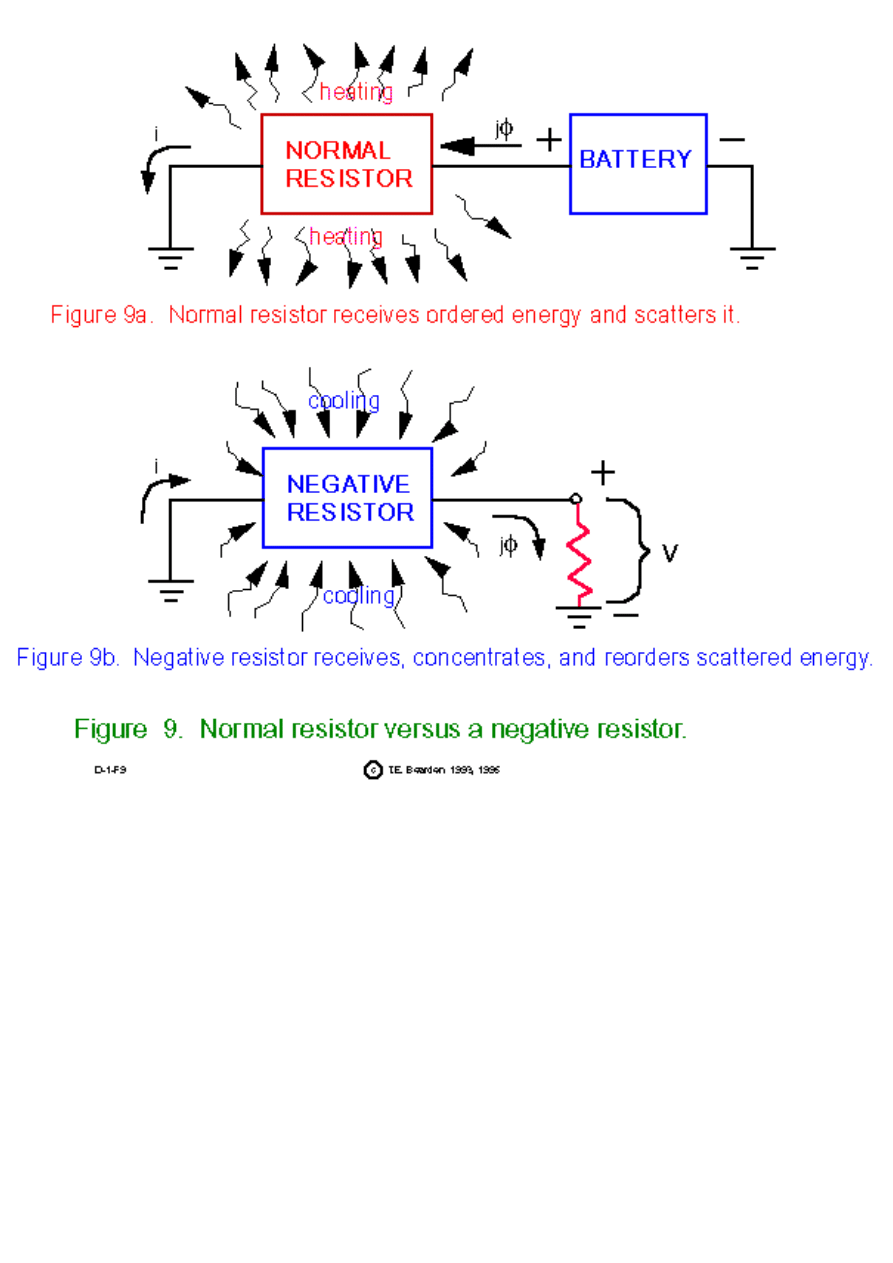
articles. Also, we are working mightily upon true negative resistors
scavenges some of the disorganized energy from the vacuum's energetic exchange with the charges in
the system, organizes and collects it, and then outputs that collected energy flow into the external
circuit. Such a resistor acts as a power source. Kron, perhaps the greatest of the electrical machinery
scientists, is known to have produced such true negative resistors.
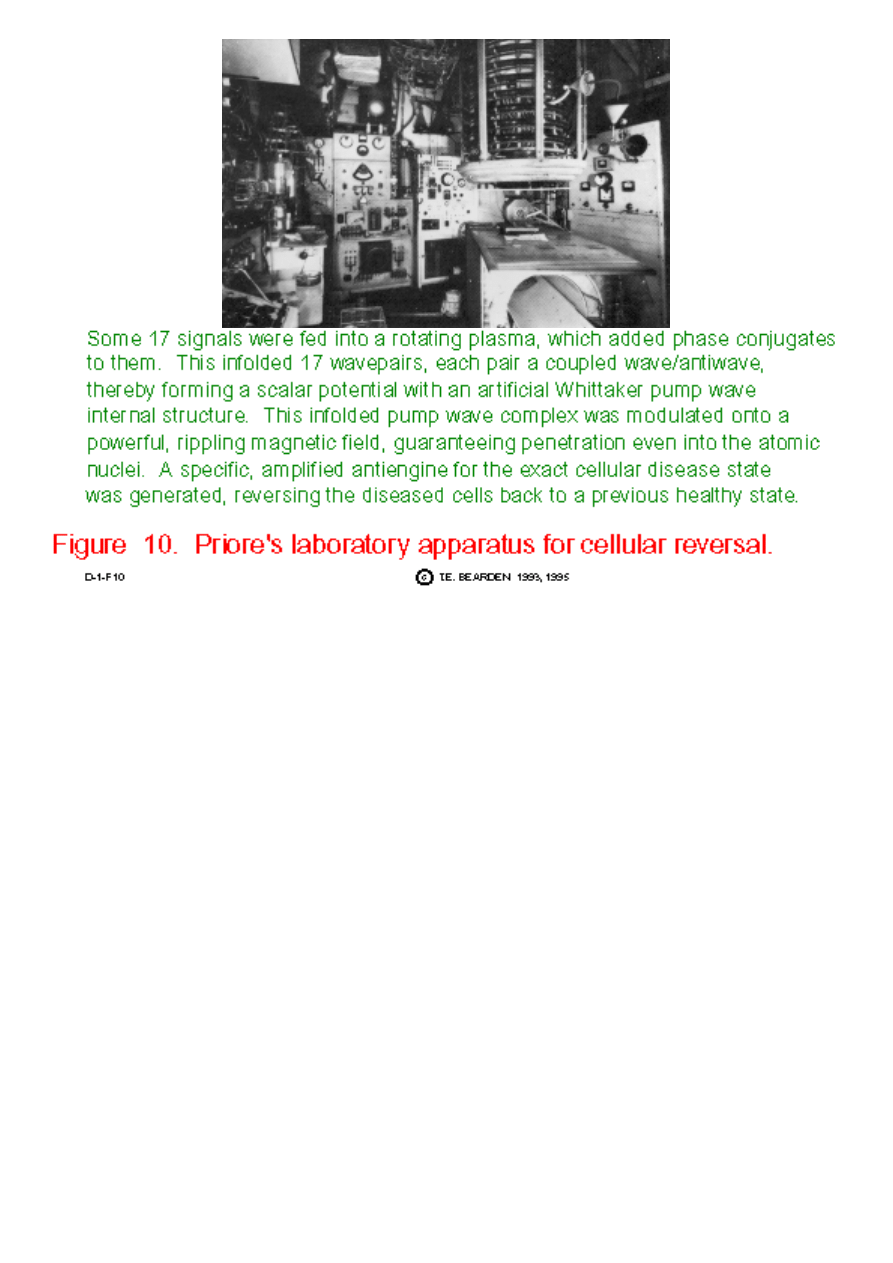
I have also proposed a theoretical explanation of the Priore device
laboratory animals demonstrated remarkable cures of terminal tumors, cured trypanosomias, reversed
atheriosclerosis, and restored suppressed immune systems. The Priore work was not anecdotal, but
was performed under rigorous scientific protocols, working under the auspices of renowned French
scientists such as Courrier and Pautrizel. The work is properly reported in numerous papers in the
French medical literature.
The results were certainly achieved, but neither Priore himself
nor the scientists of the day could understand the mechanism involved. The deciphering of that
causative technical mechanism utilized by the Priore group required 10 years of intense effort. The
results have now been published in the journal Explore! and are there for anyone to read.
|
http://www.hsv.com/writers/bearden/page004.htm (1 of 2)24.11.2003 20:26:41

CHASING THE WILD DRAGON:
Comments may be sent to
the
of The Virtual Times
http://www.hsv.com/writers/bearden/page004.htm (2 of 2)24.11.2003 20:26:41
Tables:
http://www.hsv.com/writers/bearden/fig007.htm24.11.2003 20:26:46

Notes and References:
[10] When Maxwell's theory was constructed, the electron had not yet been discovered, and so the
dipolarity of the atom was unknown. An atom was regarded just as a "blob." Electricity in a
conductor was regarded as a thin material fluid Maxwell's equations are in fact hydrodynamic
equations. So the founders regarded the detection of induced motion in the electric fluid as induced
translation, not induced precession. They had no idea of "spins" of particles of the fluid, nor of gyro
precession of those particles. Instead, q was regarded just as a "piece of electric fluid," similar to a
cubic centimeter of fluid.
http://www.hsv.com/writers/bearden/ref10.htm24.11.2003 20:26:47
Tables:
http://www.hsv.com/writers/bearden/fig008.htm24.11.2003 20:26:51

Notes and References:
[11] E.g., see L. Mandelstam [Mendel'shtam, L.I.], N. Papalexi, A. Andronov, S. Chaikin and A.
Witt. (1935) "Report on Recent Research on Nonlinear Oscillations," Translation of "Expose Des
Recherches Recentes Sur Les Oscillations Non Lineaires," Technical Physics of the USSR,
Leningrad, Vol. 2, 1935, p. 81-134. NASA Translation Doc. TT F-12,678, Nov. 1969. Summarizes
lengthy work at the Institute of Physics of the University of Moscow and several of the laboratories
on the problem of self-powered, self- oscillating nonlinear oscillators. The paper reports significant
work and progress in oscillations created by the oscillating system itself (self-oscillation) without
participation of any external forces varying with time and without the expense of a constant source of
energy (e.g., a storage battery). Such a system was shown to self-increase in an underdamped manner
until system self-destruction. Adding a nonlinear load allowed the systems to stabilize its dynamic
operation so that it powered a load under overunity conditions and did not self-destruct. Extensive
additional references on this spectacularly successful overunity energy project are listed.
http://www.hsv.com/writers/bearden/ref11.htm24.11.2003 20:26:53
Tables:
http://www.hsv.com/writers/bearden/fig009.htm24.11.2003 20:26:57
Tables:
http://www.hsv.com/writers/bearden/fig010.htm24.11.2003 20:27:06

Notes and References:
[12] For citations and the exposition of our proposed explanation of the Priore mechanism, see T.E.
Bearden, "Vacuum engines and Priore's methodology: The true science of energy-medicine." Part I,
Explore!, 6(1), 1995, p. 66- 76, Part II, Explore!, 6(2), 1995, p. 50-62.
http://www.hsv.com/writers/bearden/ref12.htm24.11.2003 20:27:08

Notes and References:
[13] Bearden, "Vacuum engines and...," ibid.
http://www.hsv.com/writers/bearden/ref13.htm24.11.2003 20:27:09

CHASING THE WILD DRAGON:
Presently my CTEC colleagues and I have filed three patent applications
and a continuation, on various methods for overunity processes and apparatuses, room temperature
superconductivity, Poynting generators, etc.
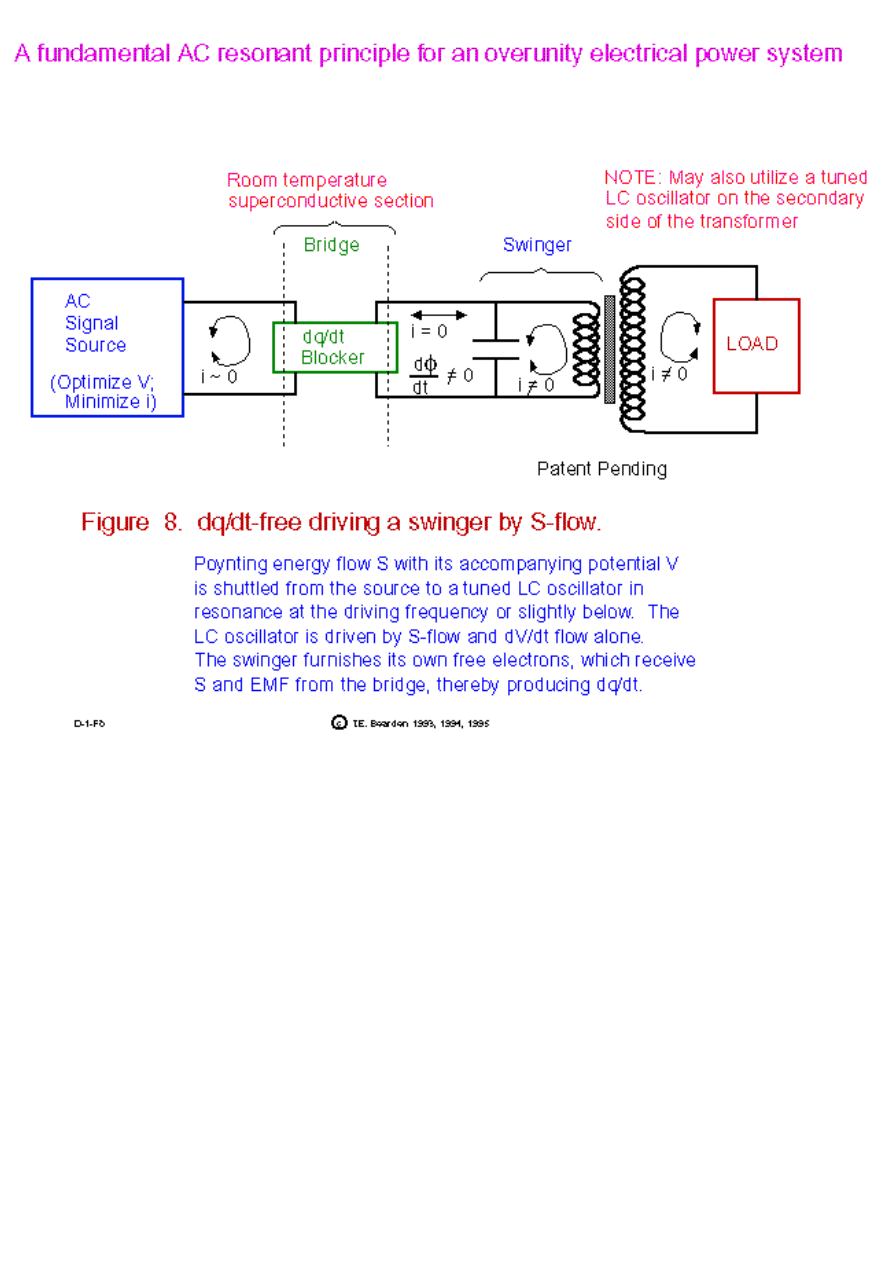
As an example, we took exactly the opposite approach to room temperature superconductivity as has
been taken by all the orthodox researchers to date. What exactly is sought, after all, for
superconductivity (SC) in a section of an electrical circuit? Well, one has some electrons on one side
of that SC section that are transporting excess potential, as given by the Slepian vector J*.
What is desired is to get some electrons on the other side of the SC section that also are transporting
the same amount of excess energy in the form of J*. You can do that in two ways: (1) you can flow
the electron carriers through the SC section, carrying their J*, or (2) you can block the J and flow the
* itself across as the Poynting flow S.
Nondivergent Poynting flow flows along an
equipotential, which is just another way of saying that, if the S-flow does not diverge, it carries the
same potential * along with it. Hence it carries the EMF right along with it as it flows without
divergence.
Conventional approaches have all tried to shove the electron carriers through the SC lattice section.
Doing that is like trying to fire a very slow bullet through several million rotating fans in a straight
line. So cryogenics (to slow the fanblades to a crawl) and massive correlation of the electrons and of
the electron-to-lattice interactions is necessary if one is to get the electrons through there without
excess collisions that shake off some of the excess * from J*, as scattered photons (heat) or as a
change of form of the energy (as in straining the dielectric of a capacitor to convert electrical energy
to mechanical strain energy via the piezoelectric effect.)
Our approach is exactly the opposite (
). Why not just stop the flow of excited
electron carriers on one side of the SC section, and continue the nondiverging flow of the Poynting
field energy density S across that section at room temperature? Then the cryogenics is not needed at
all. After all, circuits already work that way anyhow __ except standard practice is to nullify the
process by letting current be driven around the sourcing current loop and back through the back EMF
of the primary source. A quantum well (or several other methods) can be used to trap the "sourcing"
electrons in the conductor just prior to entering the SC section. The "receiving" electrons on the other
side of the SC section, however, must be in their own dq/dt-isolated current loop.
|
Comments may be sent to
the
of The Virtual Times
http://www.hsv.com/writers/bearden/page005.htm24.11.2003 20:27:11

Notes and References:
[14] Briefly, the S-flow outside the wire will be flowing along essentially at the speed of light, at or
with the same since S-flow without divergence is along an equipotential. Said another way, a
nondiverging Poynting flow S exhibits a constant potential ~ along its streamlines. A tiny, tiny
portion of the S-flow is intercepted by the sluggish electrons (which may be moving as dq/dt at 11
feet per hour, in a typical case), to form the Slepian vector J~. The J~ portion is just the minute
fraction of the S-flow that is actually intercepted by the electron current and transported to the
impedances, for releasing the excess ~ in the loads and losses. [Incidentally, this wee note resolves a
century of controversy over exactly how EM energy flows in circuits. The orthodox literature
abounds with discussions, differing positions, and debates and with errors.]
http://www.hsv.com/writers/bearden/ref14.htm24.11.2003 20:27:12

Notes and References:
[15] Note that this also automatically involves a host of other types of controversial displacement
currents, such as d~/dt, dV/dt, dE/dt, dP/dt, dD/dt, etc. The literature is thoroughly floundering as to
exactly how all these currents are related, together with the Slepian vector J~ and the Poynting vector
S, as well as the "normal" current dq/dt. We will be discussing the "master key" for these
relationships in future articles.
http://www.hsv.com/writers/bearden/ref15.htm24.11.2003 20:27:14
Tables:
http://www.hsv.com/writers/bearden/fig011.htm24.11.2003 20:27:19
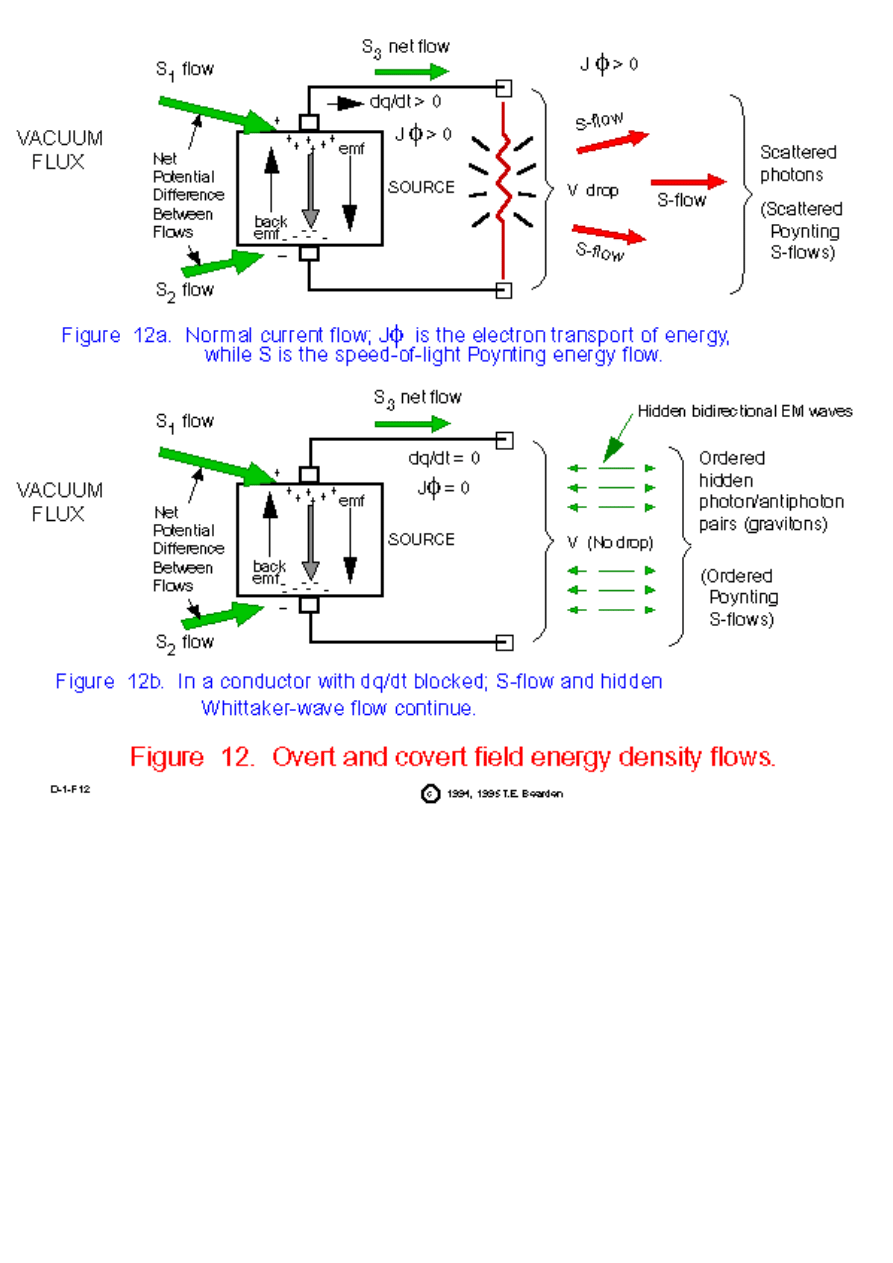
Tables:
http://www.hsv.com/writers/bearden/fig012.htm24.11.2003 20:27:23

CHASING THE WILD DRAGON:
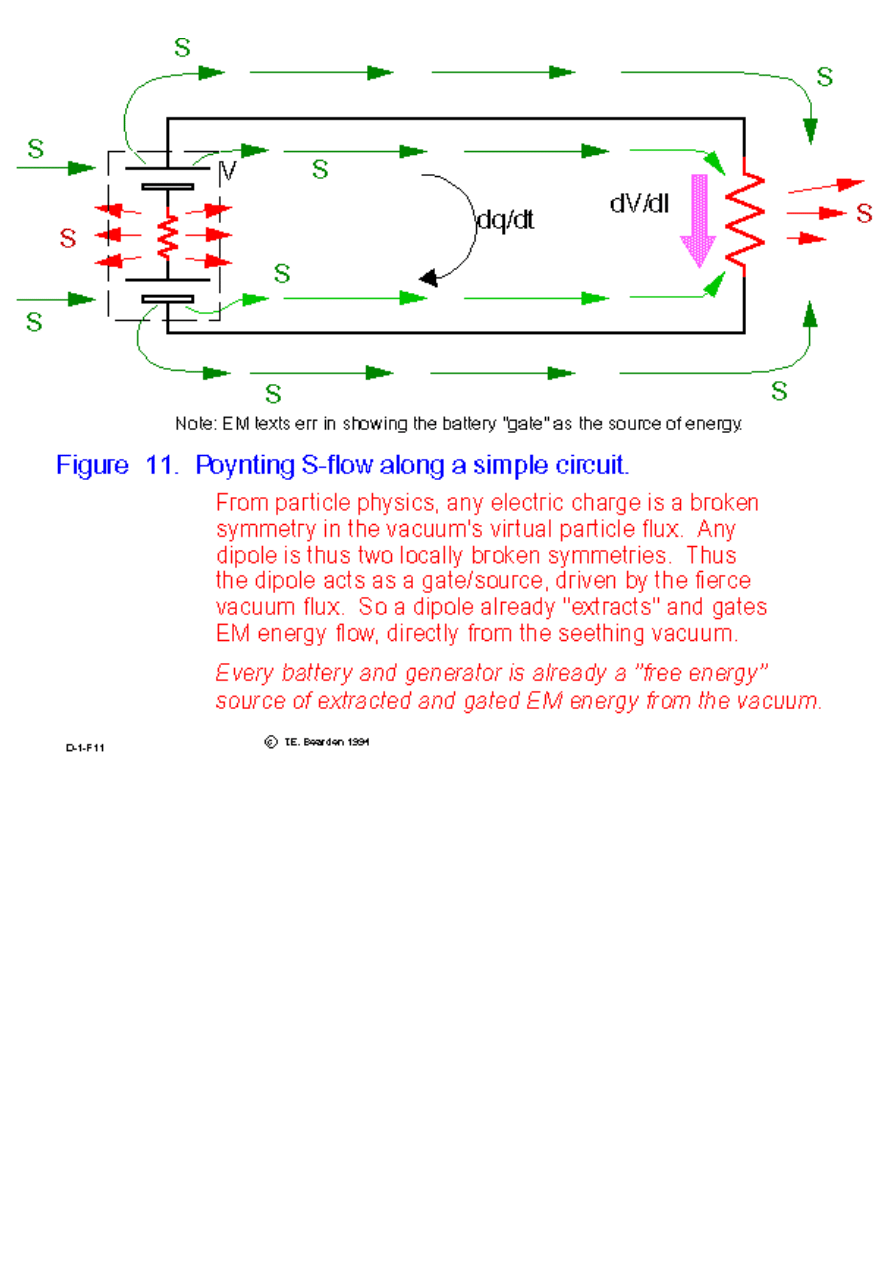
Normal sources do not furnish electrons and current to a circuit anyway.
Sources just furnish Poynting flow S and EMF.
In the receiving current loop, the EMF
appears automatically once the S-flow flows in and is "locked on to" by the receiving electrons.
Given q**, you will immediately have J* if the electrons are free to move in the conducting circuit
. Further, you have eliminated all the loss terms from the standard Poynting equation
for energy losses. So all the energy flow S just flows across the SC section, without any current or
Cooper pairs flowing through that SC section. The SC section has become a "bridge" which (1) strips
off the Poynting field energy density flow S from the electron current dq/dt on the sourcing side of
the SC/bridge section, by simply reducing the dq/dt to zero; and (2) continues to pass the S-flow
across the dq/dt-blocked SC/bridge section to the other side
EMF) pours into the receiving dq/dt-isolated current loop, exciting the electrons therein to produce
dq/dt and J*. Any closed current loop is self-powered, once it receives S and EMF. It furnishes its
own electrons; it only requires excess energy and EMF.
So our approach gives room temperature superconductivity in a very straightforward manner, once
you discover how to block the current dq/dt in a conductor. Blocking it in an insulator is not
sufficient, because that drops the potential and stops the S-flow and the equipotential * (the EMF).
However, a degenerate semiconductor such as the Fogal chip can be used, as can several other
processes for blocking dq/dt in a conductor. We will discuss these in a future article.
Another advantage of this approach to room temperature superconductivity is that now one can also
have permissible overunity coefficient of performance. Now the load can be placed in its own S-
receiving, isolated current loop. With the sourcing current loop furnishing only S and not dq/dt, the
load is still powered normally in its own closed dq/dt current loop, but none of the load current is
passed back through the back EMF of the primary source in the sourcing circuit.
This principle -- that at least a substantial portion of the load current must not pass back through the
primary source -- is the primary principle required for a permissible overunity electrical machine
. A permissible overunity electrical machine is one which produces more power in the
load than you have to put into the machine to run it.
|
Comments may be sent to
the
of The Virtual Times
http://www.hsv.com/writers/bearden/page006.htm24.11.2003 20:27:24

Notes and References:
[16] E.g., see Robert L. Shrader, Electronic Communication, Sixth Edn., MacMillan/McGraw-Hill,
New York, NY, 1991. (1993 Imprint). Quoting from p. 6: "A source of electric energy does not
increase the number of ~ree electrons in a circuit; it merely produces a concerted pressure on any
aimlessly moving electrons."
http://www.hsv.com/writers/bearden/ref16.htm24.11.2003 20:27:25
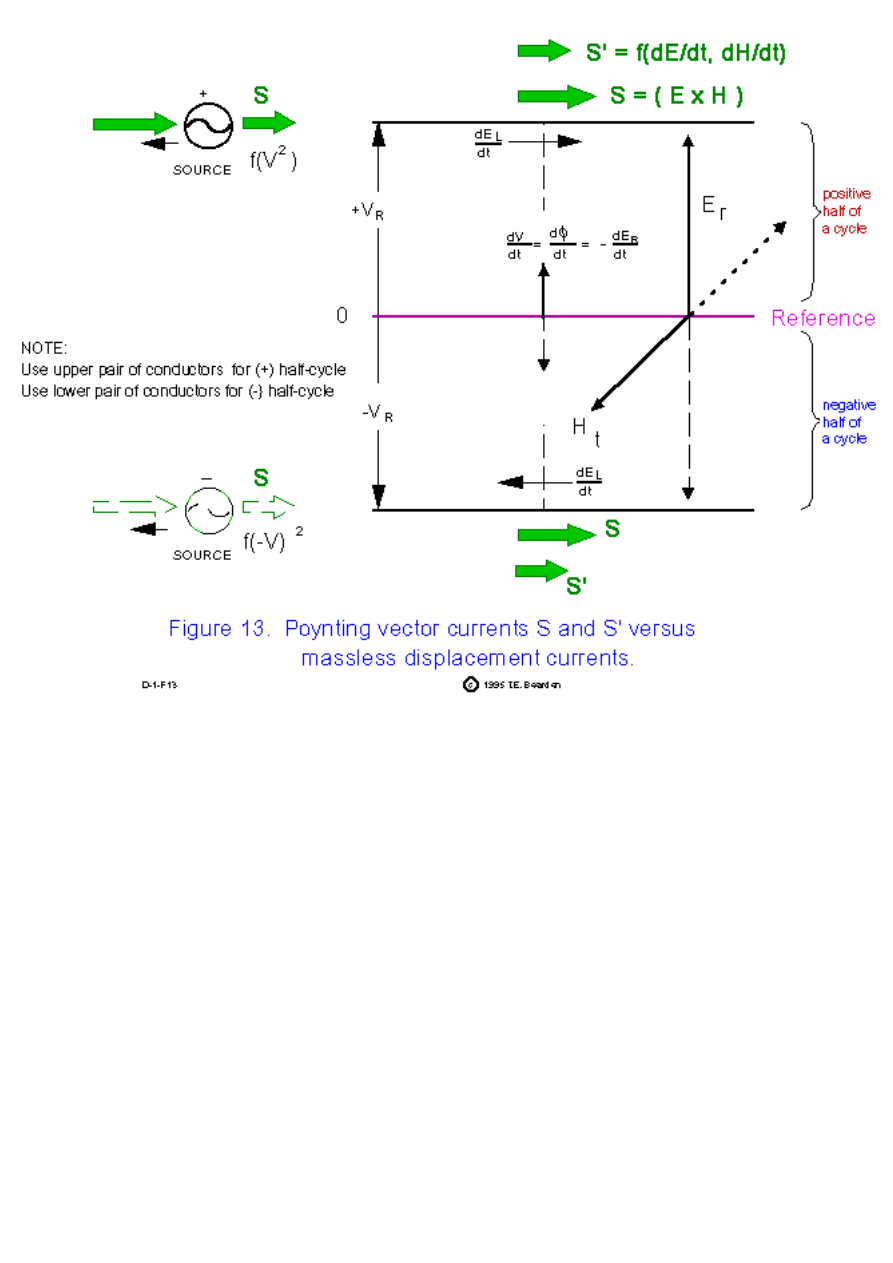
Tables:
http://www.hsv.com/writers/bearden/fig013.htm24.11.2003 20:27:28
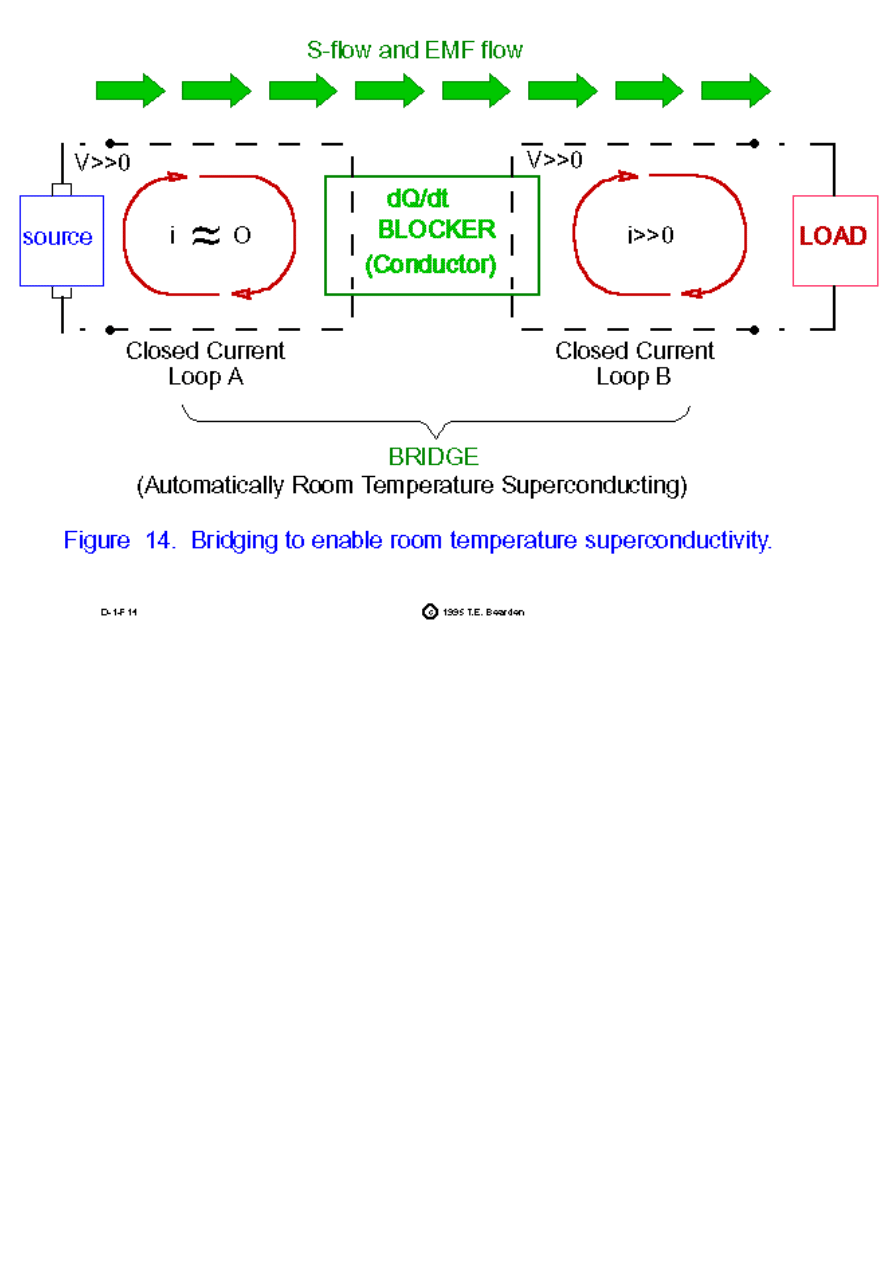
Tables:
http://www.hsv.com/writers/bearden/fig014.htm24.11.2003 20:27:36

Notes and References:
[17] My own approach has been, if that's all that the circuits require from our primary power source,
then let's simply accept that directly from the source without performing any work in the source. Iœ
you do it this way, the source is never dissipated, but will last indefinitely. Sources furnish flowing
field energy density, not "energy" per se. If you only demand S-flow, you can have all you wish from
a source, without exhausting your source. The trick is to find how to steadily dissipate some of this
"artesian well" of flowing S to drive electrons through the load, but without driving electrons back
through the back EMF of the source.
http://www.hsv.com/writers/bearden/ref17.htm24.11.2003 20:27:38
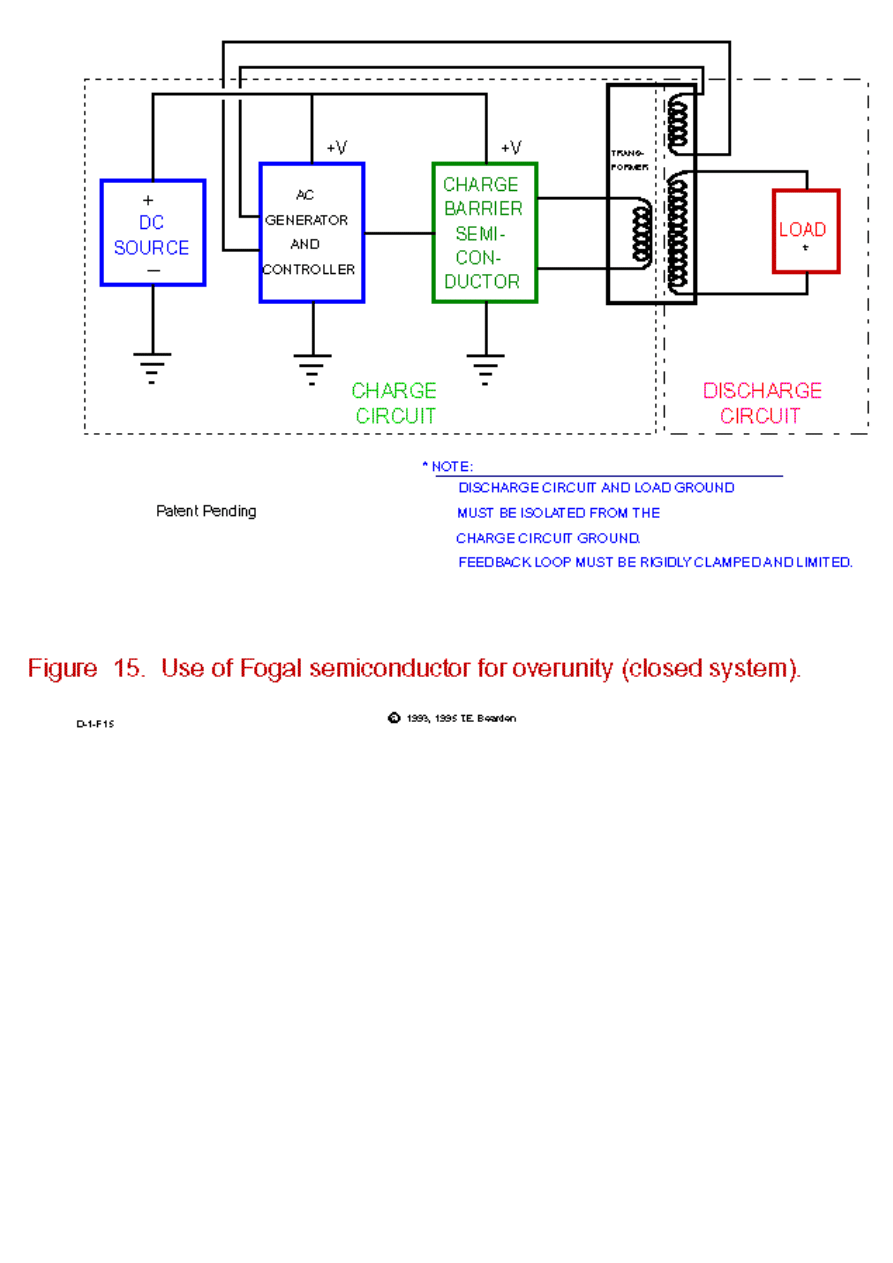
Tables:
http://www.hsv.com/writers/bearden/fig015.htm24.11.2003 20:27:42

CHASING THE WILD DRAGON:
Obviously, the laws of physics and thermodynamics require such an
overunity machine to be an open system that extracts and utilizes excess energy from an external
source. In the case outlined, we extract the excess energy directly from the vacuum in the form of S-
flow; essentially we convert our primary source to a Poynting generator rather than a
"power" (energy flow loss rate) generator. The resulting overunity machine accomplishes both room
temperature superconductivity and also overunity coefficient of performance
violate the conservation laws of physics. It does not violate the second law of thermodynamics
because it is an open system receiving and utilizing excess energy from the vacuum, and the second
law need not apply to such systems.
You see, all power systems are already free energy density flow sourcing systems, if we but use them
correctly. Every dipole is a "gating device" for extracting excess field energy density flow from the
violent bidirectional flux exchange between the vacuum and each end of the dipole.
When we attach "conducting leads" to a dipolar source, as in the simple two-wire circuit, all we
are doing with the conductors is providing waveguides for the extracted S-flows from the vacuum to
flow along (it flows outside the conductors) without loss. In effect, each lead is simply extending the
pole (i.e., the terminal) to which it is connected.
My associates and I are also working on several other inventions at present, including two more
patent applications to be filed in the near future. One of those is in the field of overunity power
systems, while the other is in an entirely different, highly proprietary nuclear effort. I will address all
these areas in future columns, and those columns will have real "meat" in them.
Present "big science" proclaims that overunity electrical machines are impossible. The reader should
understand that the U.S. Patent and Trademarks Office is never going to grant a patent for an
overunity electrical machine unless the machine is independently tested and replicated, and unless it
is certified by scientists of impeccable credentials. This is as it should be. Legitimate free energy
researchers accept that dictum. Eventually the stuff has to work on the bench in order to be validated.
On the other hand, free energy researchers also point out that one must not demand of us the next 100
years of national research by a hundred major laboratories immediately! This is still a shoestring
operation, because all conventional sources of research funds are denied to the serious overunity
researcher (with the single exception of occasional personal funding of a researcher by a private
individual). In other words, we demand at least the same kind of consideration that the orthodox
nuclear fusion community has enjoyed. Billions of dollars have been poured into that sinkhole, and
not a single controlled fusion power unit is working anywhere in the world after decades of work at
enormous expense to the taxpayers.
So we overunity researchers deserve at least a decade or two of our own, to try to accomplish
overunity electrical system development. We also painfully point out that "Big Science" will not fund
a single overunity researcher, for specific overunity purpose, no matter what his credentials or
capability. In fact, "Big Science" is part of the problem, because it fervently seeks to prevent any
legitimate research in overunity. To carry out its suppression campaign. it resorts to vilification,
character assassination, libel, and slander of the overunity researchers themselves __ again, regardless
of their qualifications or legitimate scientific procedures.
http://www.hsv.com/writers/bearden/page007.htm (1 of 2)24.11.2003 20:27:45

CHASING THE WILD DRAGON:
|
Comments may be sent to
the
of The Virtual Times
http://www.hsv.com/writers/bearden/page007.htm (2 of 2)24.11.2003 20:27:45
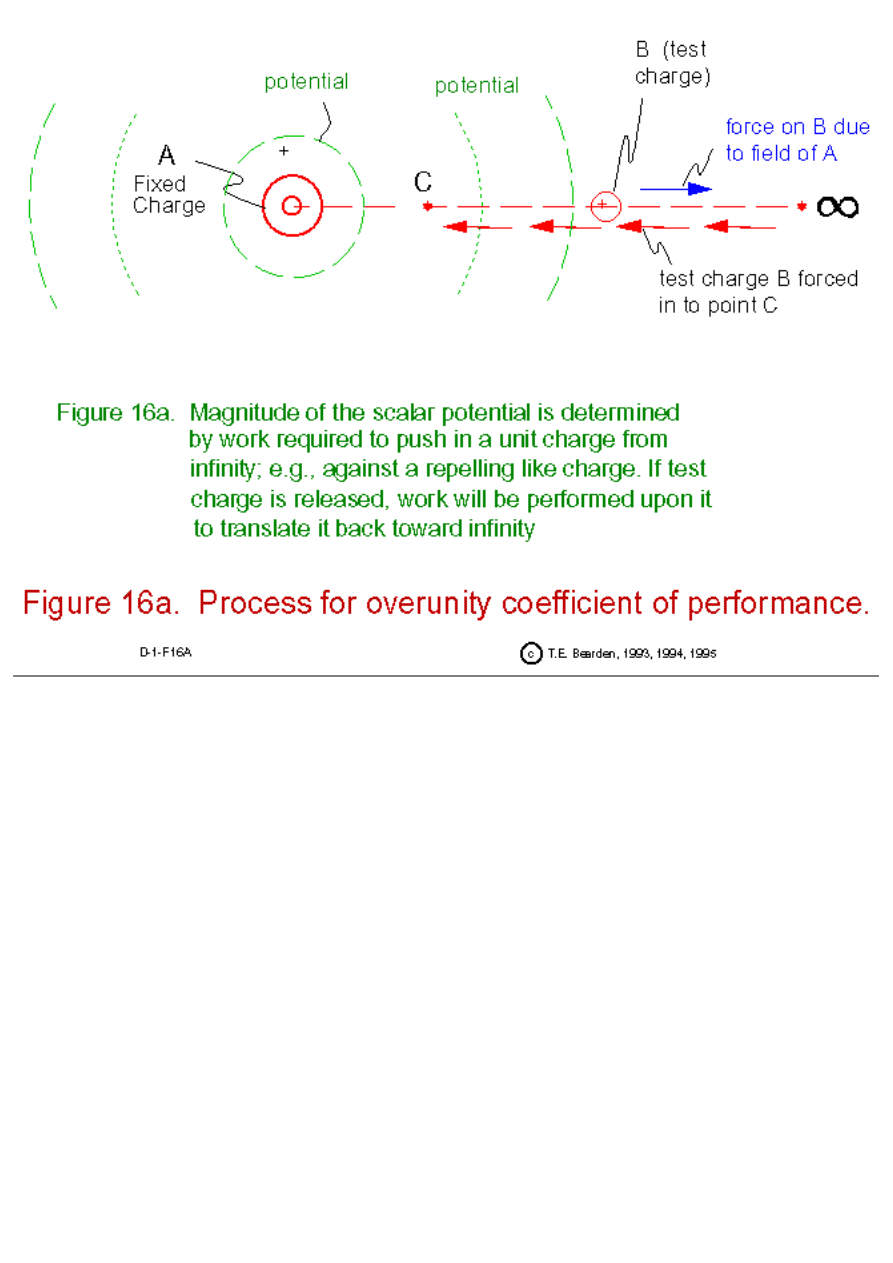
Tables:
http://www.hsv.com/writers/bearden/fig016.htm (1 of 2)24.11.2003 20:27:50
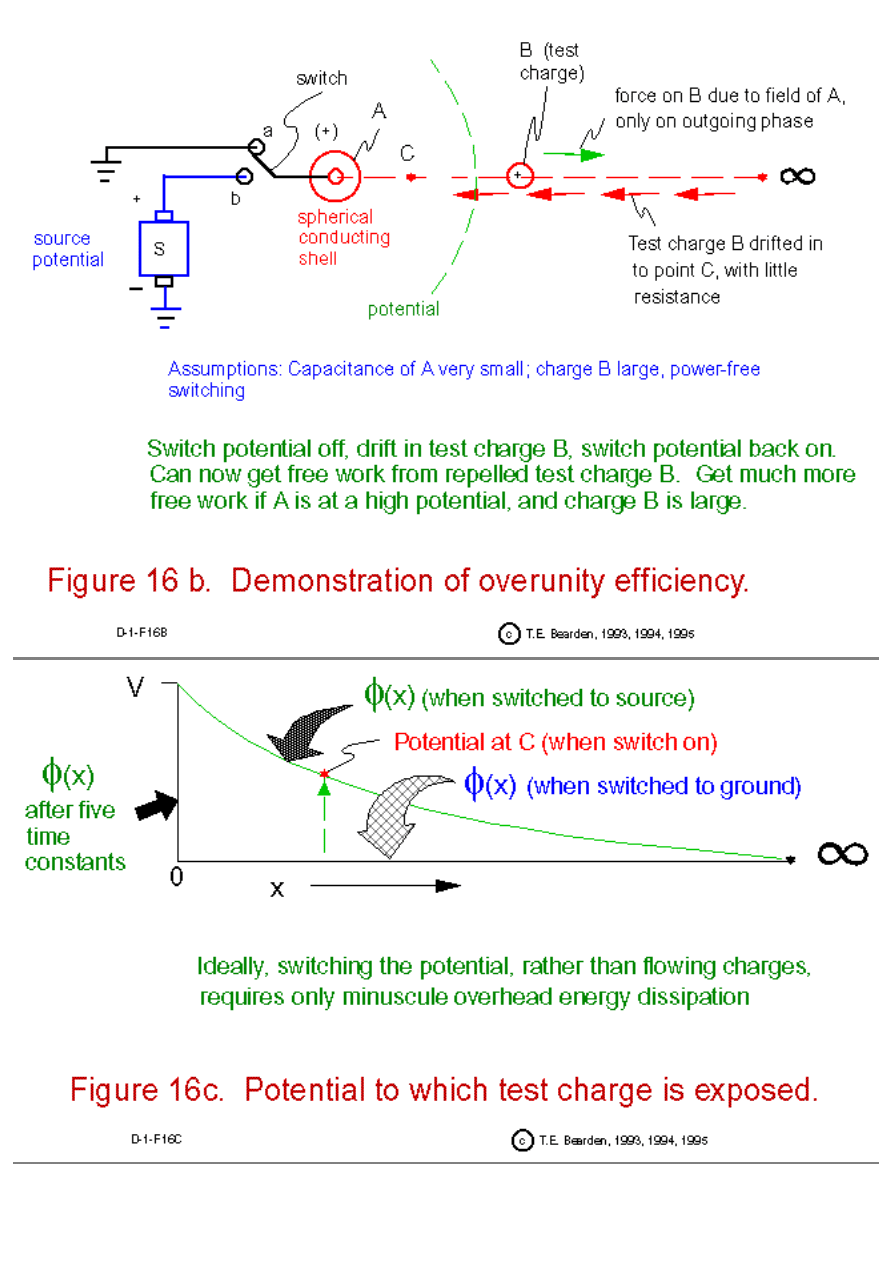
Tables:
http://www.hsv.com/writers/bearden/fig016.htm (2 of 2)24.11.2003 20:27:50

Notes and References:
[18] The system does comply with the nonlinear thermodynamics of a system œar from equilibrium.
E.g., Prigogine received the Nobel Prize œor significantly developing this new field. For a detailed
technical presentation of nonlinear thermodynamics of a system far from thermodynamic
equilibrium, see G. Nicolis and I. Prigogine, Explorinq Complexity, Piper, Munich, 1987. Such
systems can exhibit negentropy, self-organization, and other effects outside the confines of classical
thermodynamics. Since local symmetry is broken, they can also permissibly exhibit overunity
coefficient of perœormance.
http://www.hsv.com/writers/bearden/ref18.htm24.11.2003 20:27:52

Notes and References:
[19] Each end 0œ a dipole has its own potential (with respect to the local vacuum), which differs
from the potential of the surrounding ambient vacuum. For each of these "end-potentials," one can
mathematically decompose that end-potential into a hidden bidirectional set of harmonic wavepairs in
harmonic sequence. Each wavepair consists of the wave and its phase conjugate. For the proof, see E.
T. Whittaker, "On the Partial Differential Equations of Mathematical Physics," Mathematische
Annglen, Vol. 57, 1903, p. 333-355. Since one of the dipole potentials exceeds the local vacuum
potential and the other dipole potential is lower than the local vacuum potential, the two bidirectional
EM wave flows are at or "carry" different equipotentials. This is the generatrix for the automatic dual
œ1ow of energy from the vacuum through the dipolar power source and out along the two leads of
the "transmission line" conducting the S-flow to the components of the circuit for powering the loads.
So as can be seen, rigorously every dipole is already a "free energy source" if we learn how to
properly use it. The energy will flow forever, if we do not allow the destruction of the sourcing
dipole.
http://www.hsv.com/writers/bearden/ref19.htm24.11.2003 20:27:54

Notes and References:
[20] See also E.T. Whittaker, "On an Expression of the Electromagnetic Field Due to Electrons by
Means of Two Scalar Potential Functions," Proceedinqs of the London Mathematical Society, Series
2, Vol. 1, 1904, p. 367-372. Here Whittaker shows that the fields of classical electromagnetics can be
replaced by scalar potential interferometry of two potentials. Our own comment is to note that by
Whittaker 1903, we can with a little difficulty make artificial potentials with deliberate substructures.
We can then interfere those potentials (actually, interfere their hidden multiwave structures) even at a
distance, to create new EM fields. Or we can dissolve EM fields that exist at a distance, simply by
constructing the correct negative EM fields by distant scalar interferometry. My point is that, when
we utilize the "inner" electromagnetics inside the potential, we are employing a vastly more powerful
electromagnetics of a new kind, which includes and extends the present inadequate EM theory.
http://www.hsv.com/writers/bearden/ref20.htm24.11.2003 20:27:56

CHASING THE WILD DRAGON:
Indeed, orthodoxy has a black record with respect to energy. When
Mayer advanced the conservation of energy law, orthodoxy hounded him unmercifully. He was
universally ridiculed as the very epitome of a fool. He lost his job and suffered a nervous breakdown.
Then years later toward the end of his life, scientists came to accept the conservation of energy as a
most useful tool that dramatically simplified much of their analyses. So then science began to laud
Mayer. There are a thousand other such examples; suffice it to say that "big science" is a bureaucracy
and a "bell-shaped distribution curve" just like any other large group of people. Some scientists are
near-angels. Others are near-devils. The vast majority are neither, but are just ordinary persons doing
a special kind of job. In the scientific bureaucracy, however, the manipulative scientists scurry, slash,
and manipulate their way toward the top. So the leadership of any big bureaucracy __ including the
scientific bureaucracy __ is always rife with such near-scalawags and power-hungry individuals.
Scientists are not exceptions to the same human weaknesses that we all evidence. If you really want
to see jealousy, backbiting, and fierce "back-room dealing" and power-struggling, just get into a
university research environment! But because the "power merchants" of any bureaucracy always
fiercely resist any challenge to their position or superiority, big science has always fiercely resisted
anything truly revolutionary. And today they also enlist the power of the state to enforce their
dictums. We will devote one of our future columns to pointing out some glaring examples of
persecution of independent researchers by big science. It is an area that all unorthodox researchers
should be well-aware of. The world of science does not run by sweet reason and lofty ideals; that is
just the dogma. It runs strictly by "who's going to be the big monkey," just like everything else.
Primate dominance is still a dictum of the functioning of all bureaucratic human systems.
The free energy researchers are not working on the so-called "perpetual motion machine," where a
closed system is erroneously stated to produce more output than must be put into it to operate it. That
old saw is actually a red herring that dogmatic scientists use to vilify free energy researchers. It is a
lie that they have also successfully sold to the U.S. Patent and Trademarks Office. Anyone with a
modicum of knowledge of modern physics already knows that there does not exist a single closed
system in the universe, anywhere. In particular, every physical system is continuously "open" to the
violent exchange of energy with the surrounding vacuum. It's just that most systems are in local
equilibrium in these flow exchanges, except for minuscule gating accomplished for such things as the
Lamb shift, etc.
By analogy it's something like this. The free energy researcher is standing by the banks of a mighty,
rushing river with breathtaking falls, turbulent areas, etc. Big Science is begrudgingly admitting that,
yes, there is a river there, but it is an insane delusion to think that you can tap that energy. The free
energy researcher is saying that, well, if I can build a gating sluice a little distance upstream, perhaps
I can divert a small portion of the river's flow downstream to my waterwheel, and power my mill.
The orthodox scientist then vilifies the free energy researcher for even having such a heretical
thought. In fact, says the orthodox researcher, any fool can see that the laws of nature force the river's
flow to stay firmly in its banks, because it is a closed system, and Moses brought that law down off
the mountain with him on a special stone tablet. Then he adds all the other smug remarks such as, "If
it could be done, then we at MIT and Harvard and Caltech would already have done it!" So until the
orthodox scientist develops a little less dogma and a little more common sense, and learns the
difference between a scientific discussion and a dogfight, the free energy researcher can hardly
communicate with him.
http://www.hsv.com/writers/bearden/page008.htm (1 of 2)24.11.2003 20:27:57

CHASING THE WILD DRAGON:
|
Comments may be sent to
the
of The Virtual Times
http://www.hsv.com/writers/bearden/page008.htm (2 of 2)24.11.2003 20:27:57

CHASING THE WILD DRAGON:
The goal of the legitimate free energy researcher is to find a way to break
the local equilibrium of this universal energy exchange, and gate a tiny bit of it up into the external
circuit as excess electrical energy
. Then he must collect the excess energy, and shuttle it
from the "gating and collecting circuit" over to a dq/dt-closed current loop containing the load. He
must also prevent the load current, or most of it, from passing back through the primary source
against its back EMF, because if it does that, he will destroy the separation of charges in the dipolar
source, killing the dipole and extinguishing the "excess energy gating." In other words he must find a
way to process and transport the energy flow across dq/dt-blocked bridges between the source's
closed dq/dt-current loop and the load's closed dq/dt-current loop. Ruthlessly it is an energy transport
S-flow problem, not a J* energy transport problem. If he uses J* in his sourcing current loop, he
automatically drives the current dq/dt back through the back EMF of his source and kills it. If he does
not drive dq/dt back through the source, the source will furnish S-flow for an indefinite period! Every
battery and generator we have ever built is already a "free energy" machine in that it already involves
broken local symmetry in the vacuum energy exchange. We have just not realized how to use our
power sources purely as Poynting S-flow sources.
So we must treat an electrical system as an open system with broken local symmetry
in the
vacuum flux exchange, so that the system extracts (gates) excess energy from an external source. In
this case the source is the system's flux exchange with the vacuum. This approach is no more
mysterious or bizarre than putting a waterwheel in a river, or a windmill in a wind, or a bank of solar
cells out in the sunshine. The universal "free source of energy" that the overunity researcher seeks to
tap is the violent exchange of virtual photons between the electrical charges of the system and the
surrounding quantum mechanical vacuum
. In quantum physics this powerful, energetic
exchange of the vacuum with electrical matter is now proven both experimentally and theoretically. It
is already accepted in quantum physics that the vacuum is filled with electromagnetic energy. The
researcher doesn't have to prove it anymore; he just has to find out how to properly use it. The
artesian well is already there; we just have to learn how to collect and use the flowing water without
dynamiting the well!
The remaining objection orthodox scientists usually raise against the notion of extracting vacuum
energy has been that "thermodynamics doesn't permit it." However, Cole and Puthoff have rigorously
shown that, on the contrary, the theory of thermodynamics does not prohibit the vacuum's energy
being extracted and used to produce heat, light, and power.
So the validity of that final
objection has now vanished.
|
Comments may be sent to
the
of The Virtual Times
http://www.hsv.com/writers/bearden/page009.htm24.11.2003 20:27:59
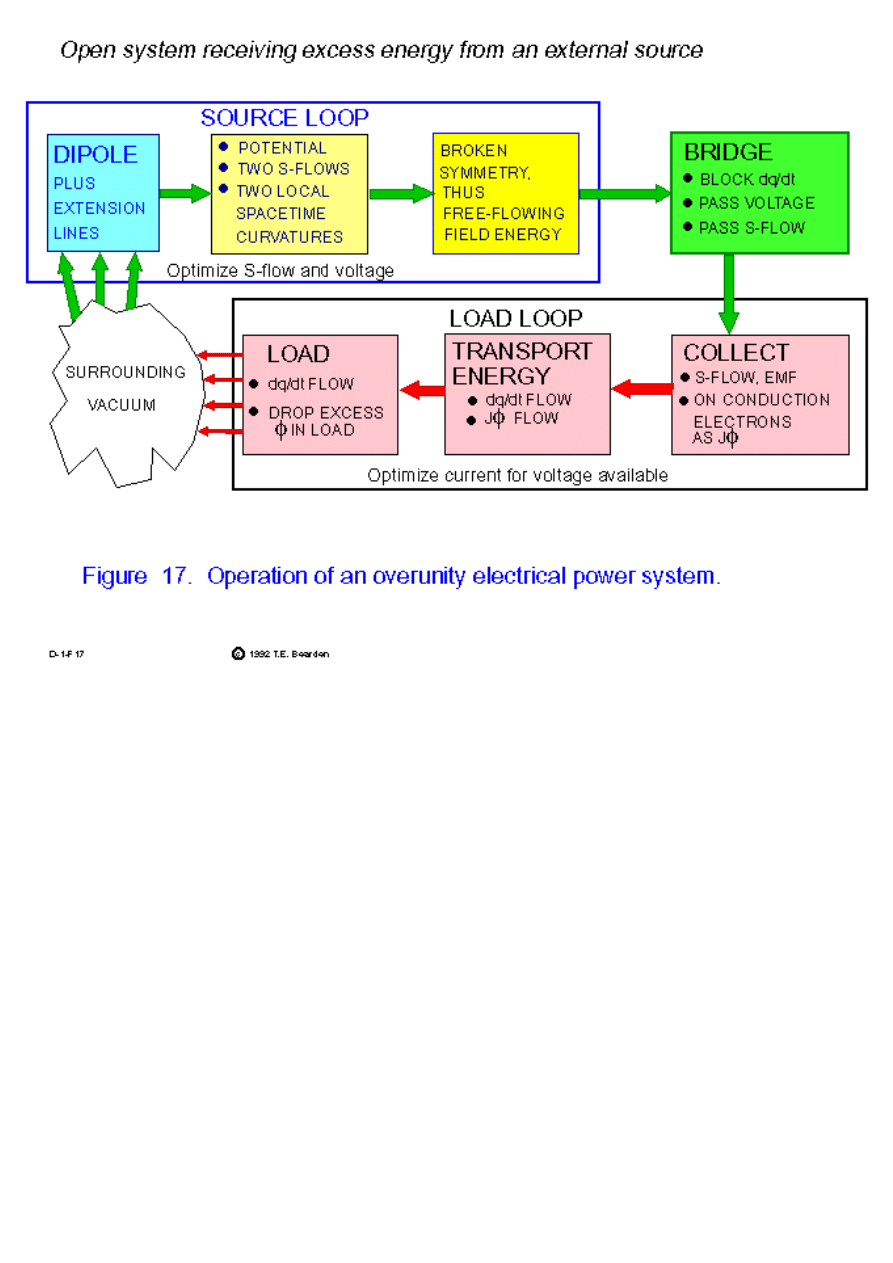
Tables:
http://www.hsv.com/writers/bearden/fig017.htm24.11.2003 20:28:02
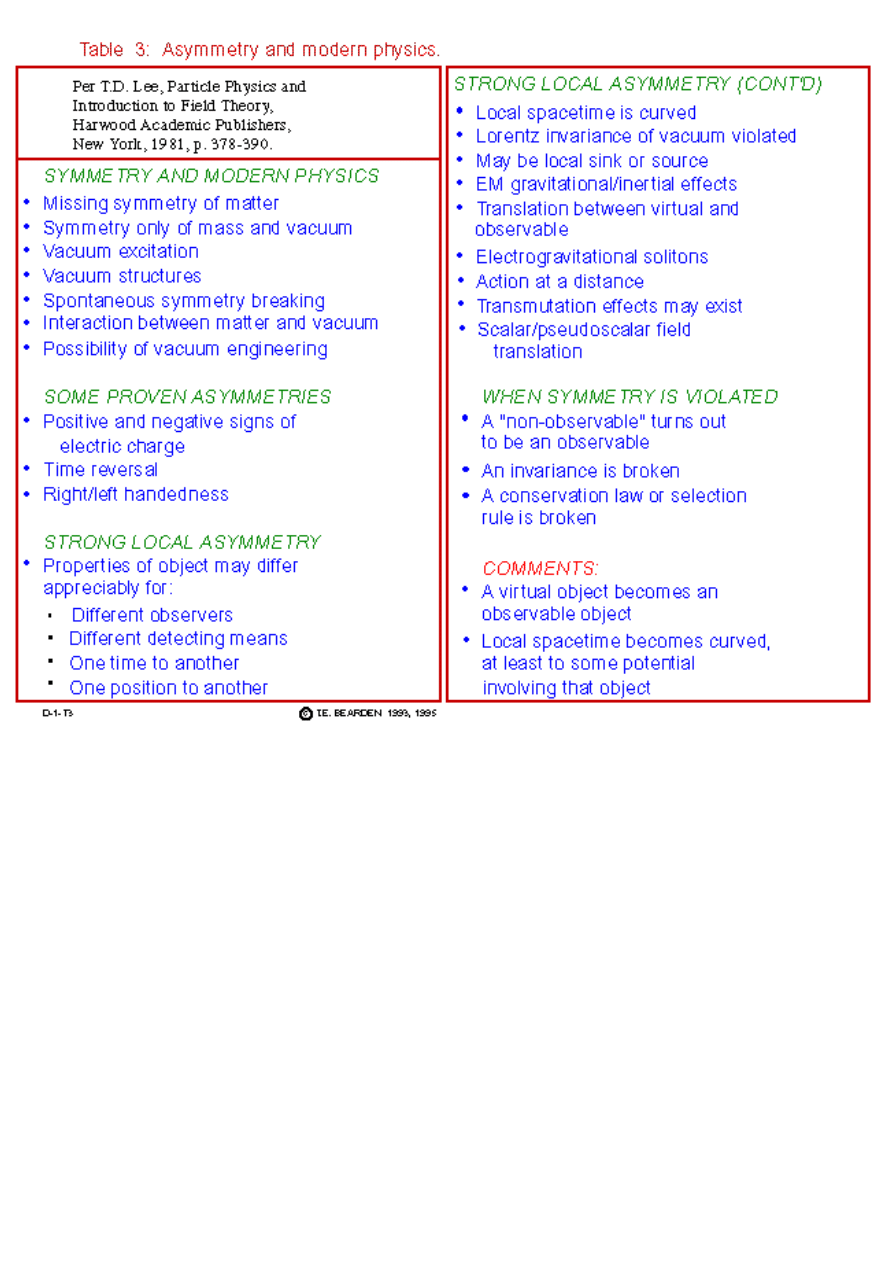
Tables:
http://www.hsv.com/writers/bearden/table003.htm24.11.2003 20:28:04
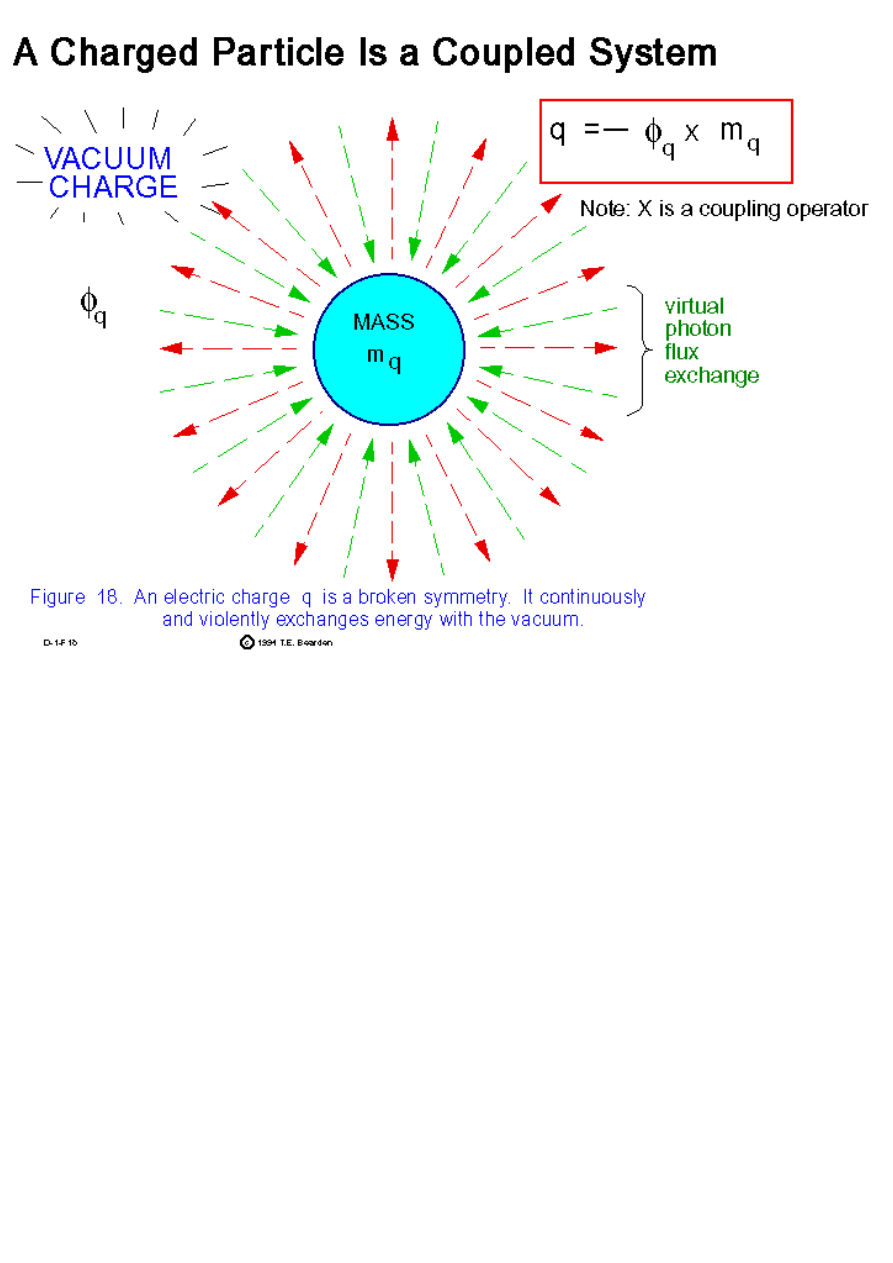
Tables:
http://www.hsv.com/writers/bearden/fig018.htm24.11.2003 20:28:07

Notes and References:
[22] Cole, Daniel C. and Harold E. Putboll. (1993) "Extracting Energy and Heat from the Vacuum,"
Physical Review E, 48(2), Aug. 1993, p. 1562-1565.
http://www.hsv.com/writers/bearden/ref22.htm24.11.2003 20:28:08
CHASING THE WILD DRAGON:
And there is mind-numbing energy density there in the vacuum, waiting
to be extracted. The well-known Lamb shift, e.g., in a single hydrogen atom is due to that vacuum
exchange.
Interestingly, the calculated energy density of the exchange causing the Lamb
shift is greater than the surface energy density of the sun. Different physicists have made various
theoretical estimates of the energy density of this seething vacuum. A conservative ballpark figure is
something on the order of 1090 grams per cubic centimeter, expressed in mass units.
It has also been my good fortune to know and work closely with several other free energy
researchers. I was a colleague of Floyd ("Sparky") Sweet (recently deceased) for about seven years;
Sparky held a Master's degree in EE from MIT and had years of experience with General Electric and
other firms. He was a highly skilled researcher who invented the solid state vacuum triode amplifier
, a unit which produced 500 watts of output and a coefficient of performance of
1,500,000. I personally tested the machine, activated the magnets on one occasion, and understand
how it all worked.
The paper
I co-authored in 1991 with Floyd is still the only
paper in the orthodox engineering literature that reports (a) successful overunity functioning of a
solid state magnetic device, and (b) a successful antigravity experiment on the laboratory bench,
reducing the weight of an object by 90%.
We stress again that a legitimate overunity electrical machine must be an open system, receiving
excess electrical energy from the surrounding vacuum. As such, it must operate in a higher topology
than normal electrical machines
.
My good friend Frank Golden has long been a close colleague. Years ago Frank developed a motor
that produced overunity efficiency, but then to our astonishment we found (courtesy of Bill Tiller,
with whom we were working at the time) that its operation depended upon a 5-year-long
conditioning (structuring) of the local ambient potential in order to work. Previously we had been
entirely unaware that one can sometimes condition the local vacuum and the local matter in the area
with a particular dynamic form. Given the local conditioning, a motor with that form will then work
in that vicinity, but not necessarily elsewhere at an appreciable distance away. We now understand
the mechanism for such "conditioning of the vacuum." We also now know what to do if an overunity
machine is actually a machine of that type (many of them are not). In other words, we know how to
convert it to a machine that will work anywhere, anytime. We will be addressing such little-known
things in future articles.
|
Comments may be sent to
the
of The Virtual Times
http://www.hsv.com/writers/bearden/page010.htm24.11.2003 20:28:09

Notes and References:
[23] Lamb, W.E. Jr. and R.C. Retherford. "Fine structure of the hydrogen atom by a microwave
method." Physical Review, Vol. 72, 1947, p. 241-243. Lamb received the Nobel prize for this work.
http://www.hsv.com/writers/bearden/ref23.htm24.11.2003 20:28:10
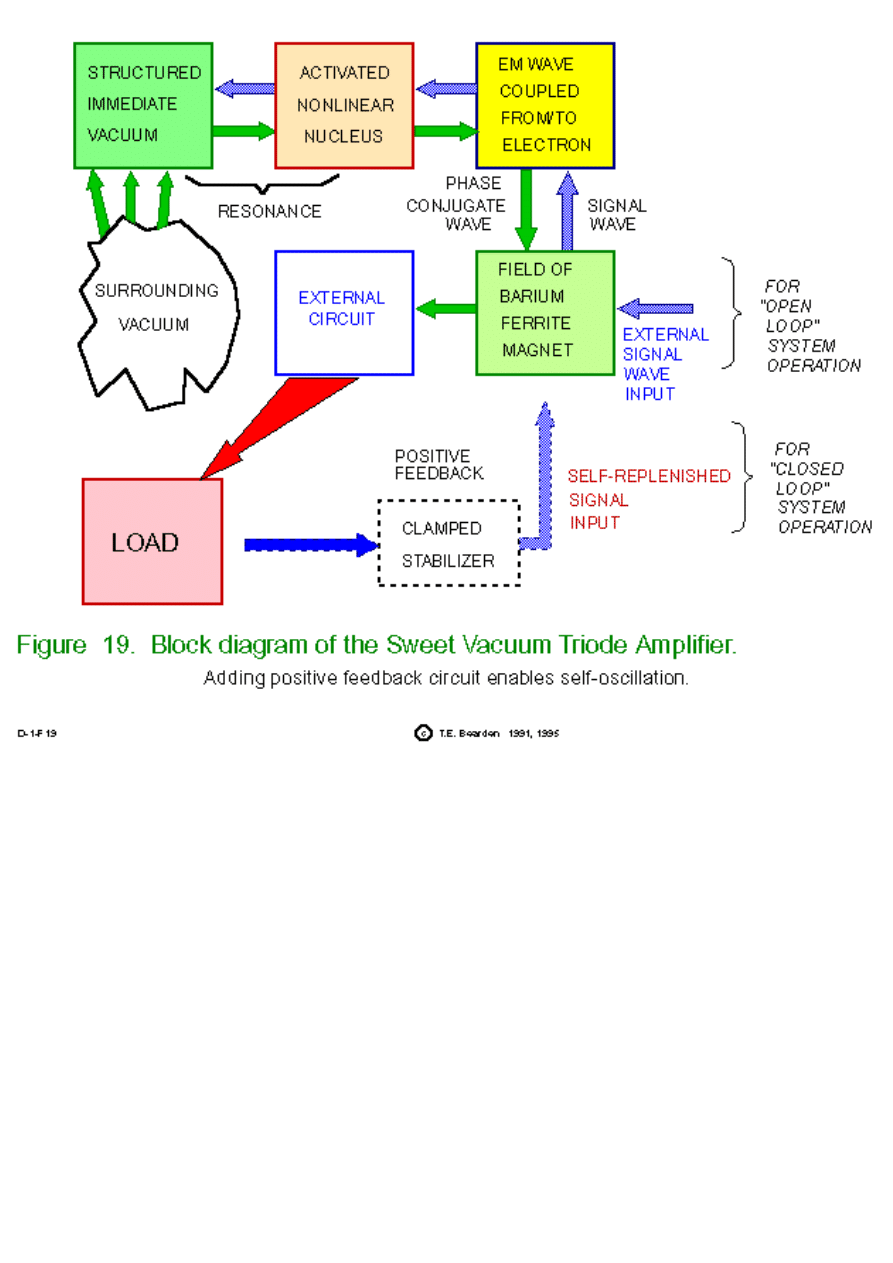
Tables:
http://www.hsv.com/writers/bearden/fig019.htm24.11.2003 20:28:14

Notes and References:
[24] Unfortunately Sweet made conflicting agreements with multiple backers, resulting in a most
thorough legal foul- up. It appears that nothing can ever be done with this machine, because its status
is a legal nightmare.
http://www.hsv.com/writers/bearden/ref24.htm24.11.2003 20:28:16

Notes and References:
[25] Floyd Sweet and T. E. Bearden, "Utilizing Scalar Electromagnetics to Tap Vacuum Energy,"
Proceedings of the 26th Intersociety Energy Conversion Engineerinq Conference (IECEC '91),
Boston, Massachusetts, 1991, p. 370-375. Paper also distributed over Internet.
http://www.hsv.com/writers/bearden/ref25.htm24.11.2003 20:28:18

Notes and References:
[26] The unit was specially rigged and "pushed" to 1,000 watts output to perform the antigravity
experiment.
http://www.hsv.com/writers/bearden/ref26.htm24.11.2003 20:28:19
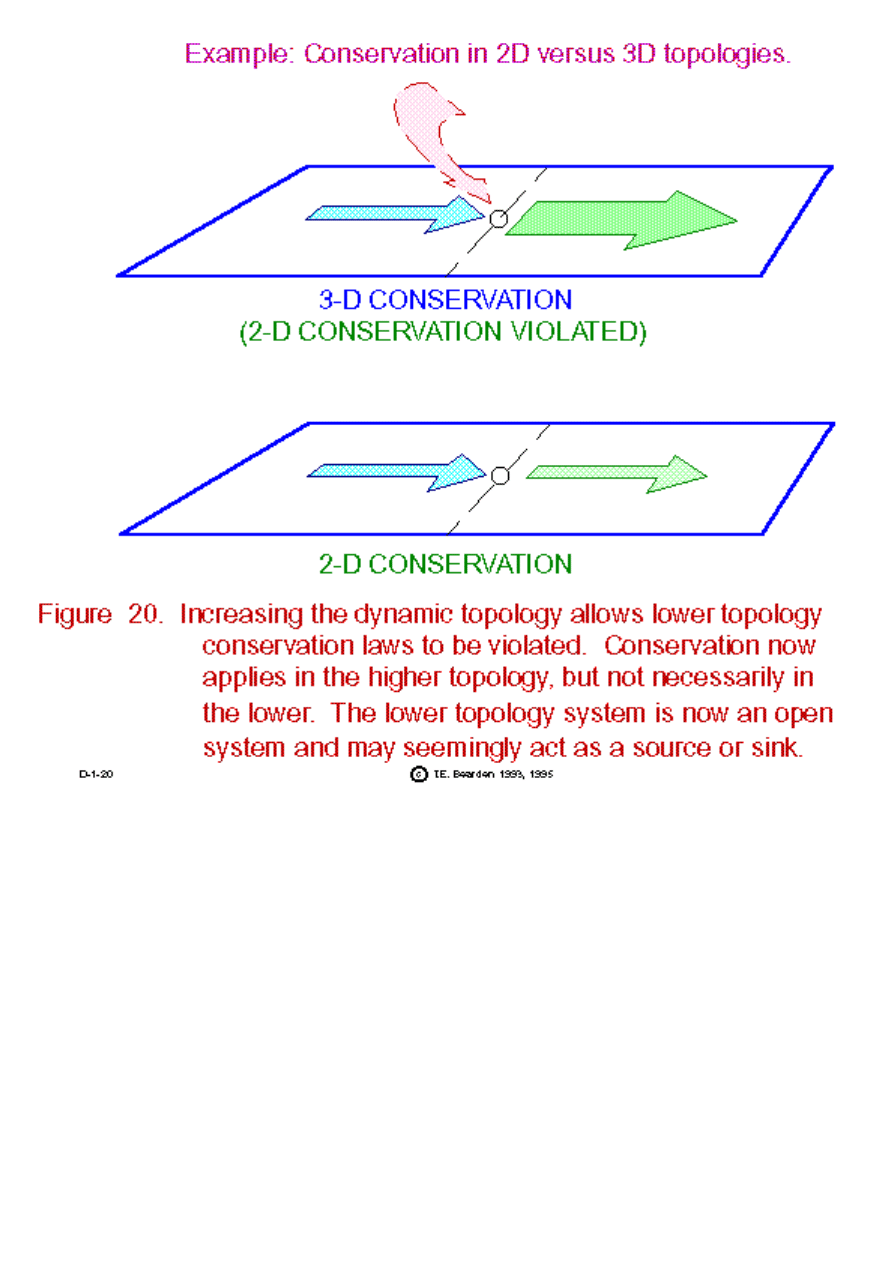
Tables:
http://www.hsv.com/writers/bearden/fig020.htm24.11.2003 20:28:22

Notes and References:
[27] Tiller was already familiar with the fact that devices that function by more subtle energy often
require special conditioning of the vacuum spacetime. He expressed it as "an archetype must first be
created for the machine to function efficiently." Tiller had previously experimented with such an
effect for several years.
http://www.hsv.com/writers/bearden/ref27.htm24.11.2003 20:28:23

CHASING THE WILD DRAGON:
John Bedini is also a close friend and colleague; John built several
experimental motors (both electrical and magnetic) in the overunity area, and performed successful
trans-mutation experiments. John is a recognized genius in high-end sound amplifier development.
Many audiophiles worldwide still swear that the Bedini amplifier is the best and sweetest-sounding
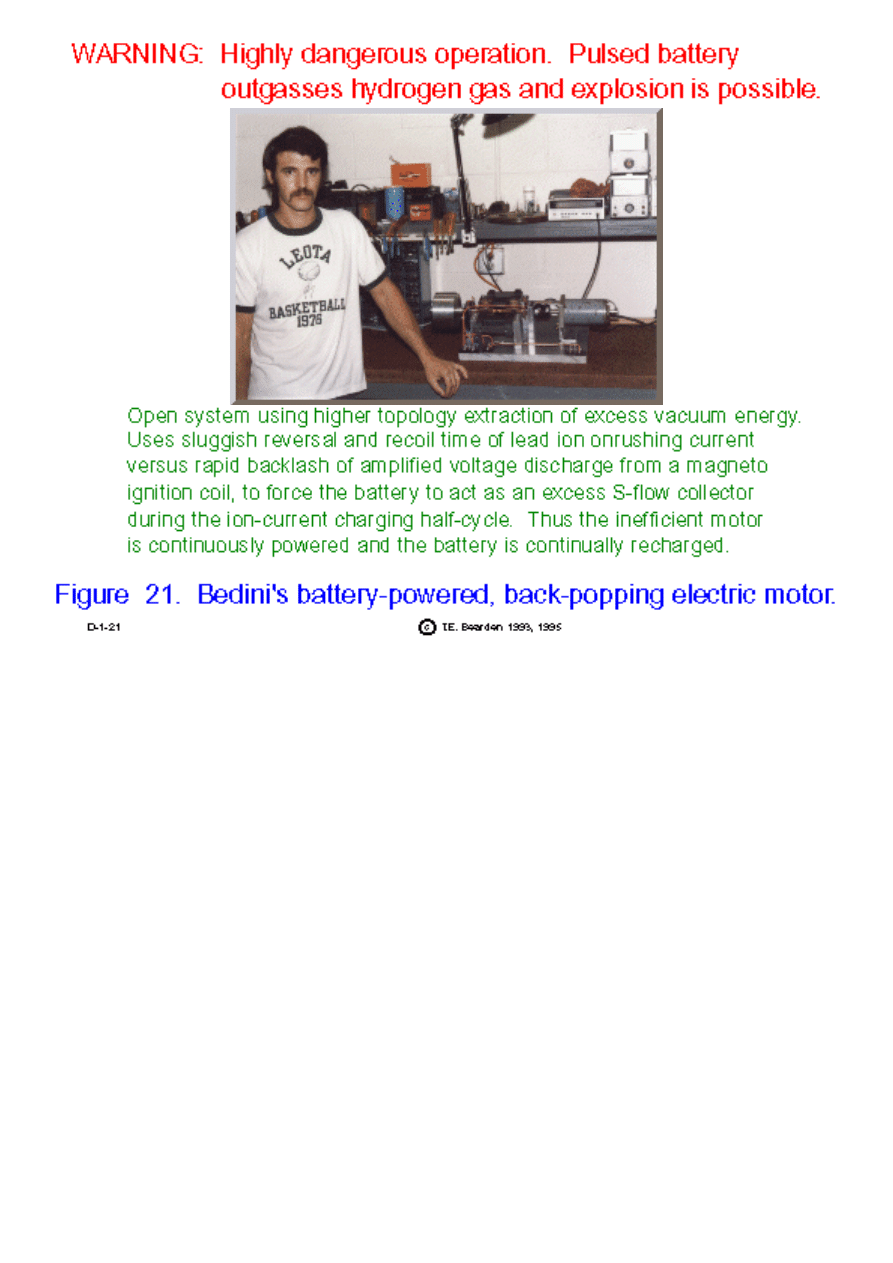
audio amplifier ever built. One of John's battery-powered electrical motors
, for example,
ran continuously off its battery for about five years, and kept the battery charged. When you realize
that such a small electric motor is only about 35% efficient, then you realize that about 65% of the
energy flowing out of the battery was being dissipated in the motor as heat, core losses, etc. So the
unit was continuously performing work for that five years.
The 1/8 hp motor represented a
load in which the continuous rate of work being done (the rate of energy dissipation) was about 0.08
hp. We will have more to say on this motor and its technical process in a future article.
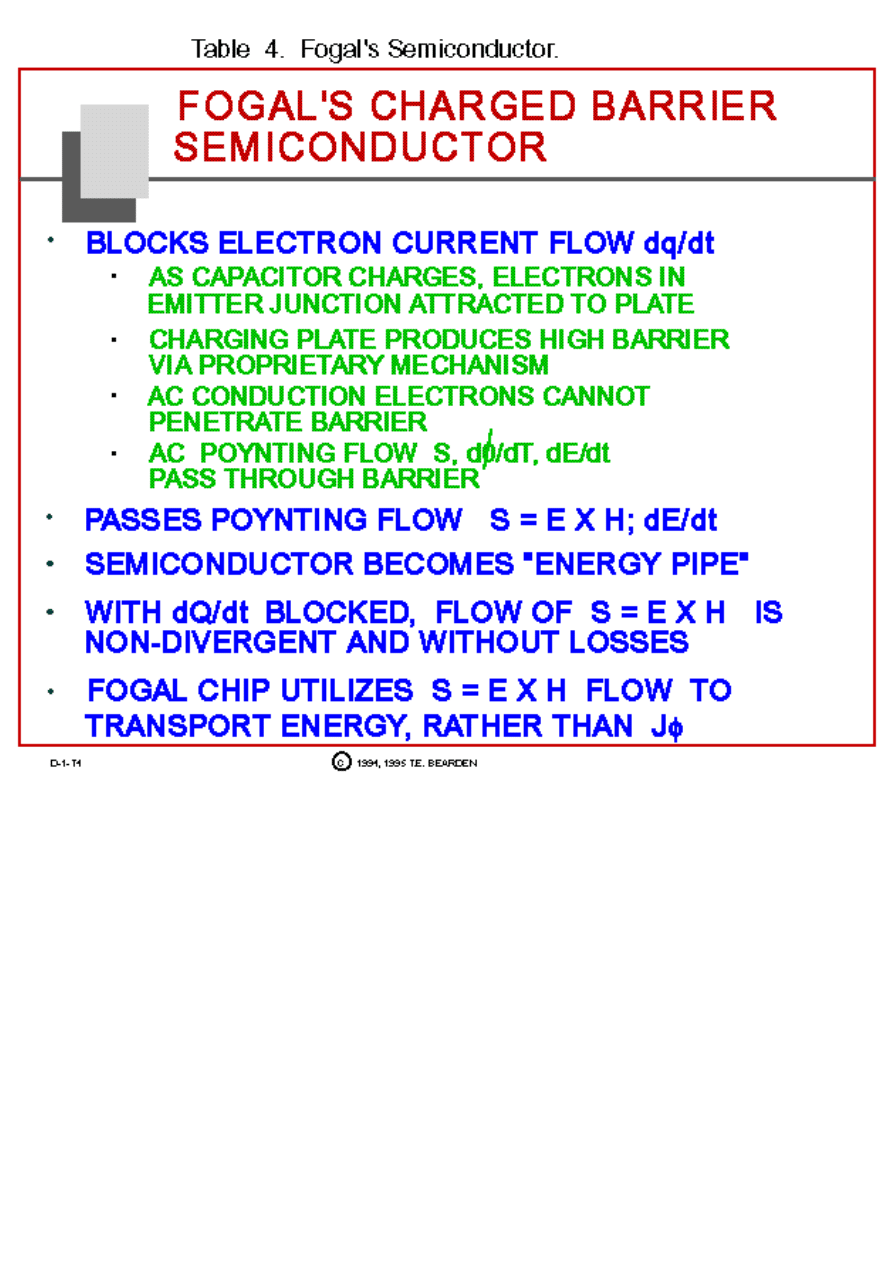
Bill Fogal is a close colleague; Bill has patented the world's first dq/dt-blocking semiconductor,
which partially blocks the normal current while continuing to pass the flow of voltage
have written a proprietary technical explanation of the Fogal semiconductor, which utilizes an
extremely little-known feature called the "overpotential." The overpotential part of the theory is
experimentally proven and theoretically explained in an obscure part of electrochemistry, by a few
chemists who specialize in electrode effects. J. O'M. Bockris is probably the leading world expert in
overpotential theory; he authored the textbook on it.
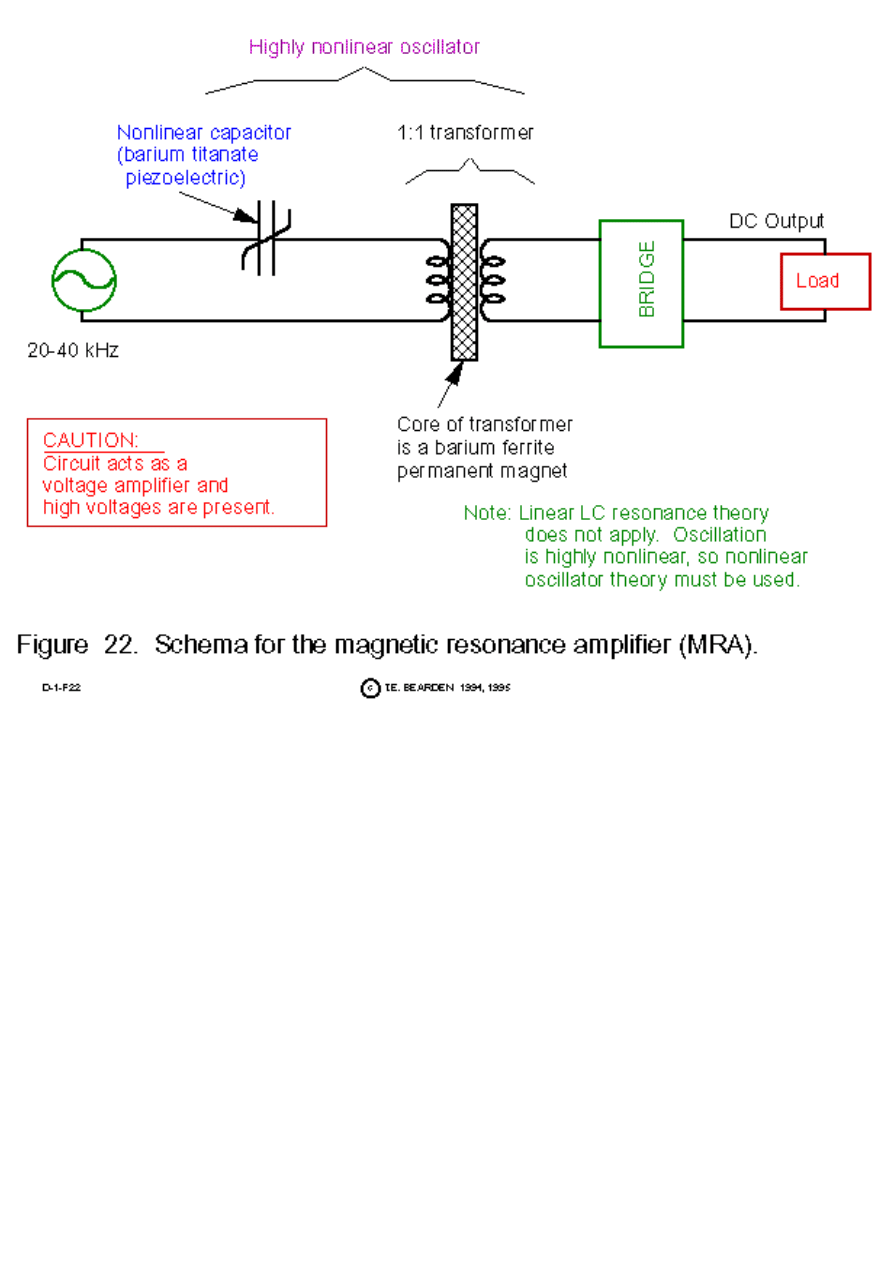
One of the latest overunity developments is the magnetic resonance amplifier (MRA) developed by
Joel McLain and Norm Wooten
. Earlier testing disputed the overunity functioning. More
recent testing at several well-known laboratories has resulted in the instrumental measurements
clearly showing overunity. While the test institute scientists themselves may be willing to attest to
overunity results of their testing, none of the corporate heads will allow it. I have personally stated
that the MRA is capable of overunity. Our own measurements had to be discarded because we did not
have the proper instruments available. E.g., all our oscilloscopes were "hard grounded" to building
ground, and we needed to make "floating differential ground" measurements in order to settle things
once and for all. McLain and Wooten have filed for a patent, and multiple tests with excellent
equipment have indeed indicated overunity. What happens next remains to be seen. I suspect that the
two inventors may simply accept foreign capital investment and go offshore.
|
Comments may be sent to
the
of The Virtual Times
http://www.hsv.com/writers/bearden/page012.htm24.11.2003 20:28:25
Tables:
http://www.hsv.com/writers/bearden/fig021.htm24.11.2003 20:28:32

Notes and References:
[28] We strongly emphasize that there is no conservation of work law in physics! It is the overall
energy of the universe that must be conserved, not work. More rigorously, the flow of energy must be
conserved. But from a free flow of energy, you can continuously extract a little and dissipate it as
work, without cutting off the main flow and without violating any of the laws of physics. If this were
not so, then waterwheels, windmills, and solar cells would not work. In fact, you can even do better
than that. The basic energy conservation law is this: Energy can neither be created nor destroyed. So
even when you "use" (i.e., dissipate or scatter) the energy, it is still there. It is only the hierarchical
ordering of the photons that constitutes entropy. Each individual photon is perfectly ordered and still
contains all its energy. By retroreflection, you can even cause those disordered photons to gather back
in your system into perfect order once again and then you can scatter them again to do some more
work. You can use the same energy over and over again! The perfect retroreflection is more easily
accomplished by phase conjugate reflection. For a vivid example of just such retroreflection of
previously scattered EM energy to restore the former order, see David M. Pepper, "Applications of
Optical Phase Conjugation," Scientific American, Vol. 254, No. 1, Jan. 1986, p. 74-83. See
particularly the striking photographic demonstration of time reversal of disorder on p. 75.
http://www.hsv.com/writers/bearden/ref28.htm24.11.2003 20:28:34

Notes and References:
[29] William Jay Fogal, "High gain, low distortion, faster switching transistor." U.S. Patent No.
5,196,809, Mar. 23, 1993. Also William J. Fogal, "High Gain, Low Distortion, Faster Switching
Transistor." U.S. Patent No. 5,430,413, July 4, 1995.
http://www.hsv.com/writers/bearden/ref29.htm24.11.2003 20:28:35
Tables:
http://www.hsv.com/writers/bearden/table004.htm24.11.2003 20:28:38

Notes and References:
[30] In a correspondence with Bockris lasting several years, he had graciously furnished me with
material on the overpotential, which is how I found out about this esoteric area. Bockris is well-
known as a leading scientist on the chemistry of hydrogen, and also as one of the leading scientists in
the rapidly developing field of cold fusion. He is a marvelous scientist, and one day his largely
unsung work with the overpotential will revolutionize the entire electronics industry.
http://www.hsv.com/writers/bearden/ref30.htm24.11.2003 20:28:40
Tables:
http://www.hsv.com/writers/bearden/fig022.htm24.11.2003 20:28:43

CHASING THE WILD DRAGON:
Howard Johnson is also a respected colleague, whom I very much
admire.
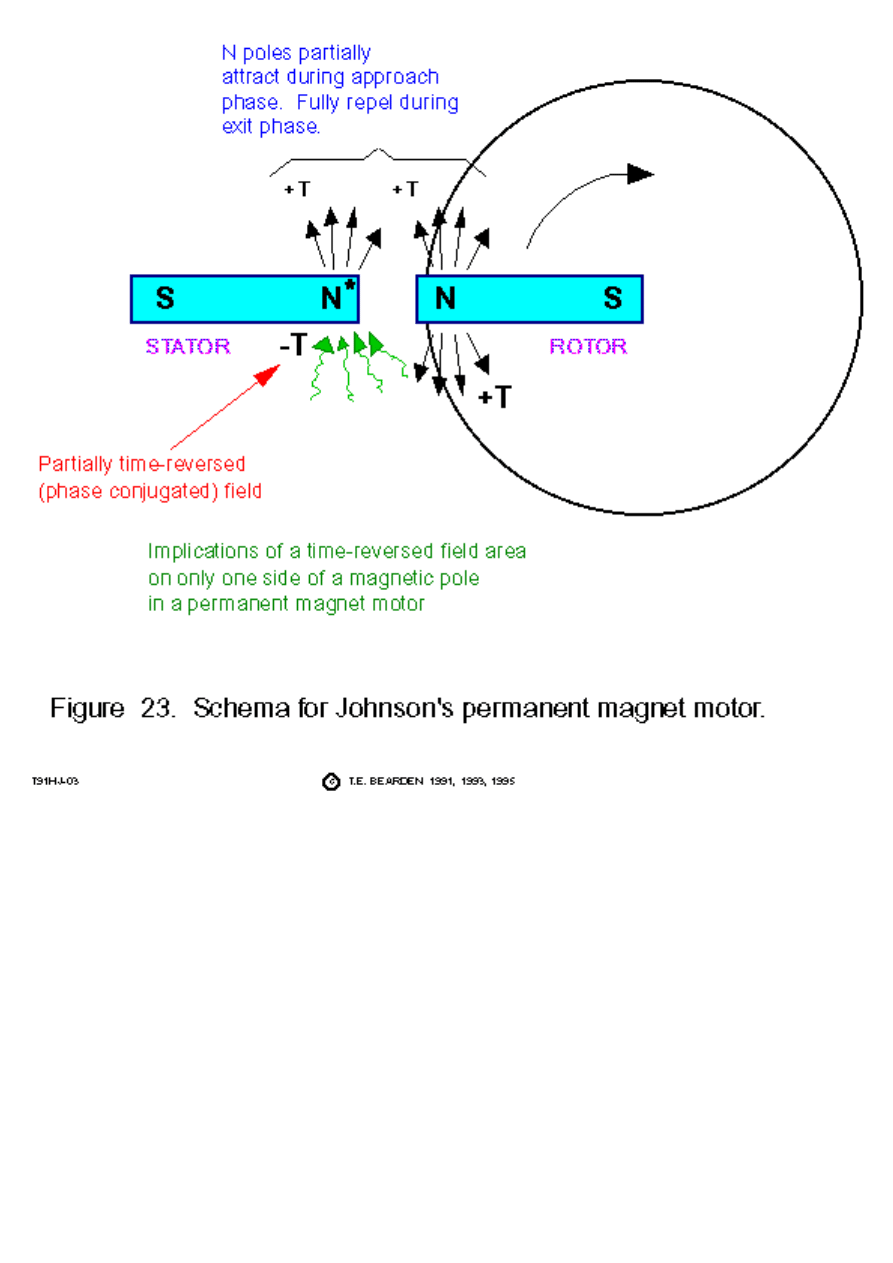
. Howard has continued to work quietly and patiently upon his patented
permanent magnet motor,
including patenting various magnetic gates, etc. that are
necessary to make such a motor work in a rotary configuration.
Howard employs a two-
particle theory of magnetism; i.e., each magnetic flux line is envisioned as having a particle traveling
from the north pole to the south pole, and also a particle traveling from the south pole to the north
pole. The particles are spinning; the forward-time particle spins in one direction, and the antiparticle
spins in the other direction. Howard then slightly separates the two particle flows.
words, Johnson splits the flux lines themselves, into two different pieces. When so separated, the
component lines are now curls, so their paths curve. The paths of the two "curl particles" are
different; one curls in one direction and the other curls in the opposite direction. Further, a
predominance of one form of curl particle gives a "time-forward" aspect, while a predominance of the
other form of curl particle gives a "time-reversed" aspect. Johnson is thus able to employ a deeper
kind of magnetism than the textbooks presently contain. He demonstrates that a "spin-altered"
magnetic assembly exhibiting (to a compass or other such detector) a north polarity can attract
another unaltered magnetic assembly exhibiting a north polarity. In short, he can make a north pole
attract a north pole. We will give you further insight into Johnson's two-particle theory in a future
article.
We will also explain how and why the physicists missed that antiparticle in the
magnetic field's flux lines, and thereby failed to advance the theory of magnetism to a deeper level.
Make no mistake, one day when the new theory is done, Johnson may well be awarded a Nobel Prize
for his epochal discovery of a deeper structure of magnetism.
Bits and pieces of the new science approach are just now beginning to spill into a few conventional
journals and symposia. For some time a few of the rebels spearheading this new science have been
doing something that the University scientists should have been doing all along. The rebels have been
meticulously examining the concepts, postulates, and definitions that the present scientific models are
founded upon, to reveal serious foundations errors. Corrections for some of these errors have been
discovered and made.
Others are still problems yet to be resolved. Yet slow progress is
being made, and a "flip-over" of the old science is likely to occur within the next decade if not
sooner. By then the new concepts will have become "solid" enough to allow producing an
engineering mathematical model. Also the supporting experiments will have become solid enough to
justify the new concepts and the model.
|
Comments may be sent to
the
of The Virtual Times
http://www.hsv.com/writers/bearden/page013.htm24.11.2003 20:28:45
Tables:
http://www.hsv.com/writers/bearden/fig023.htm24.11.2003 20:28:47

Notes and References:
[31] Howard Johnson, "Permanent Magnet Motor." U.S. Patent No. 4,151,431. Apr. 24, 1979.
http://www.hsv.com/writers/bearden/ref31.htm24.11.2003 20:28:49

Notes and References:
[ [32] I personally saw and closely examined one demonstration rotary Johnson permanent magnet
motor some years ago, and toyed with it for about one hour. It would definitely self- rotate as long as
you wished to permit it to turn. It was not a powerful device at all, but just a small laboratory "proof
of principle" prototype. It had cost Johnson an enormous amount of time, labor, and optimization to
get the critical adjustment required of his two magnet assemblies. But the device had no power source
other than the permanent magnet assemblies themselves. Johnson's nonlinear rotor and stator magnets
interacted with each other in a manner to break local symmetry. So his machine was an open system
and therefore a permissible overunity device; it was not a perpetuum mobile.
http://www.hsv.com/writers/bearden/ref32.htm24.11.2003 20:28:50

Notes and References:
[33] As I have pointed out repeatedly in the past, photons also carry time, not just energy. We have
previously shown the process and the photon interaction mechanism that creates the flow of time
itself; we will discuss this mechanism in the future. So when Johnson separates the particles and
antiparticles, not only does he partially separate them according to spin, but he also alters the local
character of time flow during which the resulting magnetic field forces must appear. In other words,
he accomplishes a partial separation of time-forward and time- reversed polar interactions. A south
pole is just a time- reversed magnetic north pole, in the first place! So a north pole of a bar magnet
that is slightly time reversed on one side will partially act on that side just like a south pole. On the
other side it will continue to act like a normal north pole. By partially time-reversing (phase
conjugating) one side of the north magnetic pole piece, Johnson makes that side look and act like a
south pole. that way Howard is able to create two north poles, one on a stator and the other on a rotor,
and time-reverse part of one face of the stator's north magnetic pole-piece. Therefore when the proper
sides of the stator and rotor north poles are facing, they attract each other, contrary to the
conventional textbook. The two poles then repel each other normally as soon as the north rotor poles
passes the north stator pole. Hence Johnson can make a surrounding north pole stator assembly "draw
in" an approaching north pole rotor assembly, and then kick it on out the other side, because he has
broken the local magnetic symmetry. In short, Johnson's magnetic gate can provide a legitimate
component of unidirectional magnetic thrust, which means that he can indeed make a rotary
permanent motor. Simply put, this "partially separating the spin particles," and thereby partially phase
conjugating one face of a magnet, is what Johnson calls a "gate," and this is the patented secret by
which his magnet assemblies can be made self-powering. The entire process is still very meticulous,
and assembly and adjustments are extremely critical. With Johnson's blessings we hope to shed more
light on this subject in coming articles.
http://www.hsv.com/writers/bearden/ref33.htm24.11.2003 20:28:51

Notes and References:
[34] For a basic article on rotary permanent magnet motors, see T.E. Bearden, "On Rotary Permanent
Magnet Motors and 'Free' Energy," Raum&Zeit, 1(3), Aug.-Sep. 1989, p. 43-53.
http://www.hsv.com/writers/bearden/ref34.htm24.11.2003 20:28:53

Notes and References:
[35] The most blatant error in all of physics is the erroneous notion that an acting force is separate
from its receiving mass. Force is defined as F ~ d/dt(mv). From that definition alone, it can be seen
that the affected mass is a component of the force itself. If you remove the mass m, you do not have
force but merely acceleration. The notion of force separated from the mass came from ancient and
familiar experiences of pushing on stones with one's hand, etc. In this primitive case the force-
creating agent (i.e., the hand) is certainly separate from the affected mass (i.e., the stone). But the
"force on the stone" is actually the force created of and with the stone. It is "stone-force," not "force
upon the stone." Quantum field theory already tells us that it is the absorption and emission of virtual
photons by the stone's mass that "creates the force." In fact it should go one step further: It is the
coupled ensemble of the virtual photon flux and the mass of the stone that constitutes a "stone-force."
In your mind, you should try mentally replacing the word "force" with the phrase "mass-force" until
you root out the deeply ingrained erroneous notion that force and mass are separate. Because of this
archaic error, today's physics can only define a mass in terms of its resistance to a disturbing force,
and it can only define a force in terms of its overcoming a resisting mass. This error has prevented
any proper definition of either force or mass! But the problem is solvable. For a proper definition of
mass without the notion of force, see T.E. Bearden, Quiton/Perceptron Physics: A Theory of
Existence, Perception, and Physical Phenomena, National Technical Information System, Report AD-
763210, 1973.
http://www.hsv.com/writers/bearden/ref35.htm24.11.2003 20:28:54
CHASING THE WILD DRAGON:
In this first article I wanted to introduce the 14 major areas. We will be
discussing these areas in some technical detail in the future. We'll also include current major news
items of development in these areas, for the interested lay reader. I'll particularly try to give you the
benefit of extensive reference citations painfully gathered over the last 30 years. The articles will be
targeted toward both the serious researcher and the interested, educated layman.
So that's the agenda for the months ahead. We hope you find this information and the approach of
direct interest and use.
Again, it's a privilege to be aboard. And we invite you to hang on in the future; it's going to be a wild
but exciting ride. We really are going to chase this wild dragon with great vigor.
Comments may be sent to
the
http://www.hsv.com/writers/bearden/page014.htm24.11.2003 20:28:56
Wyszukiwarka
Podobne podstrony:
Bearden Tech papers Extending The Porthole Concept and the Waddington Valley Cell Lineage Concept
Bearden Tech papers Vision 2000 The New Science Now Emerging for the New Millennium (www cheniere
Bearden Tech papers Giant Negentropy from the Common Dipole (www cheniere org)
Bearden Tech papers Extracting and Using Electromagnetic Energy from the Active vacuum (www chenie
Bearden Final secret of free energy (1993, www cheniere org)
Bearden Tech papers Master Principle of EM Overunity and the Japanese Overunity Engines (www cheni
Bearden Tech papers ON EXTRACTING ELECTROMAGNETIC ENERGY FROM THE VACUUM (www cheniere org)
Bearden Tech papers EM Energy from the Vacuum Ten Questions with Extended answers (www cheniere o
Bearden Tech papers Engines and Templates Correcting Effects Confused as Causes (www cheniere org
Bearden Tech papers Bedini s Method for Forming Negative Resistors in Batteries (www cheniere org)
Bearden Tech papers Precursor Engineering (www cheniere org)
Bearden Tech papers Self Powering Heat Amplifier as the Mechanism for the Final Catastrophic Destr
Bearden Tech papers Fogal Transistor Notes and Reference (www cheniere org)
Bearden Tech papers Utilizing Scalar Electromagnetics To Tap Vacuum Energy
Bearden Slides Technical Background on the Priore Healing Process (www cheniere org)
Bearden Misc The Astronaut s Magnetic Boots (www cheniere org)
Bearden Free book Star wars now (www cheniere org)
Bearden Slides Visual Tour of what they don t want you to know about electrical circuits (www chen
więcej podobnych podstron