Ćwiczenie 1.1
a)
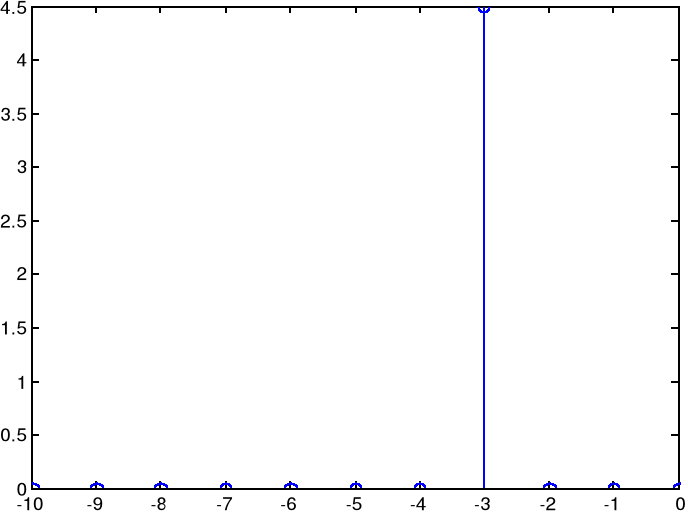
nn=(-10:0);
x4=zeros(1,11);
x4(8)=4.5;
stem(nn,x4);
b)
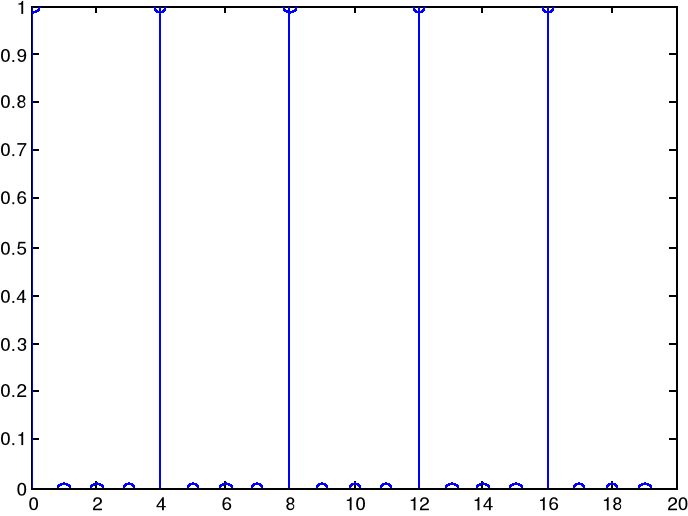
nn=(0:19);
x=[1;0;0;0]*ones(1,5);
x=x(:);
stem(x);
Ćwiczenie 1.2
a)
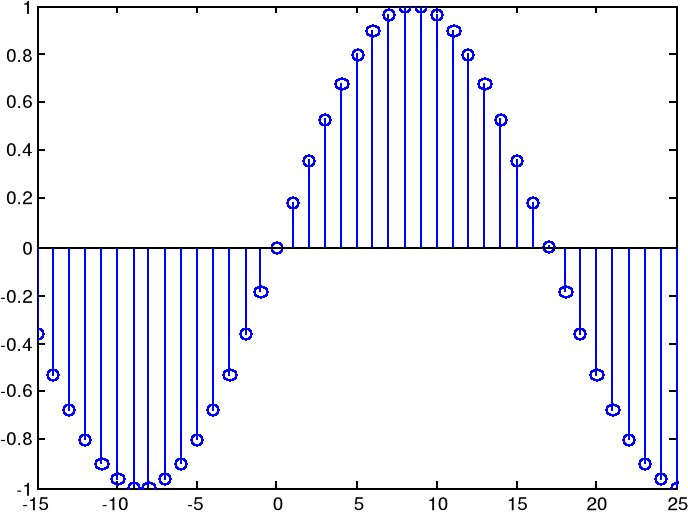
nn=(-15:25);
sinus=sin((pi/17)*nn);
stem(nn,sinus);
b)
Definicja funkcji
function [x] = moja(amp,omega,faza,pocz,kon)
nn=(pocz:kon);
x=amp*sin(omega*nn+faza);
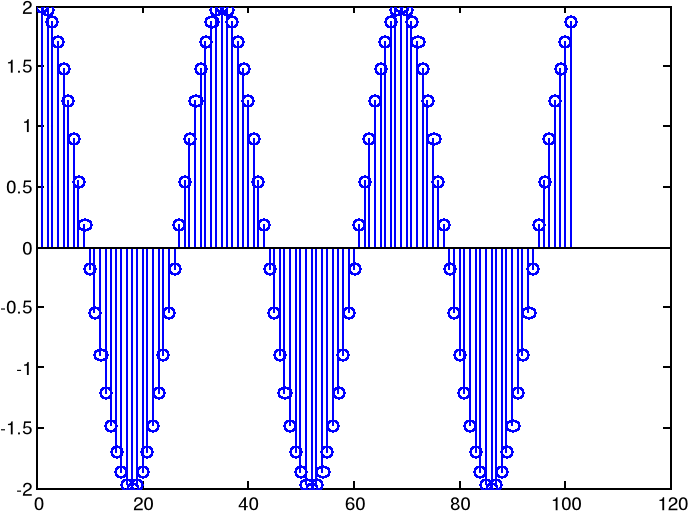
Wywołanie funkcji dla danych parametrów:
stem(moja(2,pi/17,pi/2,0,100))
Daje wykres:
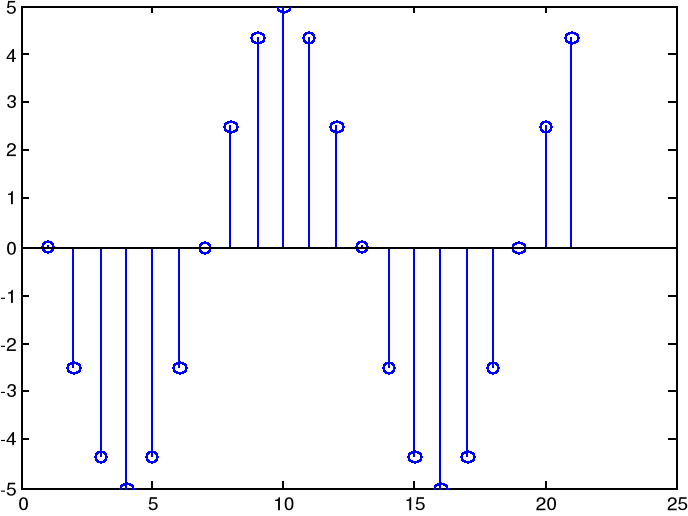
Dla
stem(moja(5,pi/6,pi,0,20))
Uzyskujemy:
Ćwiczenie 1.3
a)
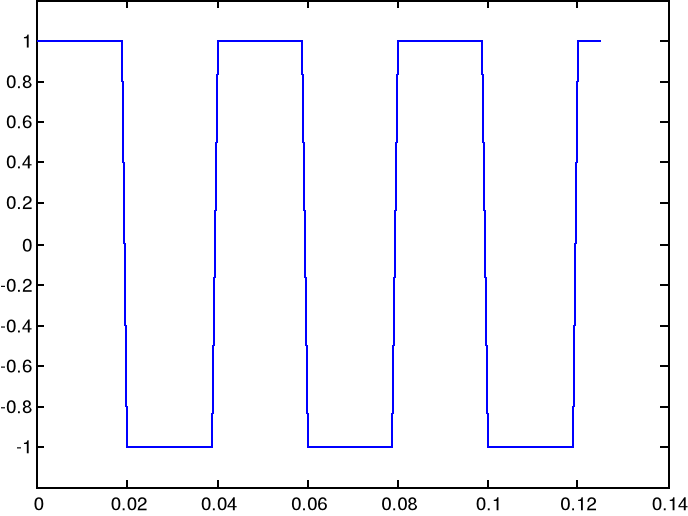
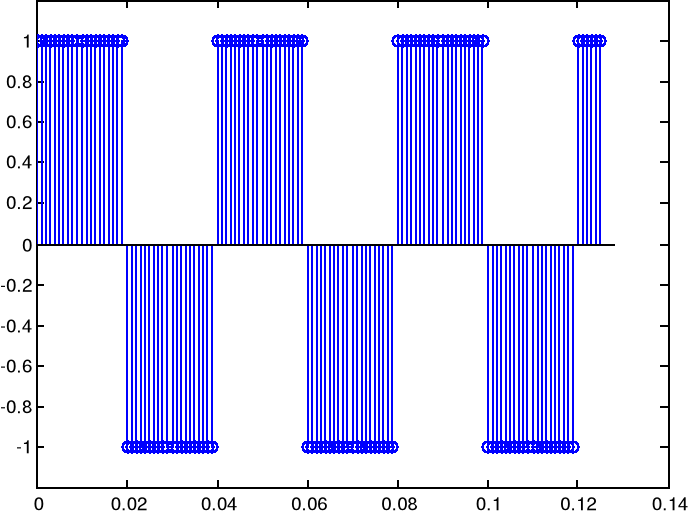
t=0:0.001:0.125;
y=square(2*pi*25*t);
efekt instrukcji plot
efekt instrukcji stem(t,y)
b)
T = 4/55;
t = 0:0.01*T:T;
stem(t,5*sawtooth(110*pi*t))
Ćwiczenie 1.4
a)
Zgodnie z instrukcją, funkcja genexp przyjmie postać:
function y=genexp(a,n0,L)
if (L<=0)
error('Dlugosc sygnalu jest nieprawidlowa')
end
nn=n0+[1:L]'-1;
y=a.^nn;
Komenda:
plot(genexp(0.8,0,20))
Komenda:
stem(genexp(0.8,0,20))
b)
Sumowanie wartości sygnału:
for r =1:21
suma = suma + t(r);
end
Wynik:
suma =
4.9424
Z użyciem wzoru:
suma1 = (1-0.8^20)/(1-0.8)
Wynik:
suma1 =
4.9424
c)
Zgodnie z instrukcją:
clear
L=20;
x=zeros(L,1);
x(1)=1;
a=[1 -0.92]
b=[1]
y=filter(b,a,x);
figure(2)
plot(y
Ćwiczenie 2.1.1
a) Zgodnie z instrukcją
t = 0:1/8000:0.01;
f0=300;
x = sin(2*pi*t*f0);
stem(t,x);
c)
subplot(2,2,1)
stem(t,sin(2*pi*t*100))
subplot(2,2,2)
stem(t,sin(2*pi*t*225))
subplot(2,2,3)
stem(t,sin(2*pi*t*350))
subplot(2,2,4)
stem(t,sin(2*pi*t*475))
d)
e)
Analogicznie do c)
Ćwiczenie 2.1.2
a)
b)
subplot(2,1,1)
stem(t,sin(2*pi*t*7525))
subplot(2,1,2)
stem(t,sin(2*pi*t*7650))
subplot(2,1,1)
stem(t,sin(2*pi*t*7775))
subplot(2,1,2)
stem(t,sin(2*pi*t*7900))