
E-MSG
MÁSTER EN SOFTWARE DE GESTIÓN DE EMPRESA
SAP R/3
2003-2004
Certificación MM (7136)
Xavier Rovira-Juan Carlos Sarrasi
TSCM 52-2ª parte (23)


© SAP AG
TSCM52
23-1
SAP AG 2002
Course: ASAP
SAP AG 2002

© SAP AG
TSCM52
23-2
SAP AG 2001
AcceleratedSAP - Overview
Contents:
ASAP Within SAP Services
Purpose, Functions, Deliverables of ASAP

© SAP AG
TSCM52
23-3
SAP AG 2001
At the conclusion of this unit, you will be able to:
Explain the relationship between SAP Services
and ASAP
Outline the purpose, functions, and deliverables
of ASAP
AcceleratedSAP - Overview: Unit Objectives
© SAP AG
TSCM52
23-4
SAP AG 2001
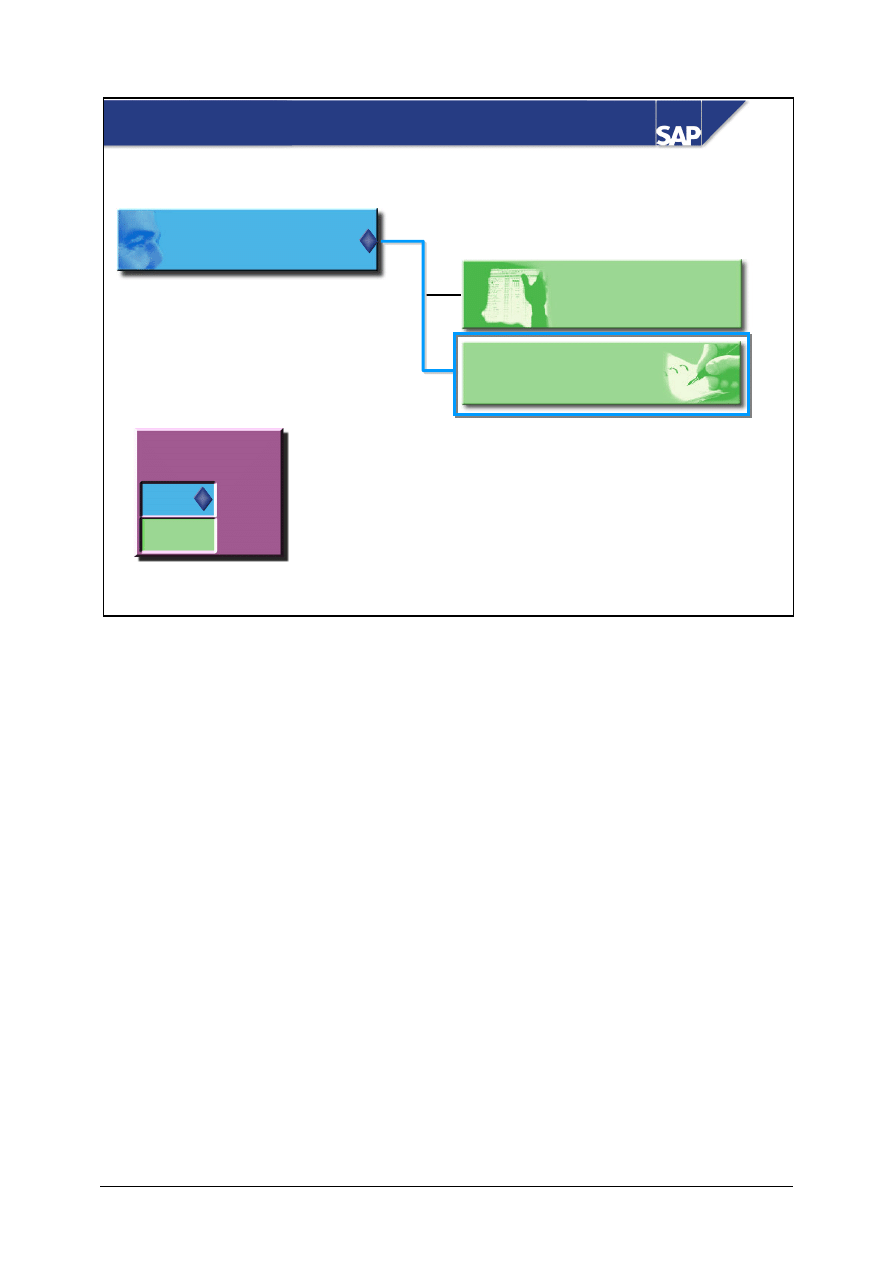
AcceleratedSAP
Overview
AcceleratedSAP Overview: Topics
Unit
Unit
Unit
Topic
Topic
Topic
Legend:
Legend:
Legend:
ASAP within
SAP Services
Purpose, Functions,
Deliverables of ASAP

© SAP AG
TSCM52
23-5
SAP AG 2001
ASAP Within SAP Services: Topic Objectives
At the conclusion of this topic, you will be able to:
Explain ASAP within SAP Services
Distinguish between the Implementation Assistant
and ASAP in R/3
Explain the need for flexibility in presenting
the content of the ASAP Roadmap
State the prerequisites that are critical to an
effective ASAP project implementation
Identify the major content and key deliverables
of each phase of an ASAP implementation project

© SAP AG
TSCM52
23-6
SAP AG 2001
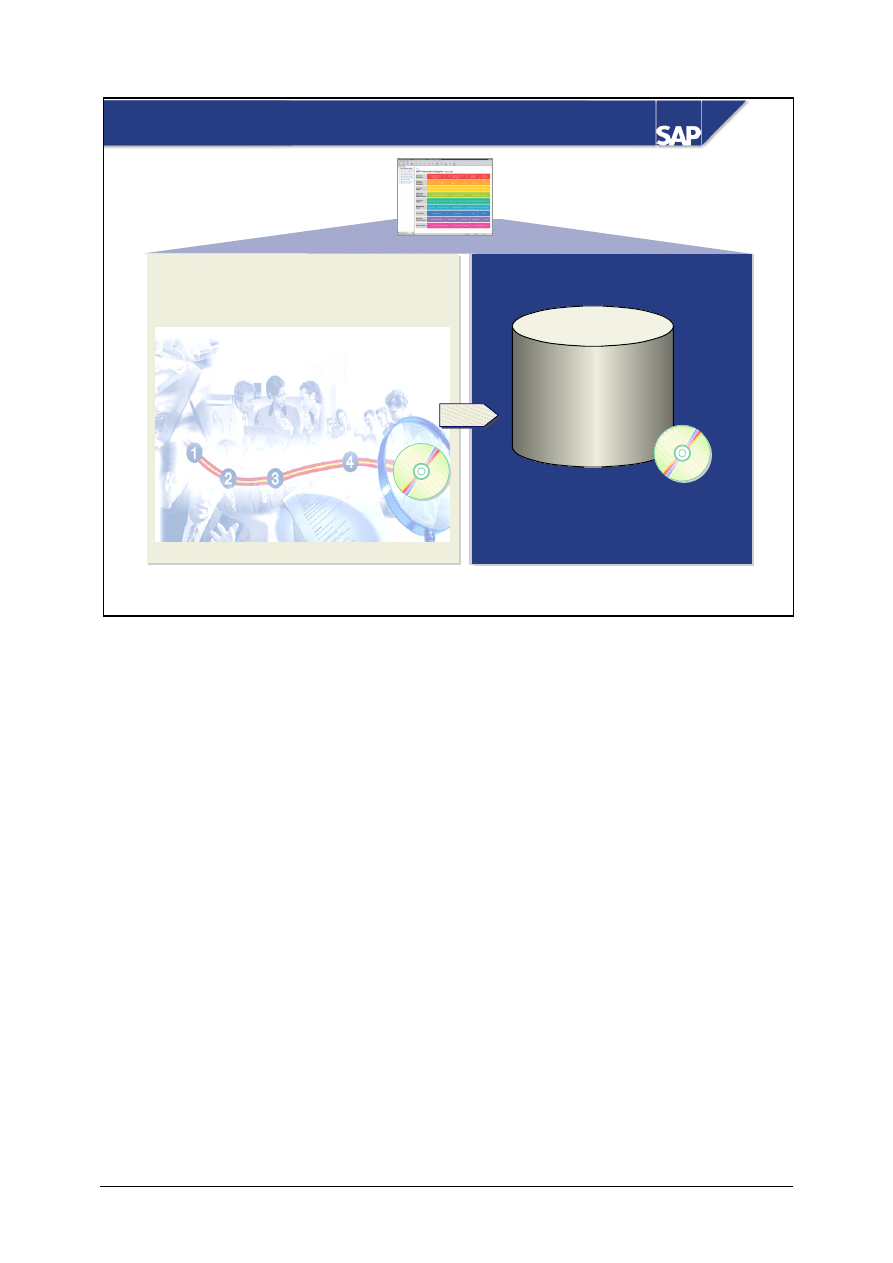
SAP Services
The SAP Services cover the entire life
cycle of a mySAP.com solution:
Discovery & Evaluation; Implementation;
Operations & Continuous Improvement
All SAP Services are listed in the
Services Solution Map.
The products listed on the right enable
the SAP Services or are the instruments
for providing the Services.
C-Business Maps
Graphical display of cross-
company business processes
and their potential for value
added
AcceleratedSAP
The SAP implementation project
methodology
Best Practices for mySAP.com
Integrated and flexible platform
for contents that provide bundled
expert knowledge in the form of
methods, documentation, and
preconfiguration for mySAP.com
solutions.
Transforms mySAP.com into a
prototype that can be run and
reused within just a few days
Services Solution Map
© SAP AG
TSCM52
23-7
SAP AG 2001
SAP Preconfigured System (PCS)
Best-in-class industry expertise built into
... with training workshop content
and end user documentation
Predefined end-to-end
Predefined end-to-end
Use of customer language
Use of customer language
AcceleratedSAP
Subset
Subset
Subset
... for all key processes
Precustomized SAP
software settings
Master data
Documentation of
configuration
Test catalogs
Pre-answered Questionnaires
Documented Business Blueprint
Industry-specific documentation
SAP Best Practices
SAP has created SAP Best Practices to package its industry expertise for your immediate access and
use. This faciliates a quicker and more effective evaluation of the SAP software, it also enables you
to train your project team. More importantly, SAP Best Practices fosters a quick and effective
implementation of the SAP software. Using SAP standardized Preconfigured Systems (PCS), you
receive comprehensive documentation on the best practices of your industry, combined with
everything you need to run these processes in a live system rapidly and with minimal effort.
Since SAP Best Practices usually anticipate between 50 and 80% of your business needs, this will
enable you to implement your mySAP.com solutions in less time, with fewer resources, and with a
lower budget than before.
SAP Best Practices comprises two ingredients. One ingredient is an industry-specific ASAP version
that contains extensive business expertise for an industry. The SAP Preconfigured System is the
second ingredient. SAP Preconfigured Systems are industry and application-specific containing
everything you need to run key or mission-critical processes in your business “out of the box”.
To order SAP Best Practices, please contact a local sales representative or the local consulting
organization.
© SAP AG
TSCM52
23-8
SAP AG 2001
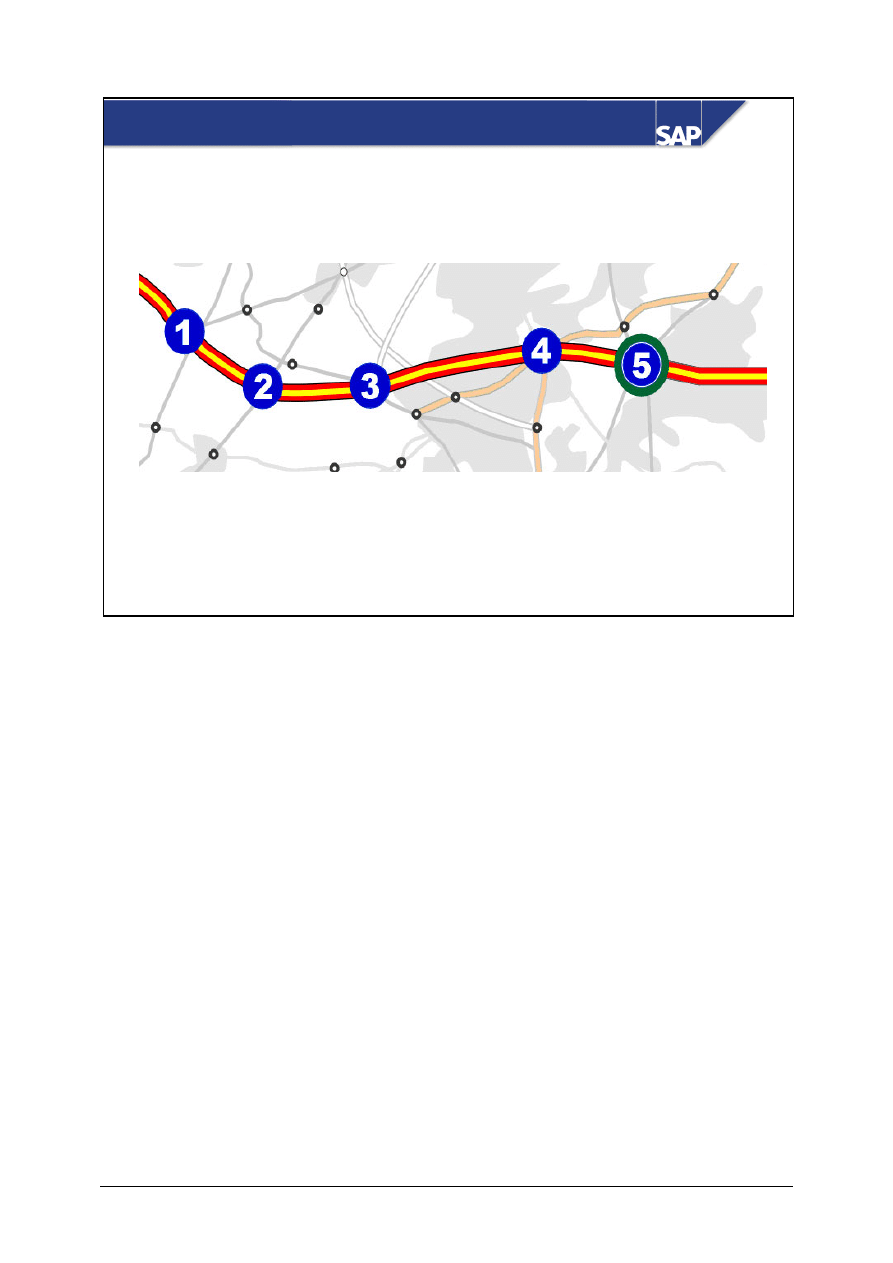
Defining the Points on the ASAP Roadmap
Project
Preparation
Business
Blueprint
Realization
Final
Preparation Go Live &
Support
•
Initial Project Planning
•
Project
Procedures
•
Training
•
Project Kickoff
•
Technical Requirements
Planning
•
Quality Check
•
Project Management
•
Organizational Change Management
•
Develop System Environment
•
Training
•
Business Organizational Structure
•
Business Process Definition
•
User Roles and Authorization
•
Quality Check
•
Project Management
•
Organizational Change Management
•
Training
•
Baseline Configuration and Confirmation
•
System Management
•
Final Configuration and Confirmation
•
Develop Programs, Interfaces etc.
•
Final Integration Test
•
Quality Check
•
Project Management
•
End User Training
•
System Management
•
System Tests
•
Detailed Project Planning
•
Cutover
•
Quality Check
•
Production Support
•
Ongoing KPI
Management
•
Project End
Phase 1: Project Preparation - The purpose of this phase is to provide initial planning and
preparation for your SAP project.
Phase 2: Business Blueprint - The purpose of this phase is to achieve a common understanding of
how the company intends to run its business within the SAP System. The result is the Business
Blueprint, a detailed documentation of the results gathered during requirements workshops. The
Business Blueprint document represents the business process requirements of the company. It is the
agreed statement of how the company intends to run its business within the SAP System.
Phase 3: Realization - The purpose of this phase is to implement all the business process
requirements based on the Business Blueprint. The system configuration methodology is provided in
two work packages: Baseline (major scope); and Final configuration (remaining scope).
Phase 4: Final Preparation - The purpose of this phase is to complete the final preparation
(including testing, end user training, system management and cutover activities) to finalize your
readiness to go live. The Final Preparation phase also serves to resolve all critical open issues. On
successful completion of this phase, you are ready to run your business in your live SAP System.
Phase 5: Go Live & Support - The purpose of this phase is to move from a project-oriented, pre-
production environment to live production operation.

© SAP AG
TSCM52
23-9
SAP AG 2001
Roadmaps and Variants
Roadmaps and Variants
Q&
Q&
Adb
Adb
Customer Solution Strategy
• R/3
• APO
• BBP
• BW
• CRM
• SEM
• The Workplace
• Knowledge Warehouse
Operations & Continuous
Improvement
Discovery &
Discovery &
Evaluation
Evaluation
Implement-
Implement-
ation
ation
Operations &
Operations &
Continuous
Continuous
Improvement
Improvement
R/3, Global
no
no
various views
various views
R/3
no
R/3
Global Template
Global Rollout
SMB & Hosting
Upgrade
Implementation
Installation Options
During ASAP installation, you can decide which Roadmap is to be installed.
The Roadmaps and relevant Q&Adb appropriate for an implementation are selected at installation of
the ASAP software. The selected Roadmaps and associated Q&Adb are then available as variants in
your installed Implementation Assistant and Q&Adb.
© SAP AG
TSCM52
23-10
SAP AG 2001
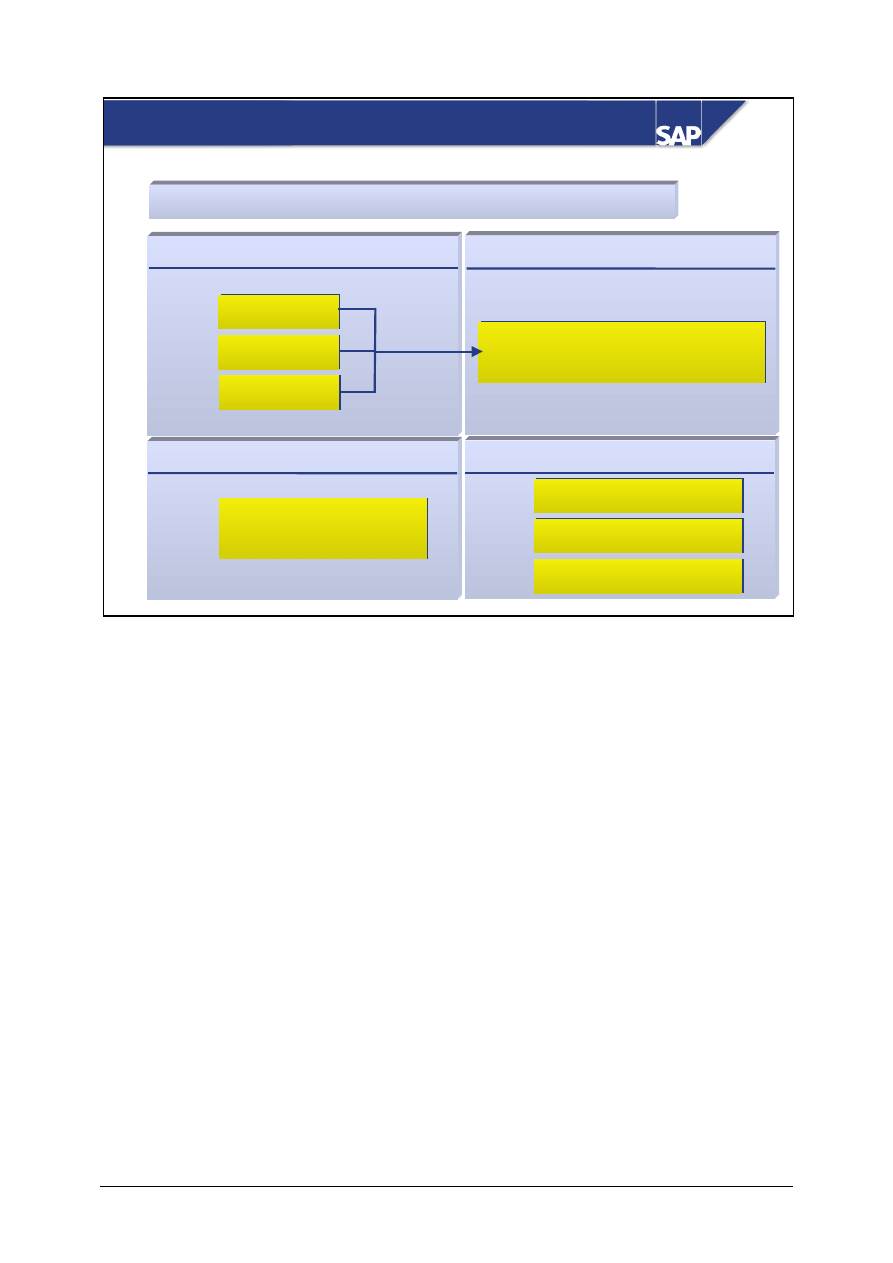
Master Lists
Microsoft Excel
Spreadsheets for
Development, Organization,
Business Processes and
Authorizations
Project
Charter
BPP
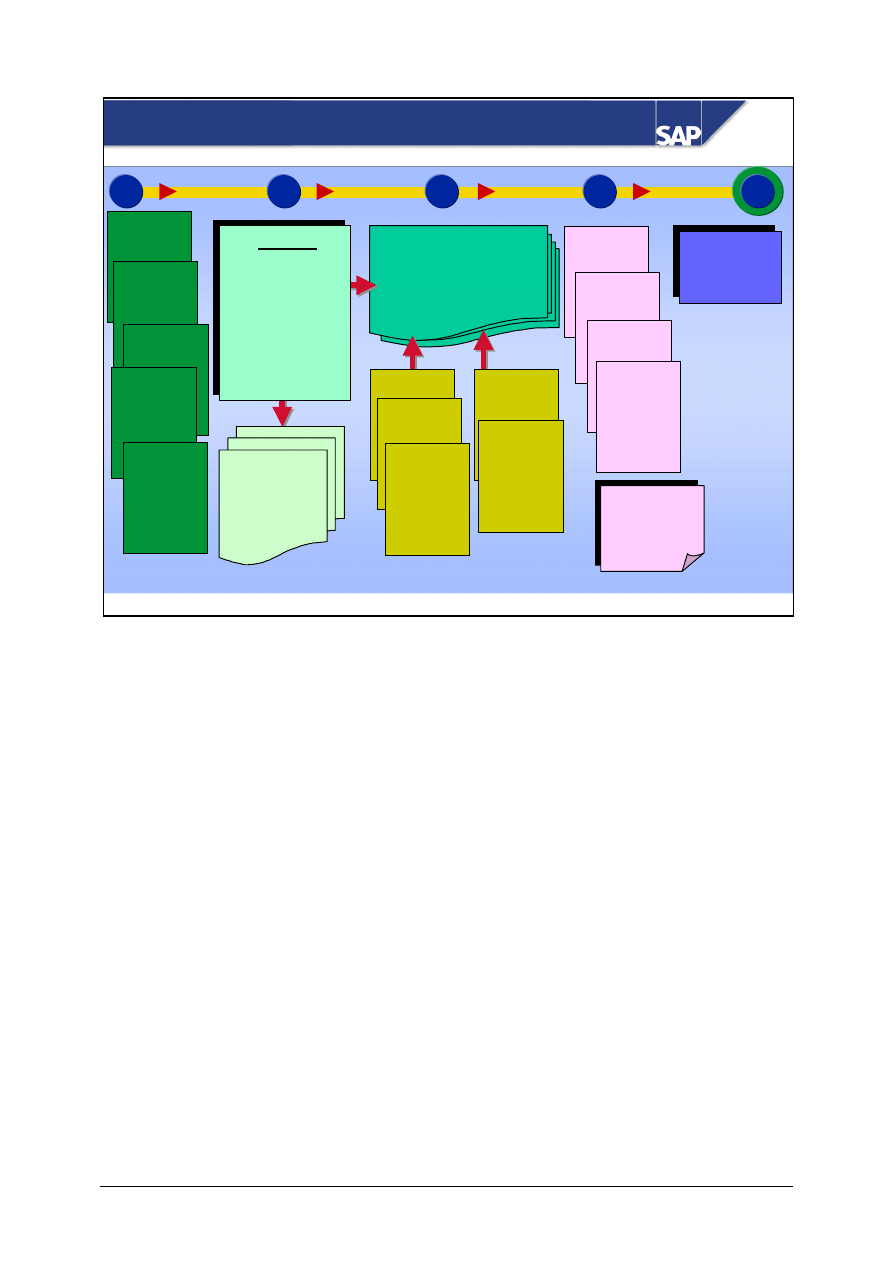
Documents of an ASAP Project
Q&Adb
Substructures:
Business Strategy
Organization
General Settings
Master Data
Business Process
Cross Application
Development
Business
Blueprint
Project
Plan
Scope
Config.
Plan
Testing
Plan
Unit testing
Test scenario
Integration
4
3
2
1
5
Cutover
Plan
Volume
Test
Stress
Test
Conduct
End User
Training
System
Performance
Review
Project
Team
Org.
Stand. &
Proced.
Technical
Operations
Manual
Progr.
Develp.
EU
Training
Material
Microsoft Word
Documents
Phase 1 - Project Preparation
Change Charter - Goals and objectives of Organizational Change Management
Project Plan - This is a first cut focusing on milestones and Work Packages; details to come.
Scope - Sets the initial definition of the project; input from sales cycle.
Project Team Organization - Sets the who of the project: Standards & Procedures - Sets the why and
how of the project.
Phase 2 - Business Blueprint - Requirements reviewed for each SAP Reference Structure item and
defined using CI Templates (in the Q&Adb). Business Blueprint - This is the output of the Q&Adb
and is the key document for Phase 3.
Phase 3 - Realization - Master Lists - Define business scenarios and R/3 transactions to be realized in
the system. BPP - Business Process Procedures representing R/3 transactions; used for unit testing &
documentation. Planning - Defines how the configuration will be done and how it will be tested.
Development Programs - Provides details of the external programming requirements. EU Training
Material - End User training material and process documentation.
Phase 4 - Final Preparation Stress & Volume Tests - Plans for confirming the production hardware’s
capabilities
Cutover Plan - The details of how to move to the production environment and go live
Conduct End User Training - Delivery of the necessary levels of R/3 End User training prior to going
live
Phase 5 - Go Live & Support: Ensuring system performance through SAP monitoring and feedback.

© SAP AG
TSCM52
23-11
SAP AG 2001
Critical Success Factors
Clearly defined and stable project scope
Only reference-based reengineering
Implementation using standard R/3 functions
Adaptable Organization
Defined Business Direction
Best People = Best Results
Whole company committed to using the ASAP Methodology
and the R/3 Business Processes:
Committed management (steering committee) and
fast decision-making
Committed, empowered project team, competent,
well-trained users and decision-makers
The project manager of an ASAP implementation must facilitate communication between team
members while directing and controlling the project.
Building a diversified team that complements the strengths of each member is very important. In
addition, the project manager should foster an environment that promotes team functioning as a
cohesive unit.
Reference-based reengineering use of SAP as the reference to conduct reengineering of the business
(adjustment/redesign/realignment of the customers own business processes and practices), and not
vice versa.
© SAP AG
TSCM52
23-12
SAP AG 2001
AcceleratedSAP Overview: Topics
Unit
Unit
Unit
Topic
Topic
Topic
Legend:
Legend:
Legend:
ASAP within
SAP Services
AcceleratedSAP
Overview
Purpose, Functions,
Deliverables of ASAP

© SAP AG
TSCM52
23-13
SAP AG 2001
Upon completion of this topic, you will be able to:
Explain the purpose of User Profiles
Explain and demonstrate what the Implementation
Assistant is and how its contents are organized
and used
Distinguish the purpose and functions of the:
SAP Reference Structure; Reference IMG; and
Project IMG
Overview the purpose of the externally linked
modeling tools
Outline the purpose and function of the tools for:
documenting an SAP implementation project; and
transporting SAP objects
Tools Available in ASAP: Objectives
© SAP AG
TSCM52
23-14
SAP AG 2001
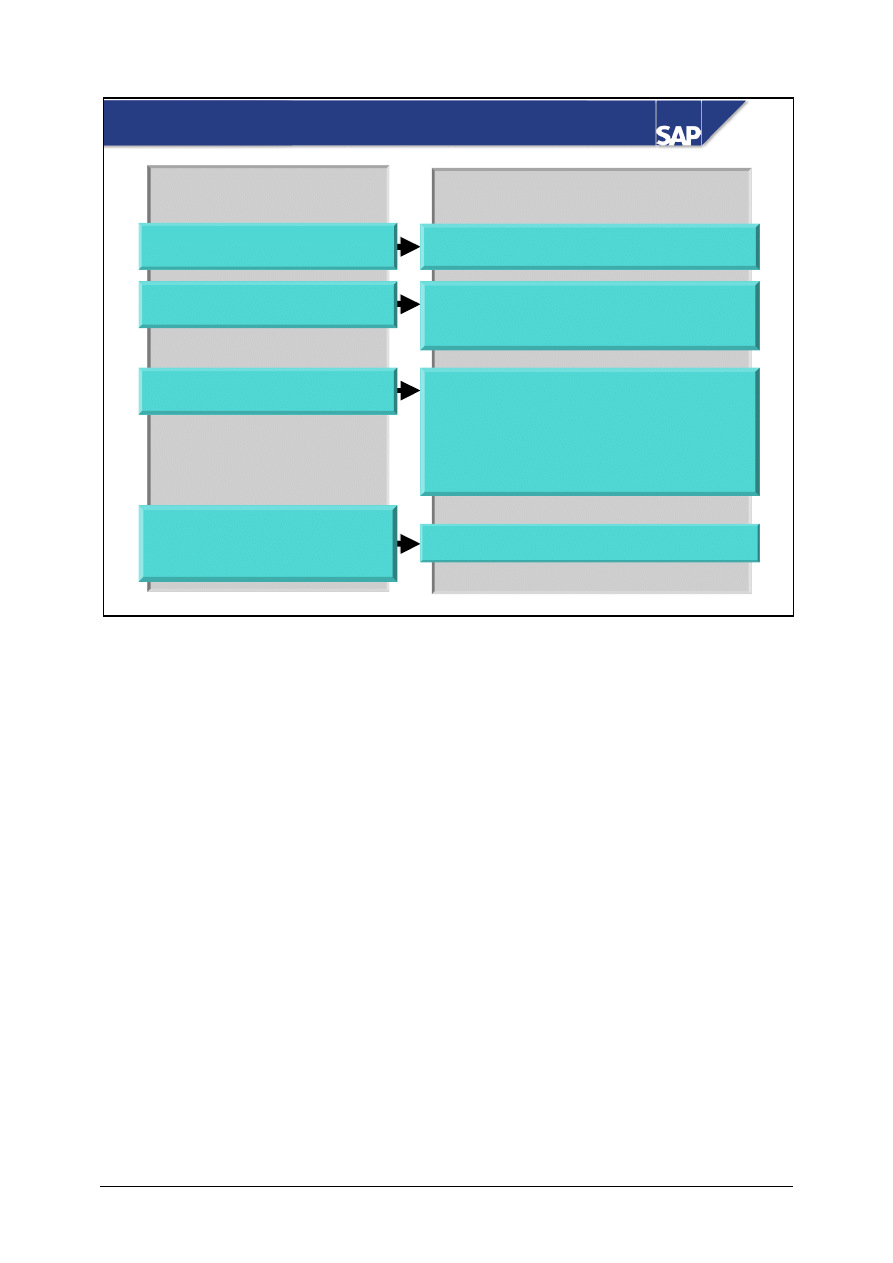
Overview
Component
Component
Purpose
Purpose
ASAP Admin Tool
Control Project Access and Database
Implementation Assistant
Roadmap - Steps to Complete Project
Knowledge Corner - Comprehensive
library of reference material
Q&Adb
Set Project Scope
Document Business Requirements in
Detail
Create a Business Blueprint Geared to
the Enterprise
Project-IMG
Transport
BC-Sets
Customizing in R/3
In notes of this slide indice Q&Adb refers to Question and Answer Database, Project IMG means
project implementation guide and BC-Sets refers to Business Configuration Sets
© SAP AG
TSCM52
23-15
SAP AG 2001
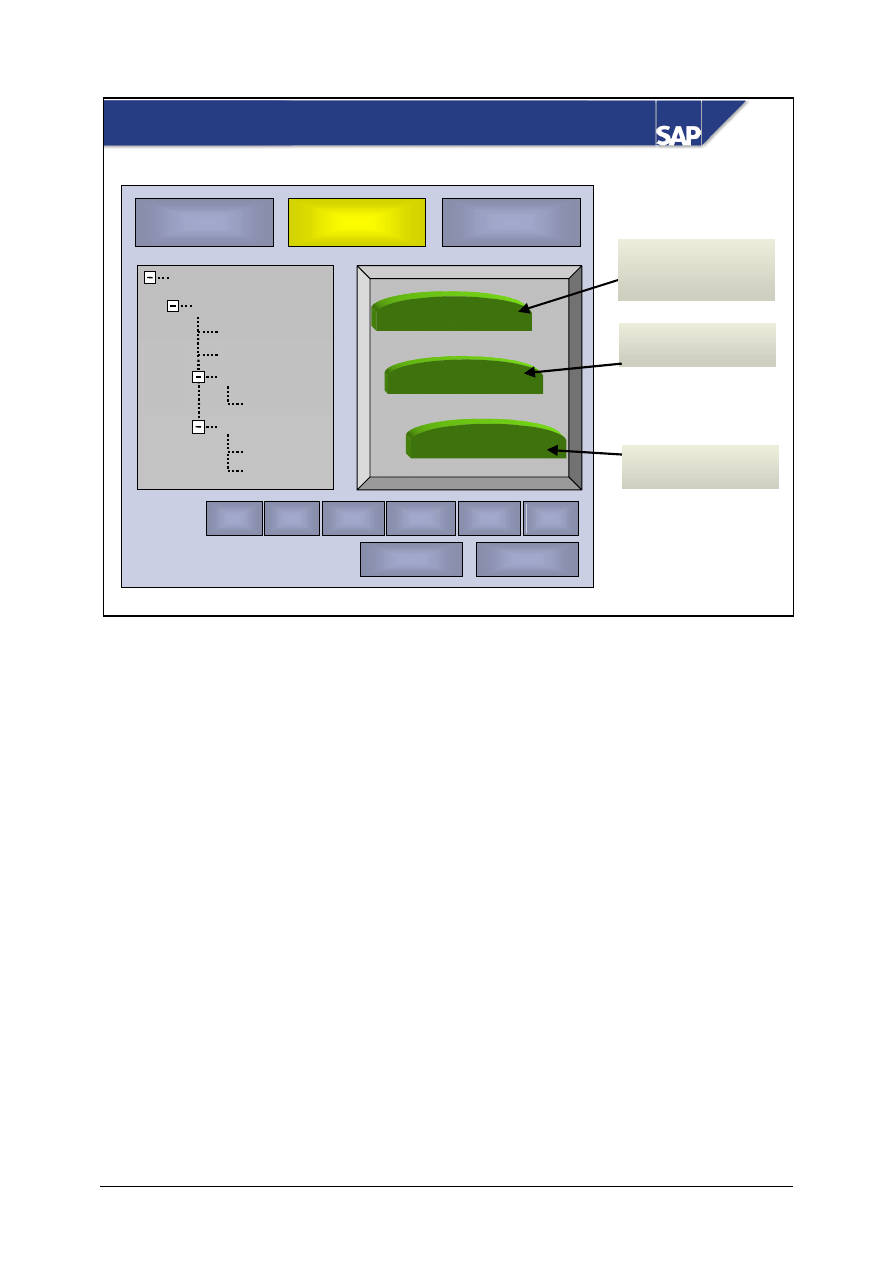
ASAP Administration - User Maintenance
Project
Project
Maint
Maint
.
.
User
User
Maint
Maint
.
.
New Session
New Session
Exit
Exit
Cancel
Cancel
Save
Save
Copy
Copy
Delete
Delete
Add
Add
f
f
ügen
ügen
Edit
Edit
General User Information
Q&Adb
R/3
Specify ownership
categories:
Database
Database
Maint
Maint
.
.
R/3 connection
parameters
User identification
and information
fields
Owner (Customer)
Consultant
ASAP 4.6C (Training)
All Projects on Server XXXXX
Team Members
Team Leaders
Smith
Project Managers
asap
sap
Read-only
One project is highlighted on the User Maintenance screen.
Depending on your access level and the access level of the user you wish to maintain, each of the
buttons or some parameters and data within a user profile may not be accessible to you. Once a User
ID is saved for a user, it can never be edited. See Determining ASAP Administration Tool User
Access Level in the Help File for more information.
General User Information - Clicking this tab displays the user identification and information fields.
The fields displayed and active (not grayed out) differ according to your access level and the
function you selected. Some fields are for information only, others are mandatory for user access and
authorization. The mandatory fields to enter a new user are User ID, Access Level, Password, and
Confirm Password.
The Q&Adb screen contains two radio buttons that allow you to specify the ownership category you
belong to in the project. The options are Owner (Customer) or Consultant. In addition, there is a
selection field that allows you to select a Business Modeler from a list of modelers. Some viewing
tools come with the Q&Adb installation package, others have to be purchased separately.
© SAP AG
TSCM52
23-16
SAP AG 2001
IA Overview
Project Area
Viewing Area
Holding Area
Attachment Area
AcceleratedSAP Implementation Assistant (IA)
Displays Documents
from Project Area
Displays Documents
from Project Area
Roadmap
Roadmap
KC
KC
Find
Find
Favorites from
Project Area
Favorites from
Project Area
Links
Links
Roles
Roles
Subjects
Subjects
The AcceleratedSAP (ASAP) Implementation Assistant (IA) provides the Roadmap methodology for
your SAP implementation. It will point you to associated services and tools as appropriate. The
Q&Adb can also be accessed directly from the IA.
After logon to the IA, the initial Roadmap main screen is displayed. This is divided into four
function frames:
The project area:
- Selecting the Roadmap tab displays a tree view of Roadmap phases. The Roadmap is structured
into five phases. Each phase is sub-divided into Work Packages. A Work Package comprises
Activities, and each Activity is made up of a number of Tasks.
- The KC (Knowledge Corner) tab displays a tree structure of documents that are available to
provide you with information relevant to SAP processes and usage.
- The Find display allows you to search for specific documents within the Roadmap.
The Viewing Area: When you click on a document in the Project area, the document displays in
the viewing area frame.
The Attachment Area: This Area displays links to accelerators, roles and subjects associated with
the displayed Phase, Work Package, Activity, or Task.
Holding Area: This Area serves as a holding area for your “favorites.” You can drag from the tree
structure & drop here your frequently used documents for ease of access. You can also save links
to often-used pages.
© SAP AG
TSCM52
23-17
SAP AG 2001
IA: Menu and Toolbar
Previous
Previous
Next
Next
Q&Adb
Q&Adb
Filter
Filter
Roadmap
flavors...
Roles...
Subject
areas...
Roadmap
scope...
Options
Options
Hide:
Holding area
Attachment
area
Project area
Collapse
Collapse
Expand
Expand
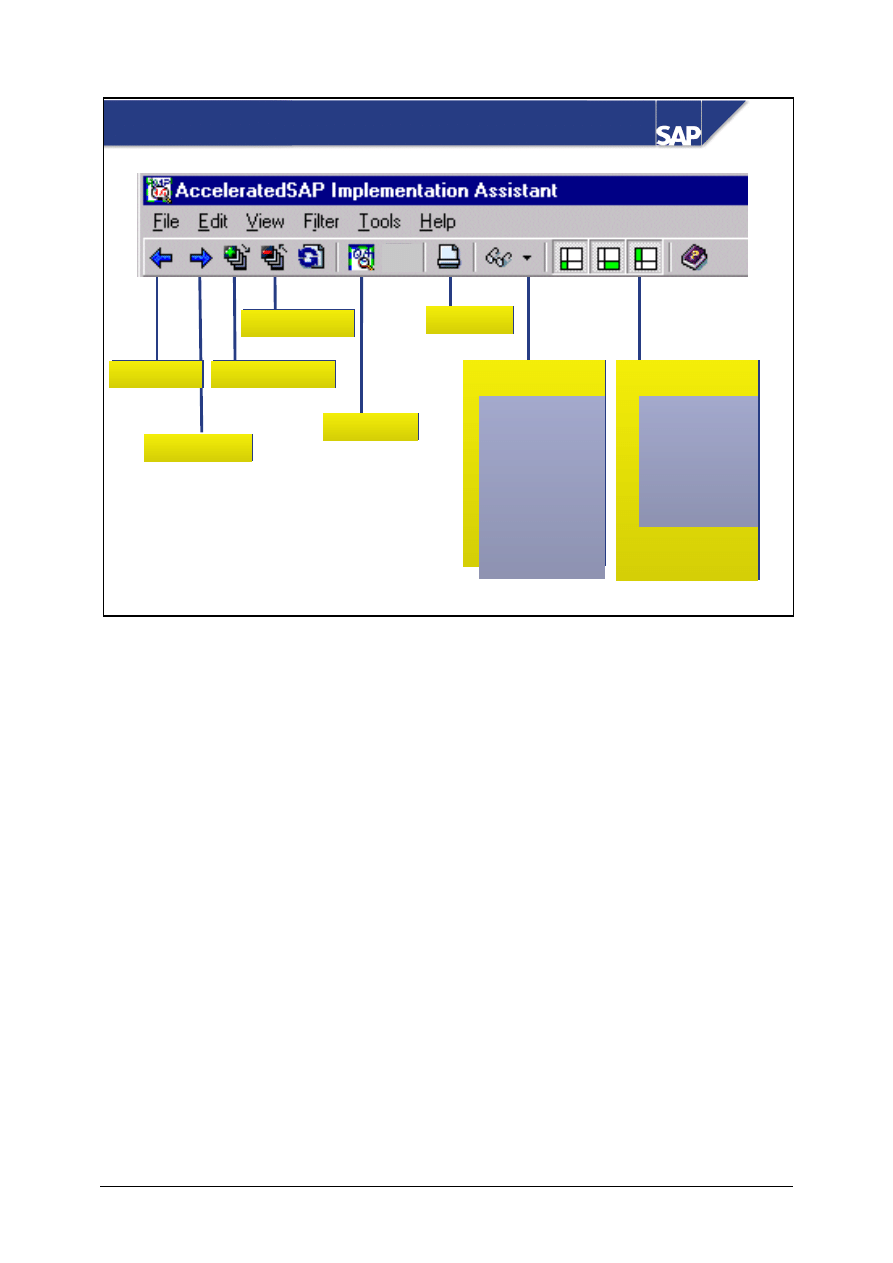
The menu and standard toolbar, located on top of the main screen, provides you with navigational
functionality.
Menu:
Click File ->Exit to close and exit the Implementation Assistant.
Click View to select options to hide frames of the IA display window you do not wish to display at
the moment.
Click Filter to display contents by role or by subject area. Click Tools to open the Q&Adb or the
Concept Check Tool (CCT) in separate windows and toggle between them and the Implementation
Assistant. Select Help to launch a separate window displaying the contents of help available for
Implementation Assistant functions.
Standard Toolbar:
The Previous and Next buttons allow you to navigate either back to the previous Roadmap level or
forward to the next level. The QA (Question & Answer database) button launches the Q&Adb in a
separate window. The CCT button launches the concept check tool. This tool can be used to analyze
the conceptual and critical factors in the Project Preparation, Business Blueprint and Realization
phases of an SAP implementation project. The Print button prints the Roadmap description currently
selected in the content area. The Filter button allows you to specify role or subject area criteria -
which will then be used to tailor the Roadmap content displayed. This button also allows you to
display the structure items of one or several Roadmap variants by selecting one or more Roadmap
flavors from a list. For example, you can set a filter to display only the Roadmap steps that are in
scope.
© SAP AG
TSCM52
23-18
SAP AG 2001
IA Project Area: Roadmap
AcceleratedSAP Implementation Assistant
Roadmap
Activities
Tasks
Work Packages
Phase
l
Steps
l
Accelerators
l
Prerequisites
l
Accelerators
l
Purpose
l
Purpose
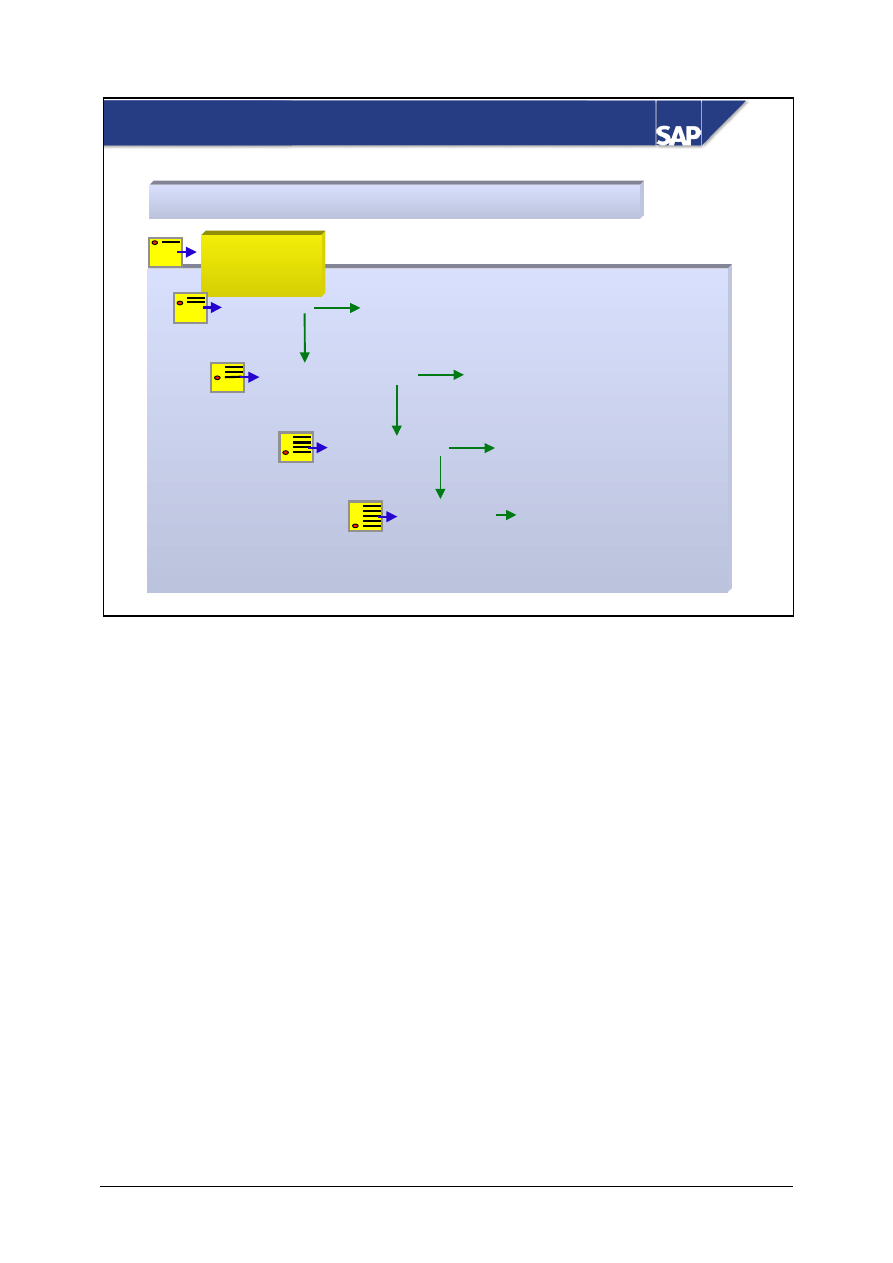
Selecting the Roadmap tab displays a tree view of Roadmap phases. Clicking the plus (+) symbol on
the left side of each phase displays the Work Package, Activity, and Task icons and titles for documents
available for that particular phase.
© SAP AG
TSCM52
23-19
SAP AG 1999
IA Project Area: Roadmap Additions and Scoping
AcceleratedSAP Implementation Assistant
Roadmap
Activities
Tasks
Work Packages
Phase
Edit Filter
ADD
...
Structure item
...
...
Roadmap
Scope
InScope
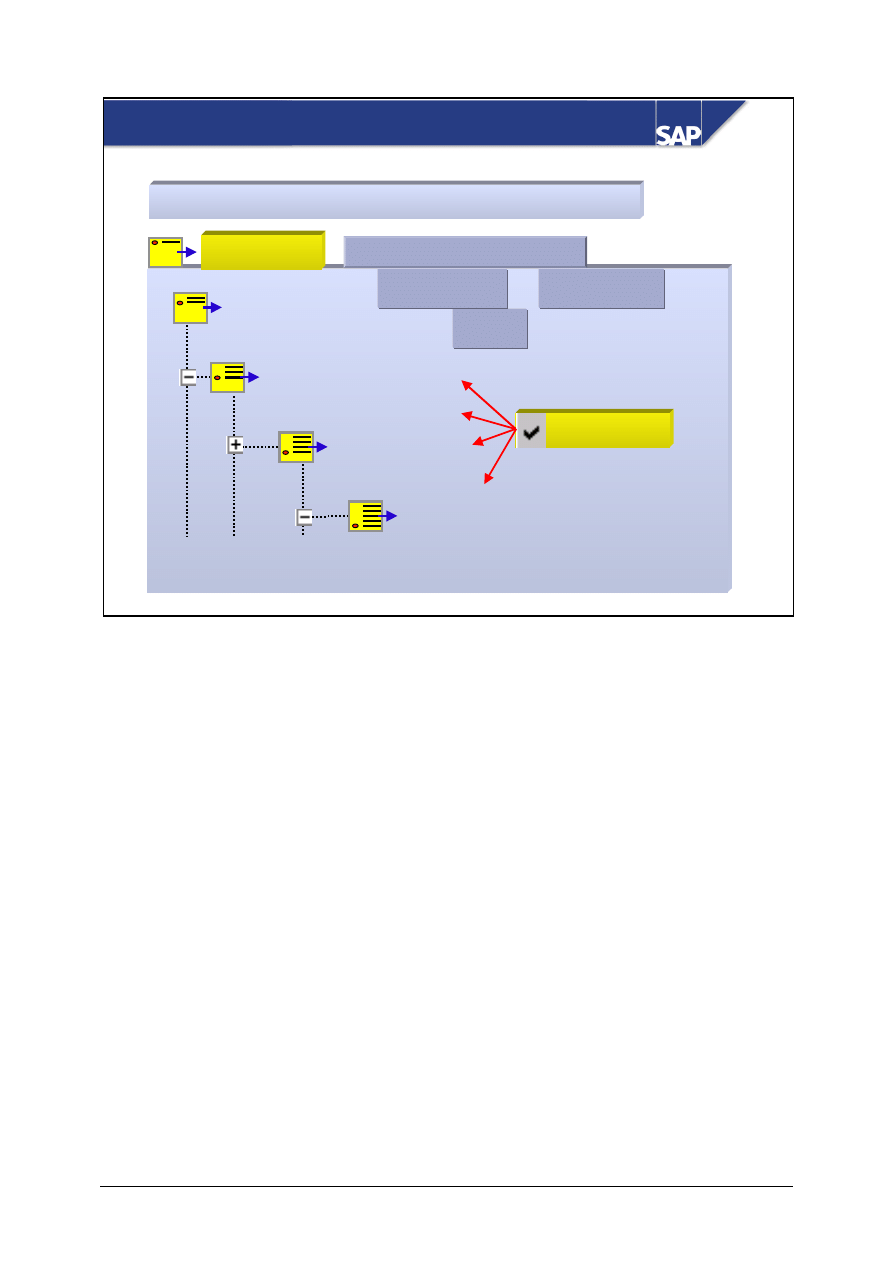
Edit Roadmap Structure Items: It is possible to „scope“ and add new items to the Roadmap
structure, so that the Roadmap can be tailored to project-specific requirements. Only the project
manager can add or hide elements of the Roadmap.
Setting Roadmap structure items in scope: SAP-delivered and user-defined items can be set out of
scope.
Adding new Roadmap structure items: For new user-defined Roadmap structure items, it is possible
to assign the following attributes: Roadmap flavors (such as R/3, APO), Role (such as Business
Process Team Lead), Subject area (such as Testing) and Scope.

© SAP AG
TSCM52
23-20
SAP AG 2001
IA Project Area: Knowledge Corner
AcceleratedSAP Implementation Assistant
KC
Industry Corner
SAPNet Links
Service Corner
SAP Products Corner
Country Corner
Cross SAP Topics
The KC (Knowledge Corner) tab displays a tree structure of available information of SAP processes
and usage.

© SAP AG
TSCM52
23-21
SAP AG 2001
IA Find
Find
Limit search to file type
Roadmap
Knowledge Corner
Limit search to
document type
BBP
Checklist
How
to
Type in the word(s)
to search for:
Title File Type
Options
Find Tool: The search function located on the Find tab of the Implementation Assistant enables you
to quickly and easily find information stored in Roadmap texts, accelerators (formats: Microsoft
Word, Excel, PowerPoint, .txt, .rtf, .htm) and the Knowledge Corner.
You can search for individual terms (for example, "workflow") or for a combination of terms (for
example, "batch input"), and you can use an asterisk to denote “any instance of“ or “all“ (for
example, "work*") will check for anything beginning with the word “work“.
Via the Options button, you can specify the search more closely. In the box Limit search to file type,
you can specify the areas to which the search is to be limited. If you want to limit the search to Find
in Title, you can also select a combination of various areas for the search:
Roadmap topic, Roadmap accelerator, Knowledge Corner topic, Knowledge Corner attachment
In the box Limit search to file type, you can select several types of documents, such as manuals,
presentations, checklists.
In the box Limit search to document owner you can make the following settings: SAP, in order to
include only SAP-delivered documents in the search. Customer, in order to include only customer-
specific documents in the search. You can set the indicator Limit search to scope in Roadmap/KC in
order to limit the search to documents in scope for the Roadmap or the Knowledge Corner (in filter).
Start the search by clicking on the Find button. If the search takes too long, you can use the Stop
button to interrupt it.

© SAP AG
TSCM52
23-22
SAP AG 2001
IA: View
Filter
Filter
Roles...
Subject
areas...
Application Consultant
Business Process Owner
Business Process Team
Leader
Business Process Team
Member
Change Team Leader
Change Team Member
Cross-Application Expert
Customer Project Manager
….
Project Sponsor
SAP Consulting Manager
TeamSAP Project Manager
SAP Reviewer
SAP Tech. Consultant
Manager
Steering Committee Member
System Administrator
Technical Consultant
Training Coordinator
Conversions, Interfaces,
Enhancements
Business Organization and
Processes
Configuration
End User Training and
Documentation
Organizational Change
Management
Project Standards
Project Team Training
Quality
Reporting, Forms
Services
System Management
Testing
Development
Authorization
Filter: Roles
Filter: Subject Areas
Note: Not all roles or subject areas are
shown
The Filter button allows you to specify role or subject area criteria, which tailors the content to be
displayed in the roadmap.
The filters consider the chosen Roadmap flavors.

© SAP AG
TSCM52
23-23
SAP AG 2001
ASAP - Reference Structure
Methodology
Methodology
ASAP Roadmap
Project
Preparation
Business
Blueprint
Realization
Final Preparation
Go Live &
Support
Com-
ponent
oriented
Com-
ponent
oriented
Process
oriented
Process
oriented
Q&A database
- SAP Reference
Structure
ASAP in R/3
- Reference
Implementation
Guide (IMG)
The SAP Reference Structure in the Q&Adb is a business process representation of the R/3 System.
This provides an important communication means for all who are involved in an R/3 implementation
project in a company.
Why use the SAP Reference Structure?
It helps you to get to know more easily the functions and processes of the R/3 System.
It reduces the risks and effort involved in the requirements analysis and in setting up the
conceptual design.
To set the scope of the business process requirements and thus for R/3 customizing required.
In addition to the SAP Reference Structure in the Q&Adb, there is also another representation of the
R/3 system provided in the R/3 system itself. this is R/3 software component oriented rather than
business process oriented, and is used for customizing. The structure here is the Reference IMG. It
contains all Customizing activities needed to customize the R/3 System.
The SAP Reference structure is most important in requirements gathering in the Business Blueprint
phrase. The Reference IMG is then used in the Realization phase to customize the R/3 system as
required to “translate” business requirements defined and agreed in the Business Blueprint phase.
© SAP AG
TSCM52
23-24
SAP AG 2001
+
+
Development
Basis Components
+
Training and Documentation
+
User Roles
SAP Reference Structure: Process View
+
+
+
+
+
SAP Reference Structure
Cross-Application Components
Business Processes
Master Data
General Settings
Organization
+
mySAP.com
+
KPI
+
Business Strategy
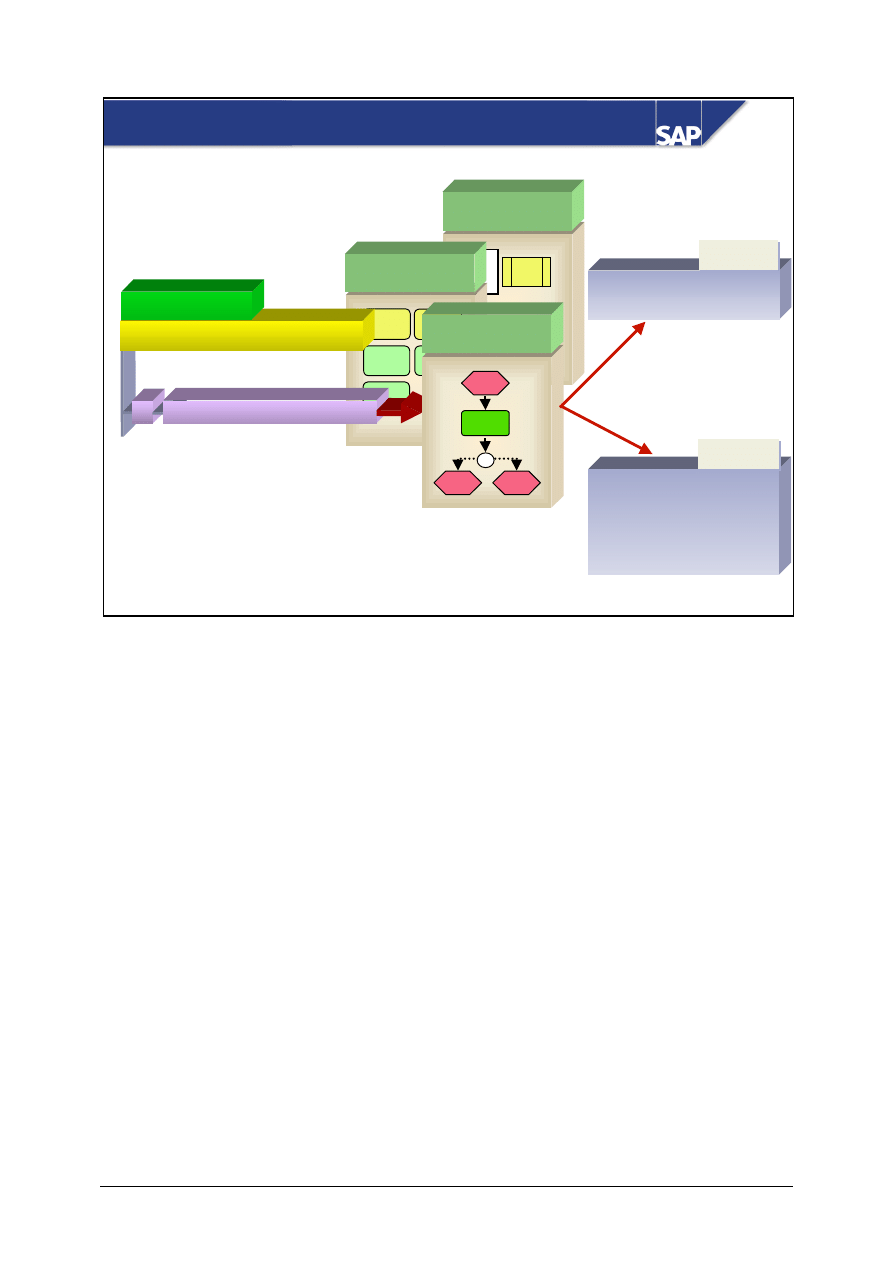
The SAP Reference Structure is a hierarchical structure containing all the elements that you need to
create your Business Blueprint. It contains substructures with structure items such as enterprise
areas, scenarios, process groups, processes and objects. These structure items are in turn assigned
associated items, such as questions, IMG activities and organizational units.
The SAP Reference Structure helps you to identify and select your enterprise’s specific needs from
the available SAP functions. These can then be mapped to your SAP System.
© SAP AG
TSCM52
23-25
SAP AG 2001
KnowledgeMap
KnowledgeMap
Matrix
Matrix
SAP Reference Structure: Graphical Representation
SAP Reference Structure
+
Business Processes
Q&Adb
EPC
EPC
Aris for R/3 (IDS)
ERP Modeler (CASE wise)
Live Model (Intellicorp)
Diagram Explorer
Delivered
with
ASAP
change
change
display
display
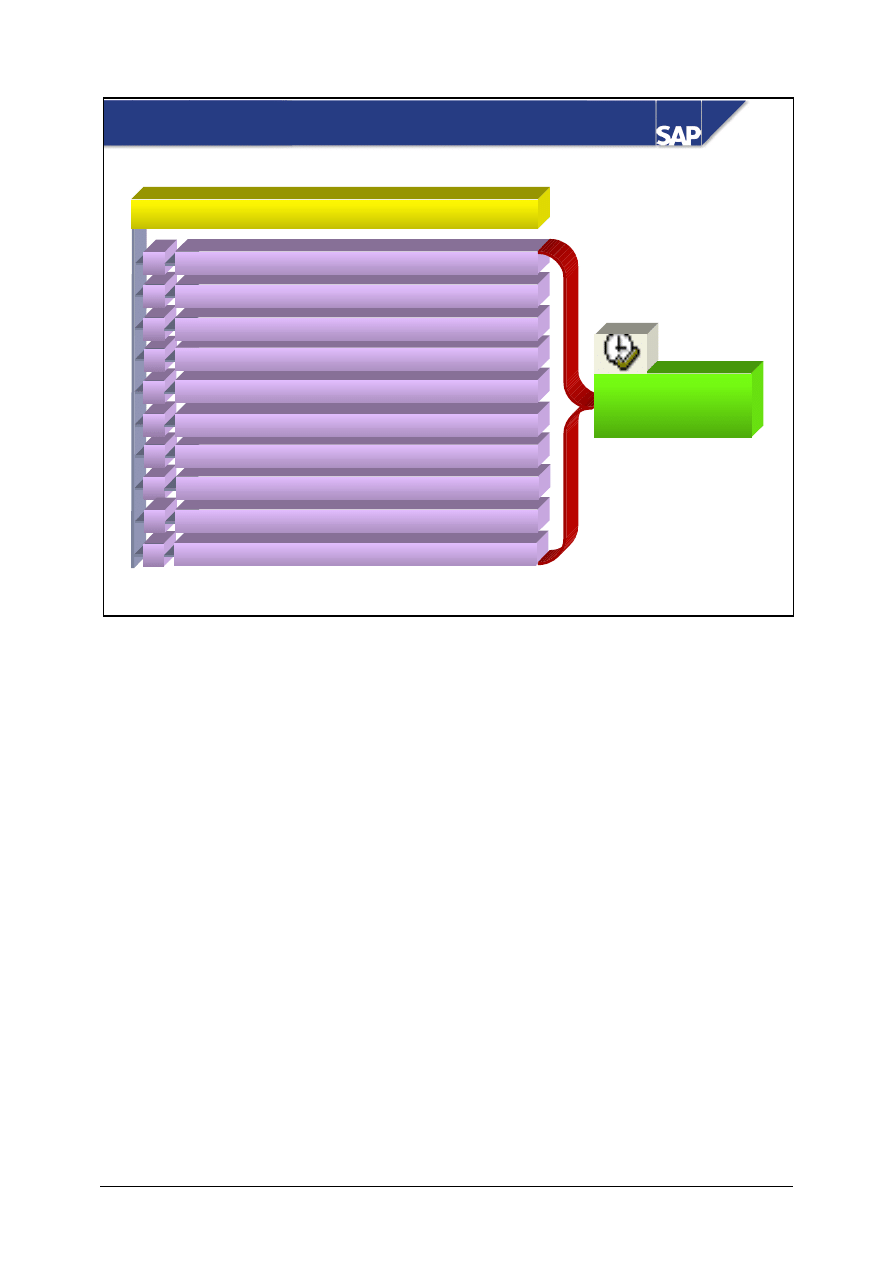
In order to perform a qualified gap analysis, enterprises may have to document the requirements that
are not included in the standard solution in the form of a model. These models can be created using
the modeling tools of SAP's technology partners and used as templates for customer developments.
Options you have for launching diagrams:
Diagram Explorer delivered by SAP
A modeling tool (which you purchase and install separately)
During ASAP installation, you have the option to install the Diagram Explorer provided on the CD.
Before launching diagrams, you need to specify in your user profiles which modeling tool you are
going to use.
© SAP AG
TSCM52
23-26
SAP AG 1999
+
SAP Reference IMG
+
+
+
+
+
+
+
+
Implementation Guide for R/3 Customizing
+
Basis Components
...
Quality Management
Materials Management
Logistics - General
...
Financial Accounting
Cross-Application Components
Enterprise Structure
Global Settings
Customizing
Activities
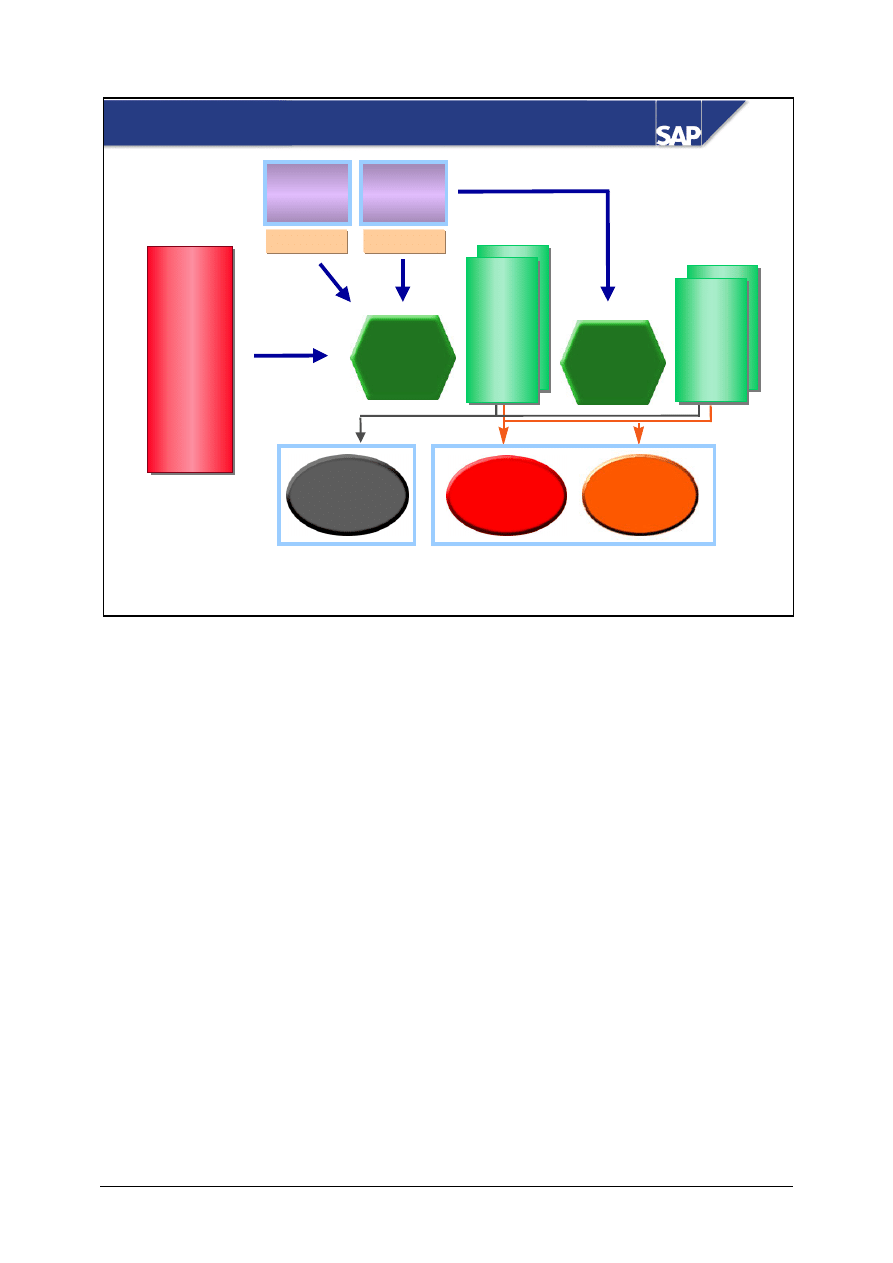
The Reference IMG (component view) contains all the Customizing activities defined in the R/3
System.
© SAP AG
TSCM52
23-27
SAP AG 1999
Customer Specific Configuration of the IMG
Project
IMGs
Project
IMG
Views
Customizing
Transactions
Project
Documentation
Project
Management
SAP
Reference
IMG
Generate
Project IMG
Views
Customizing
Projects
Manually
Generate
IMG Link
Save
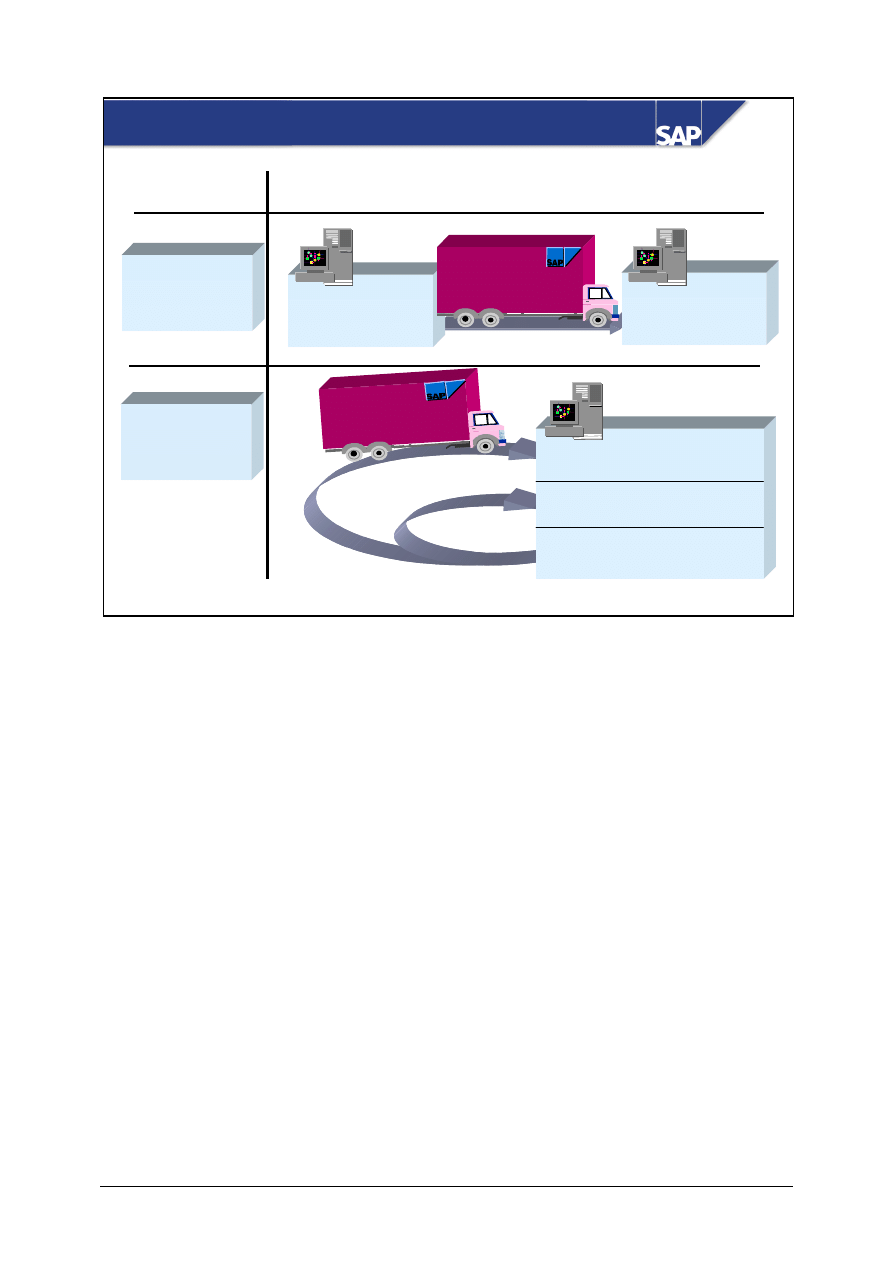
For the realization, you can divide the scope of the Reference IMG into different projects, which are
assigned in turn to individual Project IMGs.
Once created, the Project IMG is populated to produce one or more “views”. You can create views to
specify how your Project IMGs are structured. You use the Project IMG to work on Customizing
transactions, project and cross-project documentation, as well as project management information.
Do this for each view and/or all views combined.
With Release 4.6, you can create Project views via the IMG link. This functionality transports the
Project Scope which is defined in the Question and Answer database (Q&Adb) to the R/3 System.
The views generated by the IMG link contain the Customizing activities assigned to the processes
that have been put in scope in the Q&Adb.
The IMG link does not create a Project IMG. This must be created beforehand in the R/3 System.
The IMG link is used to generate and view processes which are assigned, processes which are not
assigned, or entire Project IMG views of existing IMG projects.
© SAP AG
TSCM52
23-28
SAP AG 2001
Transporting IMG Settings
SAP
System
Development
Customizing
SAP (Targ.)
System
Production
SAP
System
Client
zxx
zxx
Client
yxx
yxx
Client
xxx
xxx
XXX
Development
Customizing
Training
automatic
system setting
recording
automatic
system setting
recording
automatic
system setting
recording
automatic
system setting
recording
Tool
Transport
Management
System
Client
Copy
Function
The Change and Transport System (CTS) manages the transport requests in the R/3 System in
relation to an assigned Customizing Project.
In the Transport Mánagement System (TMS), you can use the transport requests to copy SAP
objects from one system, such as the development system, to a target system, such as the
production system.
You can also use the client copy function to copy SAP objects from one client (e.g. development
client) to another client (e.g. training client) of the system as defined by a transport request.
The system settings of the Customizing transactions are automatically recorded in transport requests.
It is assumed that the client has been set correctly.
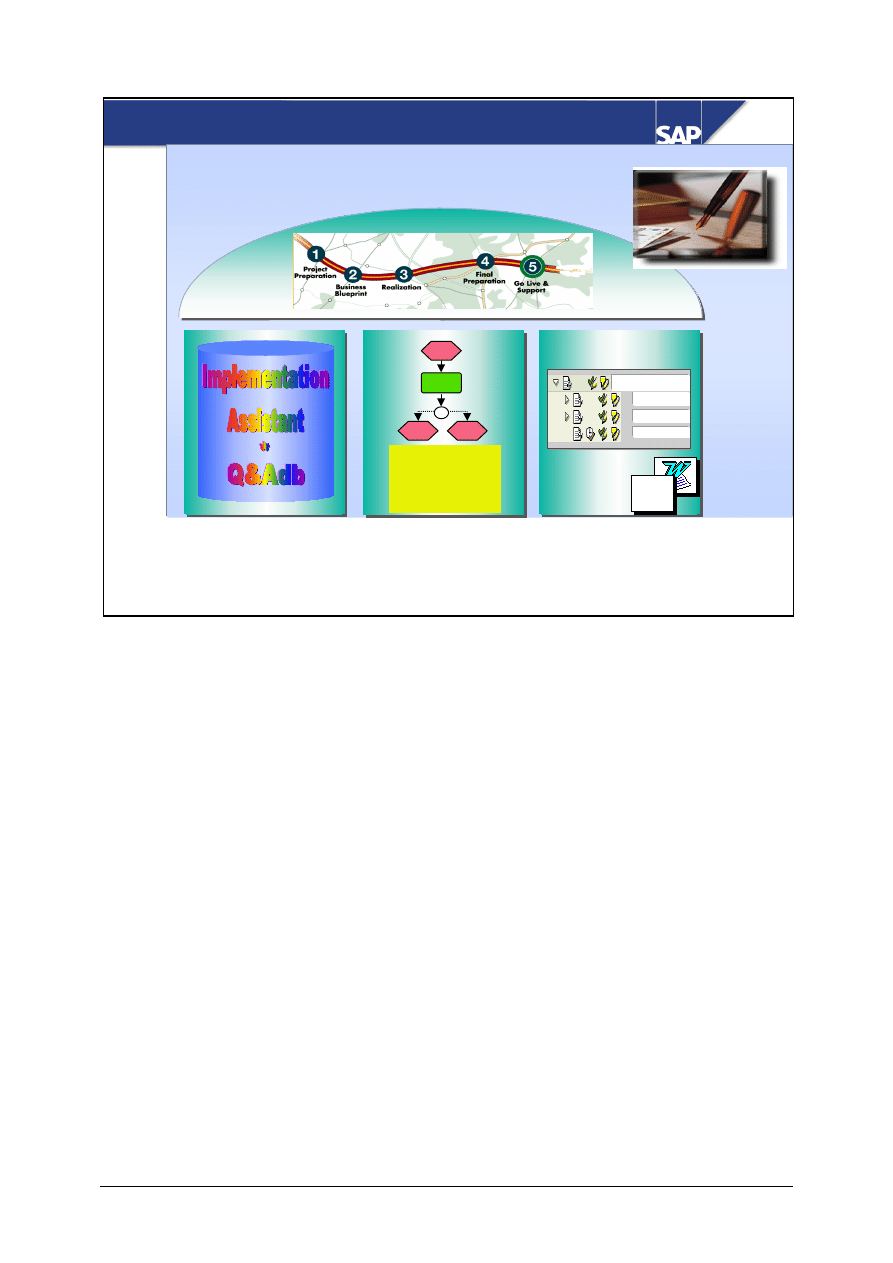
© SAP AG
TSCM52
23-29
SAP AG 2001
Tools for R/3 Project Documentation
Business Navigator
SAP
script
IMG
Fiscal year
...
...
Financial accounting
Diagram Explorer
(Intellicorp)
External modeling tools
for graphical process
modeling
ASAP Roadmap
With the documentation for the ASAP Roadmap, SAP provides information about which
documentation tools can be used for which project activities.
The following tools are provided for the R/3 implementation:
Implementation Assistant (e.g. Q&Adb, Issue DB) for request analysis, problem documentation
and end-user and Project documentation
External modeling tools for graphical process modeling
IMG Documentation for Customizing settings:
- Microsoft Word or SAPscript editors are used for documenting the Customizing settings
- Forms are available for Microsoft Word documentation
- It is possible to create multiple documents for each setting
- The documentation is:
Cross-client
Transportable

© SAP AG
TSCM52
23-30
SAP AG 2001
Describe ASAP within SAP Services
Outline the purpose, functions, and deliverables of
ASAP
You are now able to:
AcceleratedSAP Overview: Unit Summary

© SAP AG
TSCM52
23-31
Exercises
Unit: AcceleratedSAP Overview
Topic: Implementation Assistant
At the conclusion of this exercise, you will be able to:
• Navigate the Implementation Assistant
You understand the purpose and function of the ASAP
Implementation Assistant and now need to practice navigating its
structure in preparation to bringing to bear ASAP methodology on
to your SAP implementation project.
Before starting, set all structure items (nodes) of the Roadmap in
Roadmap scope. To do so, click the top structure item with the left
mouse button and then click the right mouse button. A context menu
then appears. Click the Roadmap scope function. Shortly after
having chosen this function, you can see that the small boxes, which
were blank before you defined the structure items, are now yellow.
The scope has been defined.
1-1
In which phase of the ASAP Roadmap do you prepare the project charter? What is
the WBS (work breakdown structure) numbering for the relevant activity?
1-2
Which tasks are assigned to the activity
Create and Issue Project Charter
?
1-3
Name the accelerators under the task
Create Initial Project Plans
.
1-4
Open the activity Conduct Business Process Workshops.
1-4-1 Which work package does it belong to?
1-4-2 What are the inputs for this activity?
1-4-3 In this activity, find the task
Determine Reporting Requirements
and
name the roles it involves. Name two key tasks for one of the roles.
1-4-4 In this activity, find the task
Determine Conversion Requirements
and list
the tools available to support it. List the types of accelerator that are
available.
1-5
Where would you find the accelerator
Authorizations Made Easy
?
1-6
Where in the Knowledge Corner would you find additional information about
reporting?
What type of additional information is available?

© SAP AG
TSCM52
23-32
1-7
Using the search function, view all the information available on authorizations. For
one of your searches, use a wildcard (*).
1-8
There are times during a project when you need to view information by a specific
subject area, such as configuration, end-user training and documentation, and
testing. How can you restrict the view of the Implementation Roadmap to items
with information on
Services
? Which phases of the Implementation Roadmap have
information on services?

© SAP AG
TSCM52
23-33
Solutions
Unit: AcceleratedSAP Overview
Topic: Implementation Assistant
1-1
You draw up the project charter in Phase 1: Project Preparation.
Note:
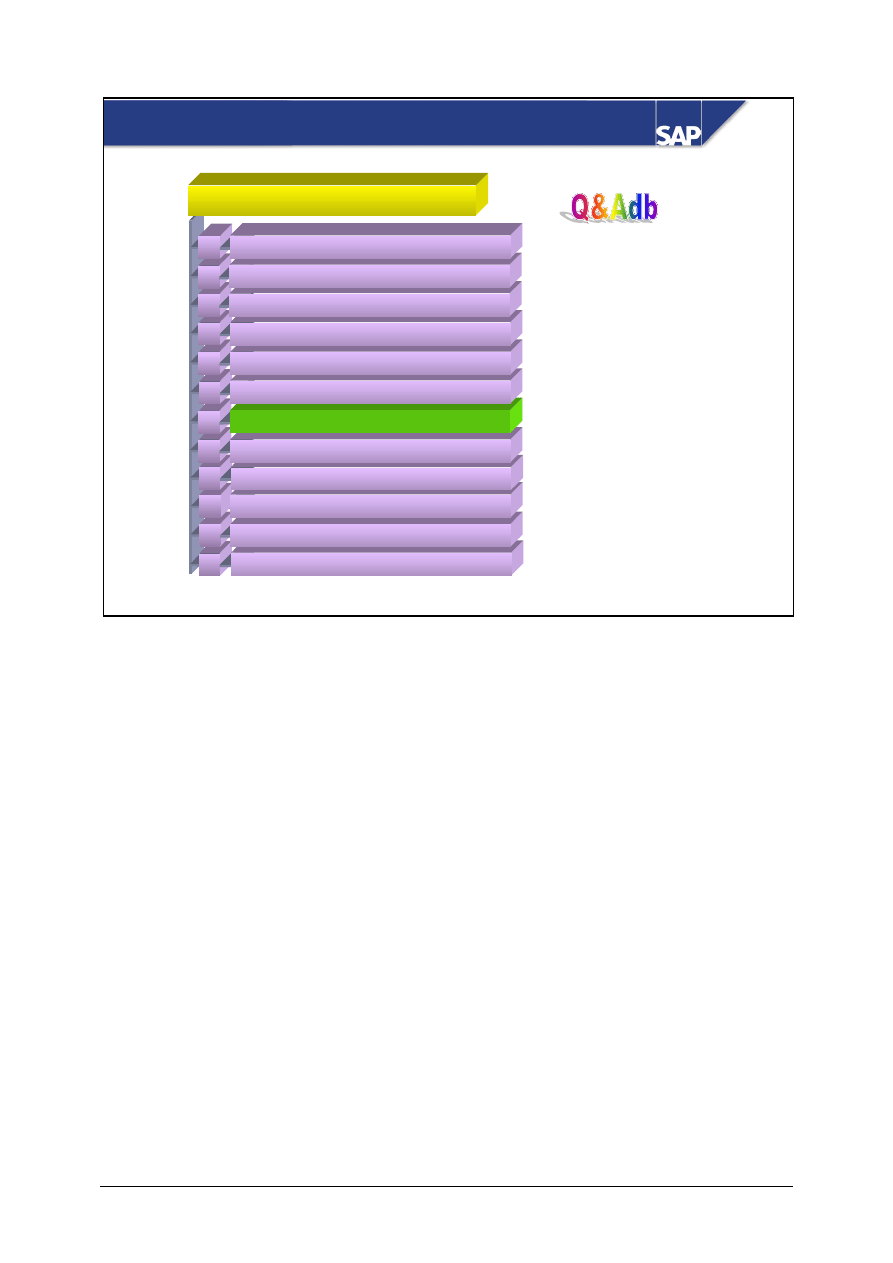
To activate WBS numbering, select
View
->
WBS numbering
. A checkmark
indicates that this option is active. When WBS numbering is active, each structure
item is numbered, in the following order: Phase, work package, activity, and task.
To find the WBS numbering in the Implementation Assistant (IA):
→ Expand the ValueSAP – Implementation node by clicking the ! icon
→ Expand the Implementation Roadmap node by clicking the ! icon
→ Expand the Project Preparation and Initial Project Planning nodes by
clicking the
! icons
→ Expand the work package Create and Issue Project Charter by clicking the
! icon.
The activity
Create and Issue Project Charter
is located in this work package.
1-2
To find the tasks assigned to the activity Create and Issue Project Charter:
→ Call up the work package Create and Issue Project Charter
→
Open the activity Create and Issue Project Charter
The relevant tasks are now displayed:
1-3
To find the accelerators under the task Create Initial Project Plans:
→ Call up the activity Create and Issue Project Charter
→ Choose the task Create Initial Project Plans
You can now access the documentation that describes this task in detail. The
accelerators for this task are located on the
Links
tab page on the lower right screen
area.
1-4
The Conduct Business Process Workshops activity is contained in Phase 2,
Business Blueprint
1-4-1 In the work package:
Business Process Definition
1-4-2 Choose the activity in the Roadmap. On the right screen area, scroll down to
the
Prerequisites
section.
The inputs for this activity are:
Business process workshop schedule
Scope Documents (Enterprise process area scope document)
Question & Answer database (Q&Adb)

© SAP AG
TSCM52
23-34
1-4-3
To go to the task Determine Reporting Requirements and find the roles
involved:
→ Open ValueSAP – Implementation
→ Open the Implementation Roadmap
→ Open the Business Blueprint phase
→ Open the work package Business Process Definition
→ Open the activity Conduct Business Process Workshops
→ Open the task Determine Reporting Requirements
→ Select the Roles tab page.
The roles assigned to this task appear on the lower right screen area. To
open the description of a role, double-click it. Read the document.
1-4-4
To find the tools available to support the task Determine Conversion
Requirements:
→
Open the task Determine Conversion Requirements in the activity
Conduct Business Process Workshops (see solution 1-4-3)
A description of the task appears in the viewing area on the right. Scroll to
point 4 and read it.
The tools available are:
Customer input template (CI template)
and
Q&Adb
.
Select the
Links
tab page and look at the documents available there. The
document type is specified in the third column.
The types of accelerator used are:
Template, Form
,
Questionnaire
,
Not specified
,
How to
,
Guidebooks
.
1-5
To find the accelerator Authorizations Made Easy in the Roadmap (IA):
→
Open the Business Blueprint phase in the Implementation Roadmap
→
Open the work package Establish Development System Environment
→
Open the activity Set Up Development Environment
→
Open the task Set Up User Master Records for Project Team
The accelerator
Authorizations Made Easy
appears on the
Links
tab page on the
lower right screen area.
To find the accelerator in the Knowledge Corner (IA):
→
Select the KC (Knowledge Corner) tab page
→
Open the structure item Cross Application Topics

© SAP AG
TSCM52
23-35
→
Open Authorizations and User Roles
The accelerator
Authorizations
appears on the
Links
tab page on the lower right
screen area.
This accelerator calls up a page in SAPNet, which provides a link for
downloading the
Authorizations Made Easy
guidebook.
1-6
To locate additional information about reporting in the IA:
→
Select the KC (Knowledge Corner) tab page
→
Open the structure item Cross Application Topics
→
Select Reporting
The following Reporting Made Easy guidebooks are available on the
Links
tab
page:
Reporting Made Easy - Book 1: Fundamentals of Reporting,
Reporting Made Easy - Book 2: Report Development Tools,
Reporting Made Easy - Book 3: Commonly Used Reports.
1-7
To find the relevant information:
→
Choose the Find tab page
→
Type *Authorizations* in the search field
→
Choose Find
You now see all the information available on
Authorizations
.
1-8
To view information related to Services in the IA:
→ Choose the Roadmap tab page
→
Select Filter in the menu bar
→
Choose Subject areas....
→
A list of the available subject areas appears
→
Select None
→
Select the Services checkbox
→
Choose OK to confirm your entries
The Roadmap disappears briefly. It will be recreated and displayed immediately in
line with the new filter criteria. The
Implementation Roadmap
now contains all
the structure items that provide information on the
Services
topic.
Wyszukiwarka
Podobne podstrony:
7131 TSCM 52 2 parte (1 5)
7133 TSCM 52 2 parte (11 16)
7130 TSCM 52 1 parte (14 16)
7135 TSCM 52 2 parte (22)
7138 TSCM 52 2 parte (24)
7127 TSCM 52 1 parte (1 4)
7128 TSCM 52 1 parte (5 7)
7137 TSCM 52 2 parte (24)
7132 TSCM 52 2 parte (6 10)
7129 TSCM 52 1 parte (8 13
7134 TSCM 52 2 PARTE (17 21)
7131 TSCM 52 2 parte (1 5)
7133 TSCM 52 2 parte (11 16)
więcej podobnych podstron