® CrossFit is a registered trademark of
© 2008 All rights reserved.
Subscription info at
Feedback to
1 of 8
J O U R N A L
A R T I C L E S
Overhead Is Rising
Bill Starr
Misunderstood, often-ignored, and unfairly tarred as unsafe, overhead exercises like presses, jerks, push presses,
and push jerks can help a wide range of athletes build wide, powerful, and flexible arms, shoulders, and back.
Here’s how to do them right.
Overhead strength provides functional power to athletes in every sport imaginable, yet the lifts used to
build this strength have been largely neglected for a long time. In fact, since the bench press replaced the
military press as the standard for upper body strength and overall strength in the early 70s, (see sidebar
below, “Why the Overhead Died”) overhead movements are often banned from strength training programs
as being ineffective and unsafe.
If you ask me, that is simply wrong. In my opinion, the overhead press is not only safe when you do it right
and safer than a flat bench press, it is capable of being a far superior strength and fitness tool for athletes.
There are a host of reasons:
® CrossFit is a registered trademark of
© 2008 All rights reserved.
Subscription info at
Feedback to
2 of 8
Overhead Is Rising...
(continued)
1. “Convertible” strength
The strength gained from doing presses and other over-
head exercises is applicable to more athletic events than
any other shoulder girdle movement—especially those
sports that require the athletes to extend their arms
overhead, including basketball, volleyball, tennis, base-
ball, lacrosse, swimming, the field events in track (javelin,
shot put), and nearly every position in football. Only inte-
rior linemen benefit from doing flat benches, whereas the
backfield, defensive backs, linebackers, wide receivers, and
tight ends use the strength gained from overhead work
more so than the flat or even the incline bench. There are
others, too, but you get the idea.
Overhead lifts are even more convertible to other lifting
exercises. I knew of many Olympic lifters who were press-
ing 300 or more who could lay down on a bench and use
400 without any prior practice on that exercise. Conversely,
I have never seen a 400-pound bencher be able to over-
head press 300. Most are barely able to handle in the 225
to 250 range.
2. Proportionate strength
Overhead exercises develop a more proportionate
strength in the shoulder girdle than any other upper
body movement. Presses, jerks, push presses, and push
jerks create wide, powerful arms and shoulders, with less
emphasis on the chest muscles, which play a minor role
in nearly every sport. Overhead work does hit the high
portion of the chest—a good thing since that part of the
pecs helps to stabilize the shoulder girdle.
3. More flexibility
Overhead exercises do not hinder shoulder flexibility.
Rather, they enhance it—an important point for anyone
participating in a sport which requires a high degree of
shoulder flexibility, such as gymnastics, the martial arts,
and wrestling.
4. Works back, hips, even legs
While most upper body exercises only work the groups
that make up the shoulder girdle, overhead movements
also strengthen the back, from the traps to the lumbars,
and also directly involve the hips, glutes, and legs. Most
do not think about how much the back is utilized during
overhead lifts. That is, until they go though a strenuous
overhead workout. Then it becomes quite clear. When
I start an athlete on overhead presses or jerks, the area
of his body that gets the most sore is almost always
his back.
WHY THE OVERHEAD DIED
Prior to the 1970s, everyone who trained
with weights did a great deal of overhead
work. In most cases, at least one-third of the
routine was dedicated to those exercises.
Strength-trained athletes, fitness enthusiasts,
bodybuilders, and, of course, Olympic
weightlifters always included several types
of overhead lifts in their programs.
Yes, even aspiring bodybuilders did them.
That’s because nearly all the contestants
in the top physique shows did presses and
jerks, and many also added push presses
and push jerks. They also snatched and
clean and jerked. Why? So they could
compete at Olympic meets and gain those
much sought-after athletic points. Those
five points often proved to be the difference
between winning and floundering way
back in the pack.
Then, in the early 1970s, several events
occurred in rather quick succession that
drastically changed the face of physical
culture in this country, and proved to
be the death knell for the overhead lifts
except for those who participated in the
sport of Olympic weightlifting. However,
even this group of athletes was affected
when the press was eliminated from official
competition by the International Olympic
Committee in 1972.
This decision ended up having far-reaching
implications. The reason the press was
dropped was because it was deemed
potentially harmful to the lower back.
However, those close to the sport knew the
real reason the lift was suddenly no longer
part of the competition and it had nothing
to do with safety. That was no more than
a smoke screen. Lifters were not injuring
their backs anymore than they injured their
shoulders, elbows, or knees. The press was
eliminated because judging the lift had
® CrossFit is a registered trademark of
© 2008 All rights reserved.
Subscription info at
Feedback to
3 of 8
Overhead Is Rising...
(continued)
5. Protects rotator cuffs
The area of the back that get the most sore is usually the
middle or right over his shoulder blades. Gaining and main-
taining strength in this latter area is extremely beneficial
since this is where the muscles that constitute the rotator
cuffs are located. Back when the overhead press was the
primary upper body exercise, rotator cuff injuries were
unheard of. We didn’t even know there were such muscles.
But when the bench press replaced the overhead press
and the lifters failed to do specific work on their upper
backs and therefore the rotator cuffs, injury rates soared
for those small but critical muscles.
In this regard, I should add that the very best way to
rebuild a slightly damaged rotator cuff is by doing over-
head presses. Start with dumbells, gradually work up to
the barbell and proceed from there. It takes a bit of time,
but eventually you will be able to strengthen those small
muscles. It sure beats the alternative of surgery.
6. Balance and good looks
The overhead lifts belong in the routine of every strength
athlete—including bodybuilder. Presses, jerks, push
presses, and push jerks build a more balanced and pleasing
physique than other upper body exercises.
become very erratic and inconsistent.
Judging the newer style of overhead
press, which was much more explosive
than the traditional technique, became
more subjective and varied from class
to class, depending on who was sitting
in the judges’ seats. One group might
be allowed to knee-kick the bar upward
at the start and lay back to ridiculous
extremes, while the very next group
was required to do the lift in strict form.
On the international scene, the press
became a political football. A judge
from a rival nation would turn down
an attempt even when it was done in
perfect fashion. When those in power
determined they could no longer
control the situation, they decided that
it would be easer just to eliminate the
lift than try to enforce stricter standards
from the judges.
The early 70s saw the spread of strength
training for athletic teams sweep across
the country, especially for football, like
wildfire. Even small high schools and
Division III colleges had some sort of
strength program. Those routines usually
had three or four primary exercises for
the back, hip and legs, and shoulder
girdle. The exercise of choice for the
upper body was the flat bench, not the
overhead press. The reasoning behind
this decision was based on: 1) the notion
that the press was a risky lift and 2) it was
much easier to teach the flat bench than
the overhead lift. But the bigger of the
two factors was certainly safety. School
administrators and coaches wanted no
part of exercise that an international
body had determined to be unsafe. They
were correct about the overhead press
being more difficult to teach than the
flat bench because it is. And since the
majority of the strength coaches in that
® CrossFit is a registered trademark of
© 2008 All rights reserved.
Subscription info at
Feedback to
4 of 8
OVERHEAD EXERCISE TUTORIALS
Correct form is absolutely key for all overhead exercises,
whose balance component requires a much higher skill
level and more practice than exercise performed closer to
the core of the body. For the record, the overhead press is
a safe exercise when done right. Those very few who did
sustain some type of lower back injury while performing
a heavy press did so because of leaning back excessively.
Some were able to lean so far backward that the lift resem-
bled a standing bench press. It goes without saying that
this outlandish maneuver should be avoided, but the truth
of the matter is, this move is almost impossible to achieve
unless it’s practiced for a number of years.
A slight backward lean is acceptable, even beneficial in
helping to keep the bar over the base of power, yet in most
cases, the athlete has trouble bowing his back at all. It’s not
a natural move. I’ve never had any athlete hurt his back
doing an overhead press because of leaning too far back-
ward. The problem is getting them to bow their backs in
perfect timing and coordination with the drive and rapid
follow through.
In regards to injuries, the bench press ranks the highest
of all exercises in strength training, but no one has ever
suggested that this popular lift be removed from any
program. Ugly form is tolerated, even encouraged by
strength and sports coaches so that they can boast of
x-number of 300-pound benchers. Quite often, bad tech-
nique is coupled with gross overtraining on the bench and
as a result, elbows, wrists, and shoulders pay the price.
Here’s how to perform the various overhead exercises
safely and effectively.
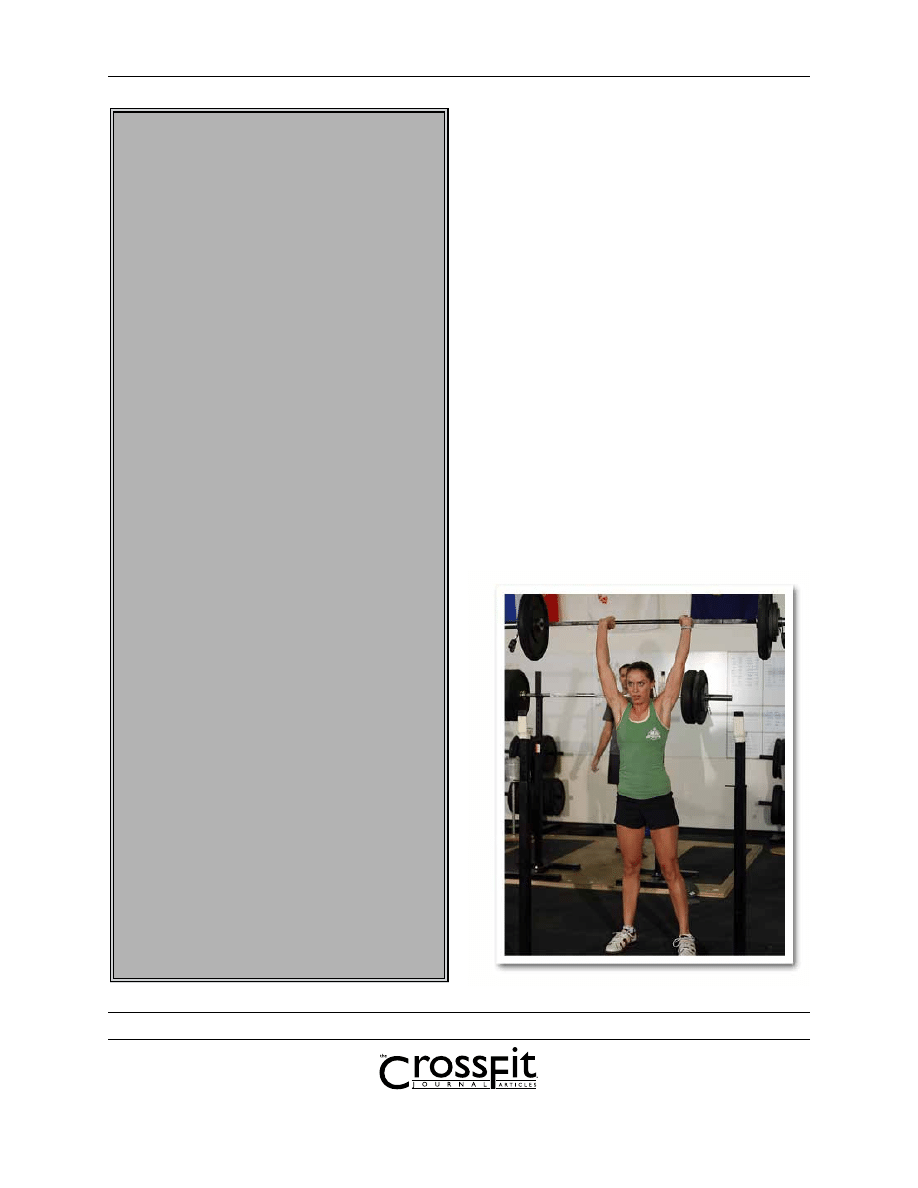
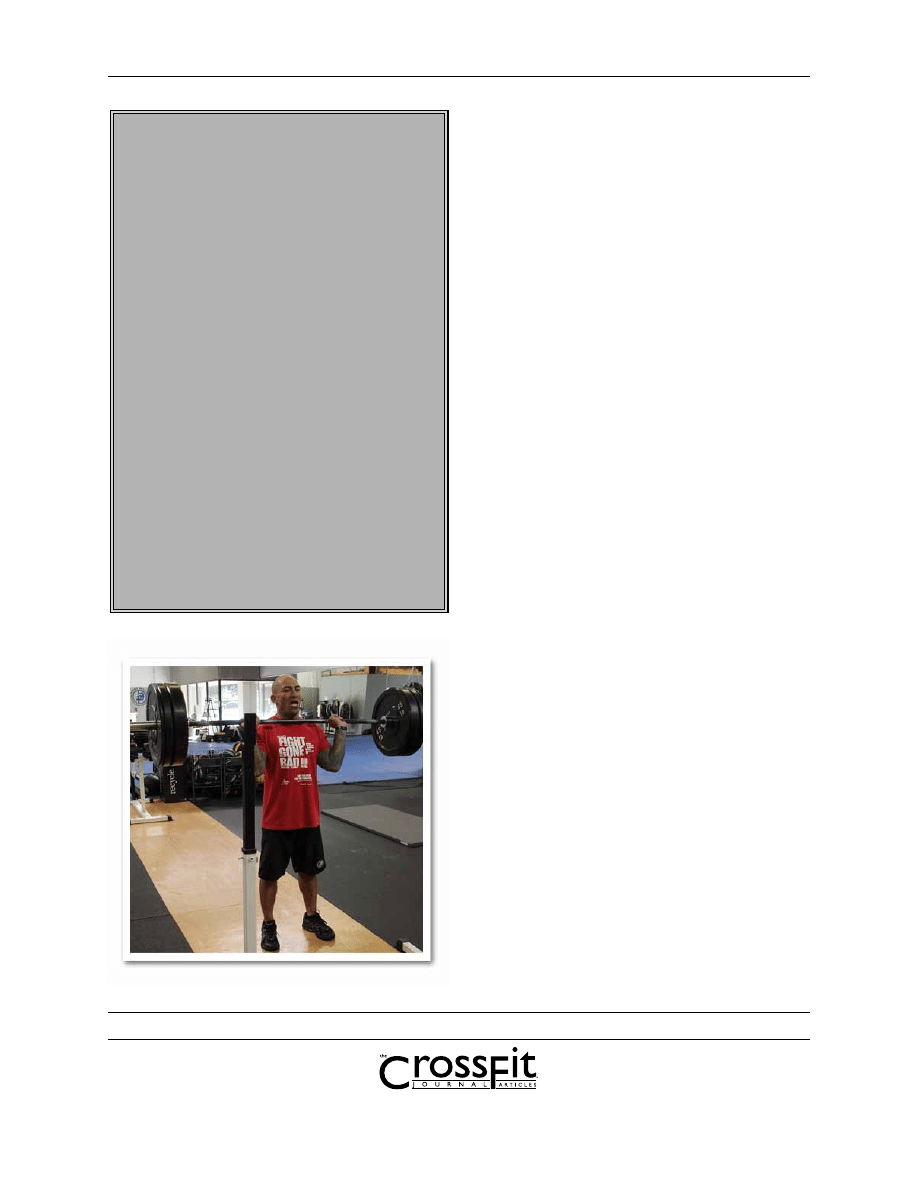
Military or Overhead press
This is an exercise that’s easy to learn but difficult to master.
In my 15 years of coaching at three universities, only two
athletes were able to do a 250-pound military press, while
I had several dozen who benched over 400—proof that
pressing heavy weights overhead is really a high-skill exer-
cise and takes a lot of training to achieve.
Feet first
Stand at shoulder width, with toes straight ahead and on
a line. One of the most common mistakes beginners make
is to place one foot out in front of the other. This is incor-
rect, because it creates a weaker base and it also places an
unequal stress on the lower back.
Overhead Is Rising...
(continued)
time frame were really football coaches,
they did not have the expertise to
teach their players how to press the bar
overhead correctly.
While this was happening, Joe and
Ben Weider took control of physique
competition with the lure of sizeable
monetary rewards that were not offered
by the A.A.U. or Bob Hoffman. One of
the first moves the Weiders made was
to drop the athletic points. That meant
the bodybuilders no longer had any
motivation to lift in Olympic meets,
so they stopped pressing, snatching,
cleaning, and jerking. This drastic change
in training procedure had a filter-down
effect on younger bodybuilders. If the
top guys didn’t do any overhead lifts,
then they wouldn’t either.
The early 70s also saw the emergence of
the new strength sport of powerlifting,
mostly because the bench press, squat,
and deadlift were much easier to learn
than the high-skill snatch and clean and
jerk. Rarely did a powerlifter include any
overhead lifting in his routine.
The final straw in the demise of the
overhead lifts came with the introduction
of many well-designed machines such
as the Nautilus. Now a person could
gain size, strength, and a higher level
of fitness without having to deal with
barbells or dumbells. At least, that’s what
the manufacturers and proponents of
the equipment proclaimed, and a great
many people bought the concept.
Machine training was easier than
working with free weights, and it seems
the majority of the population is always
eager to take the easy over hard.
® CrossFit is a registered trademark of
© 2008 All rights reserved.
Subscription info at
Feedback to
5 of 8
Hand and elbow position
For most, grabbing the bar with a shoulder-width grip
works. Extend your thumbs so that they barely touch the
smooth center of an Olympic bar. Naturally, those with
narrow or very wide shoulders will have to alter their grips
slightly, but a bit of trial and error will take care of that. Just
remember, when doing any type of pressing movement,
your elbows should always stay directly under your wrists.
That means your forearms will be in a vertical position
throughout the lift.
While learning this exercise, you can either clean the bar
or take it off the rack. Either way is effective. Once you
learn the proper form you might want to start cleaning the
weights because it’s actually easier to press a weight after
it has been cleaned than it is pressing it after taking it off
a rack.
Starting position
Fix the weight across your frontal deltoids, not on your
collarbones. To do this, elevate your shoulder girdle to
create a muscular ledge. Your elbows should not be high,
as in parallel to the floor, or pointed downward, but set
somewhere in between those two extremes. Your wrists
must be straight and they have to stay locked throughout
the lift. If this poses a problem, wrap or tape them. If the
wrists are allowed to twist or flex even slightly, the power
generated by the back, shoulders, and arms cannot be
transferred into the bar efficiently.
Once the bar is set properly on your frontal deltoids, take
just a moment to tighten all the muscles of your body.
Begin with your feet. Don’t just stand on the floor, but drive
your feet down into it and think about gripping it with
your toes. We liked to use the image of a bird sitting on a
tree limb and gripping the limb as tightly as he could. Then
move on up your body, contracting your thighs, glutes,
back, and shoulders, and arms. Now ease your midsection
a bit forward so that you’re coiled like a spring. Your knees
should be locked and stay that way during the press.
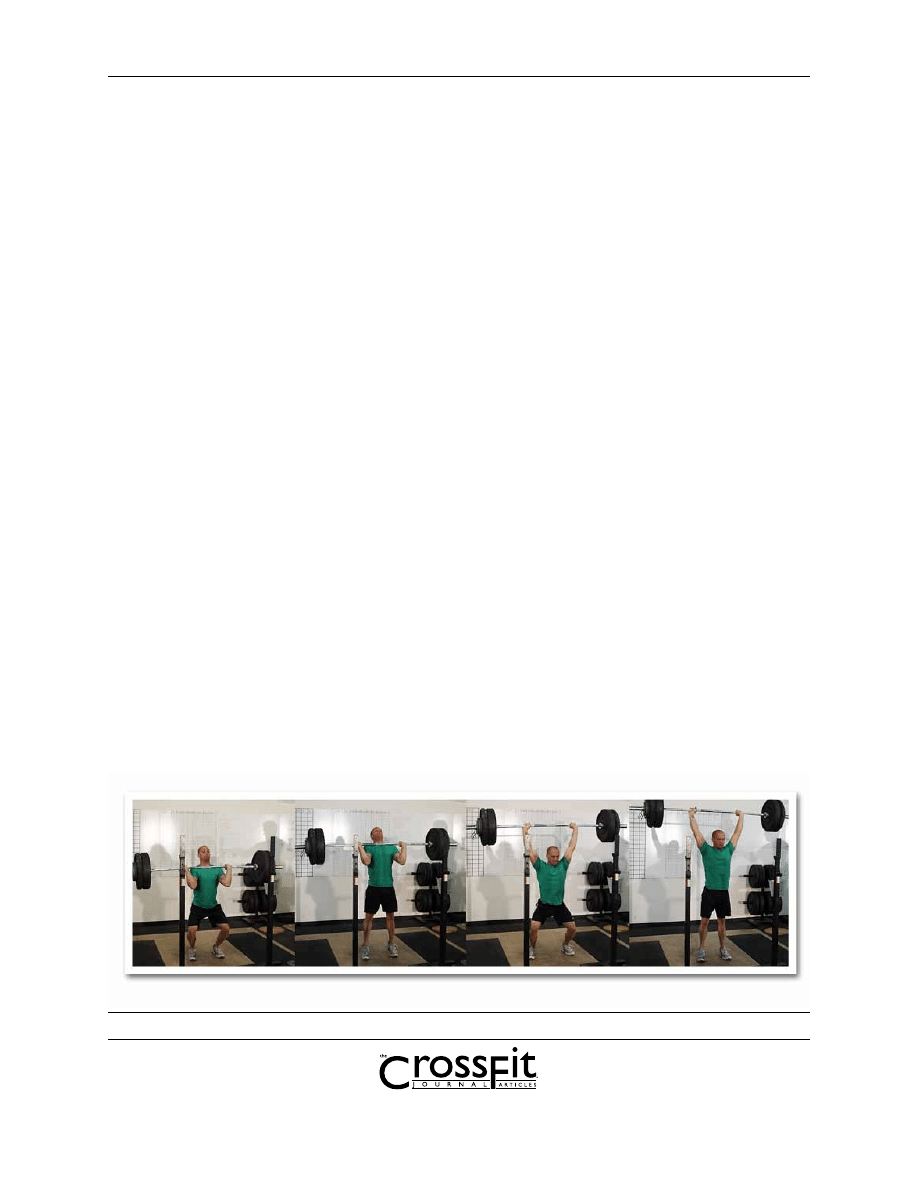
Maintain body position through the press
Look straight ahead from start to finish. Don’t follow the
bar’s upward movement with your eyes, as many do; this
will cause you to lean back and take you out of a strong
pressing position. Until you learn the form in the press,
drive the bar off your shoulders deliberately. This will
So after only a few years, the only group
of strength athletes who continued to do
any type of overhead lifting were Olympic
weightlifters. And they, for the most part,
just did jerks. Very few did any overhead
pressing, which many strength coaches,
myself included, believed to be a huge
mistake. Those muscles and attachments
used to press heavy poundages are the
same needed to control and fix a heavy
jerk overhead.
Editor’s Note: Obviously, the full spectrum
of overhead lifts are central to CrossFit’s
programming. In addition to the press,
push press, push jerk, and split jerk, we
incorporate thrusters, swings, overhead
squats, and snatches. Coach Starr is referring
to the predominant tendencies in Globo-
gyms, bodybuilding, and the presently
established strength and conditioning
protocols for universities and professional
sports teams.
F
Overhead Is Rising...
(continued)
® CrossFit is a registered trademark of
© 2008 All rights reserved.
Subscription info at
Feedback to
6 of 8
Overhead Is Rising...
(continued)
enable you to use the correct line on every rep. But after
you feel confident with the lift, begin driving the bar
upward in an explosive manner. Think in terms of a boxing
punch: quick and powerful.
The start needs to be close to your face with the bar almost
touching your nose. The initial drive will carry the bar to
the top of your head. Follow through immediately. Any
hesitation will cause the bar to stall. As it passes the top of
your head, don’t lean away from the bar, but extend your
head through the gap you’ve created and bow your pelvis
forward while keeping your knees locked. These moves
will keep your power base under the bar and allow you to
use your levers more effectively.
Be aware that the bar will always try to run forward, espe-
cially when the weights get heavy. After all, the bar doesn’t
have a brain—it goes where you guide it. So drill on the
movement until it climbs upward in the same line every
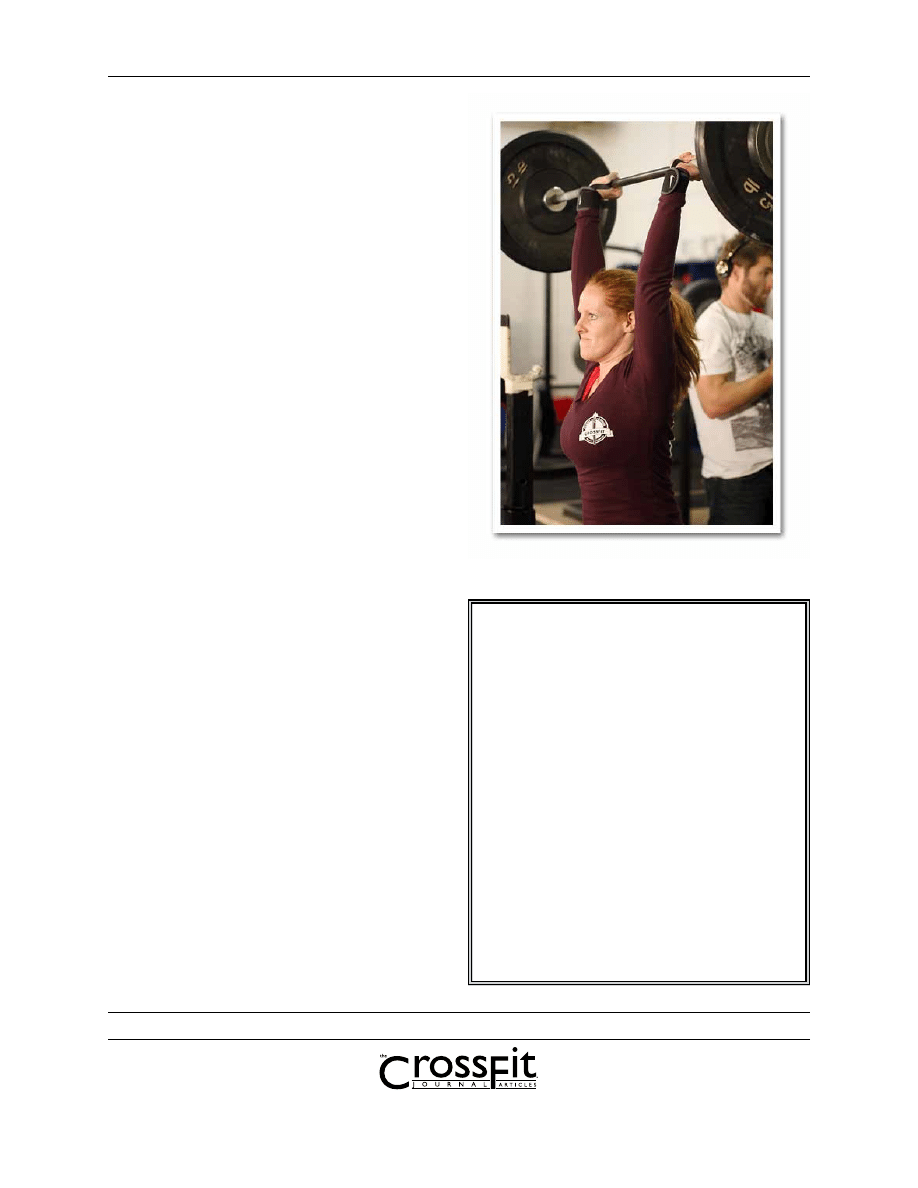
time. As soon as you lock out the bar, bring your torso erect
and push up into the bar and hold it for 5-6 seconds. This
simple act activates all of those groups which are respon-
sible for supporting weights overhead, including all of the
back, hips, and legs muscles.
When the bar is locked out, visualize a line running directly
upward from the back of your head. That’s where you want
the bar to be because that places it right over your spine
and is the strongest supporting position there is.
The press, like any other exercise consists of a start, middle,
and finish. These three segments must blend together into
a continuous, fluid movement. After you drive the bar off
your shoulders, follow through by applying more pressure
into the bar and it will shoot through the middle range.
When you do that, you’ll find that the finish is much easier.
With emphasis on good form , you will quickly begin to
feel the rhythm of pressing a weight overhead. A well-
executed press will glide upward as if an unseen hand is
lending assistance.
Coming down
Lower the bar back to your shoulders in a controlled
manner. Never allow it to crash down, because that will
not only bang up your shoulders and collarbones, it will
also move the bar out of the ideal starting position and
therefore adversely affect your next rep. When the weights
get heavy, bend your knees a bit to cushion the descend-
ing bar. Then, relock them, tighten all your muscles again,
get set, and do the next rep.
Breath control
In the beginning, while using light weights, how you
breathe during the press doesn’t matter much. However,
as the poundages get demanding, breathing is critical. Just
before you drive the bar upward, off your shoulders, take a
deep breath and hold it until you have locked out the bar
or at least driven it through the sticking point. Breathing
while the bar is in motion diminishes your ability to apply
force to it. This is because inhaling or exhaling causes
your diaphragm to relax and this, in turn, creates a nega-
tive intrathoracic pressure. In other words, you no longer
have a solid base when you breathe. Once you have the
bar locked out, take as many deep breaths as you need,
lower the bar back to the starting position, reset, and take
another deep breath before your next rep.
® CrossFit is a registered trademark of
© 2008 All rights reserved.
Subscription info at
Feedback to
7 of 8
Reps and Sets
During the learning stage, stay with five sets of five, start-
ing with light weights and working up to as much as you
can handle while using good form. Then after six to eight
weeks of practicing the technique and building a firm
foundation, switch over to this set and rep formula: two
sets of five as warm-ups, followed by three to five sets of
triples. Use the same weight on the threes and if you’re
able to make every rep, increase the top-end weight the
next time you press.
Jerks
Jerks are currently done more frequently than overhead
presses, because many high school, collegiate, and sports
coaches have learned that his dynamic, high-skill exercise
increases foot speed and coordination as well as strength.
And, like the press, it is very convertible in terms of being
able to utilize these athletic attributes in a wide range
of sports.
While jerks can be taught when someone is just starting to
train with weights, I have found that they do better if they
wait until they have built strength first through overhead
presses. After a couple of months doing those, an athlete
is better able to perform jerks correctly.
Knee kick and fast feet
The fundamentals for the jerk are the same as for overhead
presses—grip, foot, stance, and racking the bar on the
frontal deltoids. The difference is that you’ll use a knee kick
to drive the bar upward and you’ll be moving your feet.
Once you have your feet on a line and the bar racked
solidly on your shoulders, take a short dip and drive the
bar upward. As in the press, it should move close to your
face.
Now comes the hard part. As the bar climbs upward, one
foot moves forward and the other backward. They must
move extremely fast and hit the platform at the same time.
Bang them into the floor. Ideally, you will also be locking
out the bar when your feet slam into the floor or platform.
Your torso must stay erect. Any forward leaning will cause
the bar to run out front and if it’s allowed to travel too far,
you will not be able to fix it overhead.
Which foot you move forward is purely an individual
matter. It’s like being left- or right-handed. Your lead foot
will only travel a short distance, no more than the length of
your foot. In contrast, your rear foot will move much further
LIFTING BELTS
The question invariably comes up as to
whether athletes should wear lifting belts
when doing overhead lifts. I recommend
that they do wear a belt, but not for the
reason most have in mind. A belt, no mat-
ter how wide or thick it may be will not
prevent an injury if sloppy technique is uti-
lized. However, a belt is beneficial in that it
helps keep the lower back warm during a
workout and this does reduce the risk to the
lumbars. A belt also provides valuable feed-
back to signal that you’re leaning too far
backward or forward. And a snug belt helps
keep your midsection tight and this is most
reassuring when handling heavy weights.
Overhead Is Rising...
(continued)
® CrossFit is a registered trademark of
© 2008 All rights reserved.
Subscription info at
Feedback to
8 of 8
since it’s your lever leg. Your front foot will move straight
forward and your back foot must also move straight back-
ward. A common mistake most beginners make is they
swing the rear leg around slightly, so when they plant their
foot, it’s in the middle of their body. This severely affects
balance. Also, the rear foot must land on the toes. It can’t
be turned so the heel or side of the foot is making contact
with the floor.
This is a high-skill move and can only be mastered with
lots of practice. Stay with light poundages until you get
the feel and rhythm of the split. I often have lifters draw
lines with chalk to mark exactly where they want their feet
to hit. Even drilling with a broomstick helps.
Lock out the weight and recover
Once you’re in a split and have the bar locked out, continue
to exert pressure on it. If the weight is light, merely stand
up. However, when the weight gets taxing, follow this
procedure: Slide your rear foot forward a bit, then your
front foot, rear foot, front foot, until you’re stable enough
to stand erect. Do not move the front foot first. If you do,
the bar will suddenly be suspended over air with nothing
to support it. At the bottom of the split, your knee should
extend out in front of your lead foot and your rear leg
should be straight and locked.
As soon as you have the weight locked out and under
control, recover. Don’t linger in that split position. Stand up
and keep pushing up into the bar. It should be fixed over-
head in the same position as an overhead press, on a line
extending up from the back of your head, On your final
rep of a set, hold the bar overhead for a 5-6 second count.
Lower the bar in a controlled fashion, make sure your feet
are pointed straight ahead and on a line and your rack is
right, take a breath and do the next rep.
Reps and Sets
When learning the exercise with light weights, I have
athletes do five reps, but as soon as the poundages get
demanding, I recommend threes. The reason: every time
the bar is reset after a rep, it moves a bit out of the ideal
starting position. Plus, more weight can be handled with
triples than with fives and this builds greater overhead
strength. If the bar slips off the shoulders too much, stop.
Place the bar on the rack and reset it on your shoulders.
In some cases, I have the athlete use two reps rather
than three if the slippage is severe. Six to eight sets is a
good workout.
Push Presses and Push Jerks
After you learn how to overhead press and jerk, push
presses and push jerks are a snap. On both exercises, you
bend your knees to help you drive the bar upward, but
on the push press, once you lock your knees, they need
to remain locked. On the push jerk, you can rebend them
and the bar will move from your shoulders to lockout in
one fast movement. The push press is different in this
regard. You want to have to press out the weight for the
final 2-4 inches. Again, use three reps when the numbers
get higher and hold the final rep overhead for 5-6 seconds.
There is a tendency for beginners to dip too low when
push pressing or push jerking. But, when someone dips
too low, he has difficulty putting a pop into the bar. The
dip is a short, powerful stroke. Your entire body must be
rigidly tight and perfectly upright. Both exercises are
really drills to help you learn how to drive a heavy weight
upward, in the correct line, and to follow through instant-
ly. And since a lot more weight can be used on the push
press than with a military press, it overloads those muscles
to a greater extent.
If you’re not currently doing any overhead exercises, give
one or all of these a try. Many find that they have a natural
aptitude for the exercises. They will not only improve your
physique and strength, they will enhance those attributes
that help you excel in your sport.
F
Overhead Is Rising...
(continued)
Bill Starr is the author of the books The Strongest
Shall Survive: Strength Training for Football, Defying
Gravity, and thousands of magazine articles. He was
the editor of Bob Hoffman’s Strength and Health, Joe
Weider’s Muscle Builder, and a nationally-ranked
Olympic weightlifter and powerlifter back in the day.
Bill was one of the first professional strength coaches
in the country, has forgotten more about training
than most coaches will ever have the opportunity to
learn, and makes a very convincing crab cake if you
can talk him into it.
—Mark Rippetoe
Wyszukiwarka
Podobne podstrony:
CFJ Starr MasteringTheJerk
CFJ Starr PlatformCoaching
CFJ Starr PullingExercises
CFJ Starr MorePop
CFJ Starr PyramidStrength
CFJ Starr DontMuddleMiddle
CFJ Starr FullCleans
ch3 Timing Overhead
Starr Flot Rimskoy imperii 439603
Vertical Overhead Clearance
CFJ Takano Olympic
CFJ Star Mental Dec2010
Asimov, Isaac Lucky Starr 05 and the Moons of Jupiter(1)
A D Seergev Nonlinear interaction of the pantograph of electric rolling stock and the overhead cate
Sun Java Training SL 275 Java Programming Language Overheads (Sun Microsystems, 2000)
Isaac Asimov Lucky Starr 03 And the Big Sun of Mercury
Raven Starr Her Smile (pdf)
więcej podobnych podstron