CLAD Sample Exam
Page 1 of 14
Certified LabVIEW Associate Developer Exam
Test Booklet
Note: The use of the computer or any reference materials is NOT allowed during the exam.
Instructions:
If you did not receive this exam in a sealed envelope stamped "NI Certification," DO NOT ACCEPT
this exam. Return it to the proctor immediately. You will be provided with a replacement exam.
Please do not detach the binding staple of any section. If any part of the exam paper is
missing or detached when returned to National Instruments, you will be deemed to have
failed the exam.
Please do not ask the proctor for help. If you believe the intent of a question is not clear, you
may note that question, and your reasons for choosing the answer you believe best fits the
question.
This examination may not be taken from the examination area or reproduced in any way.
You may not keep any portion of this exam after you have completed it.
Exam Details:
Time allocated: 1 hour
Type of exam items: Multiple choice
Number of exam items: 40 questions
Passing Grade: 70%
IMPORTANT: When you have completed this exam, place it in the provided envelope
with you answer sheet and SEAL the envelope. Give the sealed envelope to your proctor.

CLAD Sample Exam
Page 2 of 14
Answer Sheet:
To quickly check your answers against the solutions on the Solutions Page, record your answers on this
Answers Sheet. Detach this page and record your answers as you go along This page is not included in
the actual CLAD exam; it is included here for practice purposes only. The Solutions Page is at the end of
the Sample Exam.
1. _____
2. _____
3. _____
4. _____
5. _____
6. _____
7. _____
8. _____
9. _____
10. _____
11. _____
12. _____
13. _____
14. _____
15. _____
16. _____
17. _____
18. _____
19. _____
20. _____
21. _____
22. _____
23. _____
24. _____
25. _____
26. _____
27. _____
28. _____
29. _____
30. _____
31. _____
32. _____
33. _____
34. _____
35. _____
36. _____
37. _____
38. _____
39. _____
40. _____

CLAD Sample Exam
Page 3 of 14
Sample Exam Items:
1. How do you document a VI so that the description appears in the Show Context Help
popup window?
a. Use the VI Properties Documentation window
b. Type in the Show Context Help window
c. Create a free label on the front panel
d. Edit the LabVIEW help files
2. Can a wire be used to pass data between loops that are intended to run in parallel?
a. Yes
b. No
3. Which of the following describes a Tab Control?
a. A control that outputs ASCII values equal to the selected tab label
b. A type of enumerated control
c. A control that outputs a cluster of the controls / indicators on the tabs
d. A controls that outputs the tab order of the controls on the front panel
4. What is an advantage of using a Strictly Typed VI refnum?
a. The data types of the target VI are known at compile time
b. The data types passed to the VI can change programmatically
c. You can flatten the data to a string to improve code performance
d. Causes dynamically loaded VIs to be loaded at the start of execution
5. A coercion dot indicates that:
a. The data types are consistent
b. A polymorphic operation will be performed on the data
c. A data buffer is created to handle data conversion
d. Data values are being coerced because they are out of range
CLAD Sample Exam
Page 4 of 14
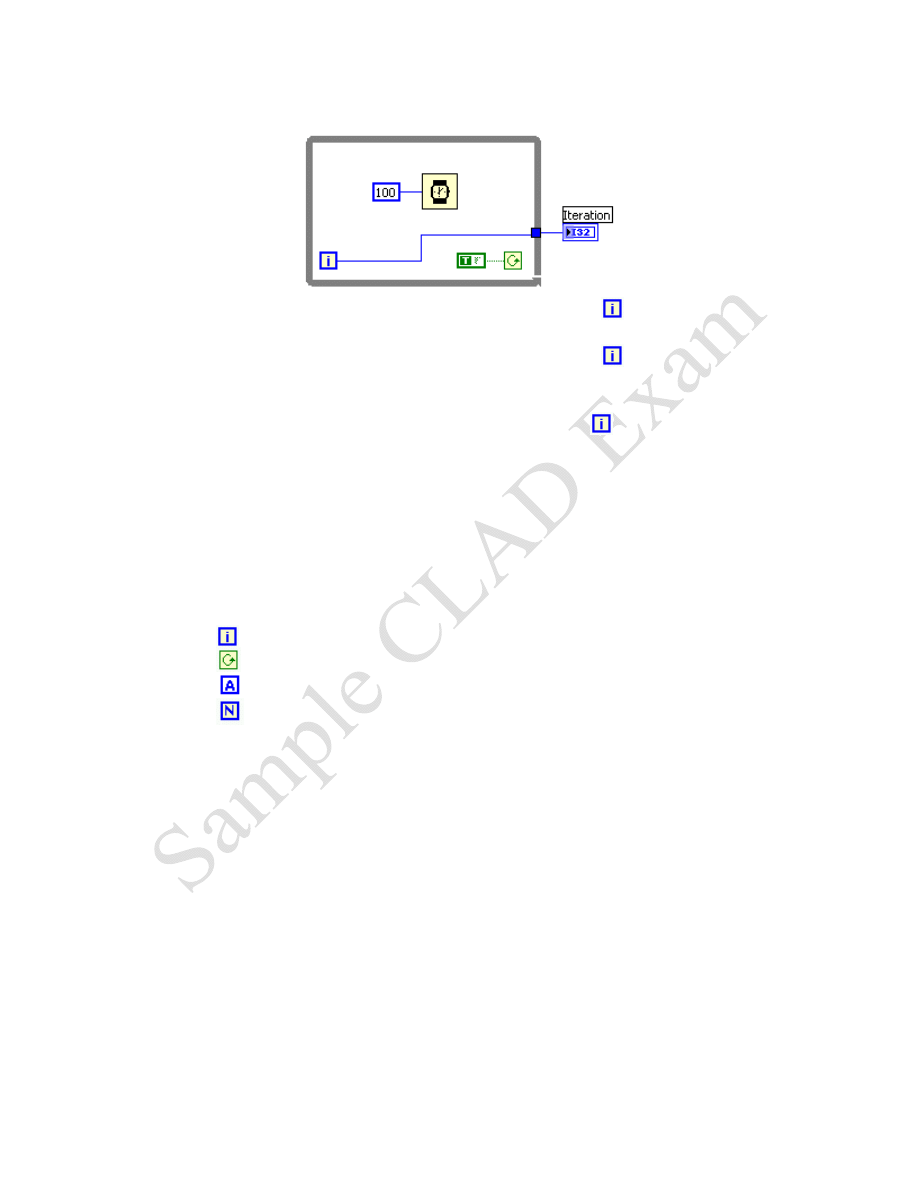
6. Which of the following statements is true about the following block diagram?
a. The loop will execute once and the iteration terminal,
, will output a value
of one
b. The loop will execute once and the iteration terminal,
, will output a value
of zero
c. The loop will execute infinitely and the program will have to be aborted
d. The loop will not execute and the iteration terminal,
, will return a null
value
7. Which of the following cannot be used to transfer data?
a. Semaphores
b. Queues
c. Notifiers
d. Local variables
8. Which of the following terminals controls how many times a For loop executes?
a.
b.
c.
d.
9. You have a control on the front panel of a VI and you need to modify one of its
properties at run time. Which of the following is the best approach you would take?
a. Create an implicit property node and select the property to modify
b. Create a control reference, pass the reference to a property node and select the
property to modify
c. Create a linked shared variable and select the property to modify the property
d. Create a local variable and select the property to modify
10. Formula nodes accept which of the following operations?
a. Basic programming language instructions Input and Print
b. Embedding of SubVIs within the Formula Node
c. Pre and post increment (++) and decrement (--) as in the C language
d. The use of nested Formula Node structures
CLAD Sample Exam
Page 5 of 14
11. Which of the following is the best method to update an indicator on the front panel?
a. Use a Value property node
b. Wire directly to the indicator terminal
c. Use a local variable
d. Use a functional global variable
12. Which of the following functions assembles Cluster elements by their owned labels?
a. Unbundle by Name
b. Unbundle
c. Bundle by Name
d. Bundle
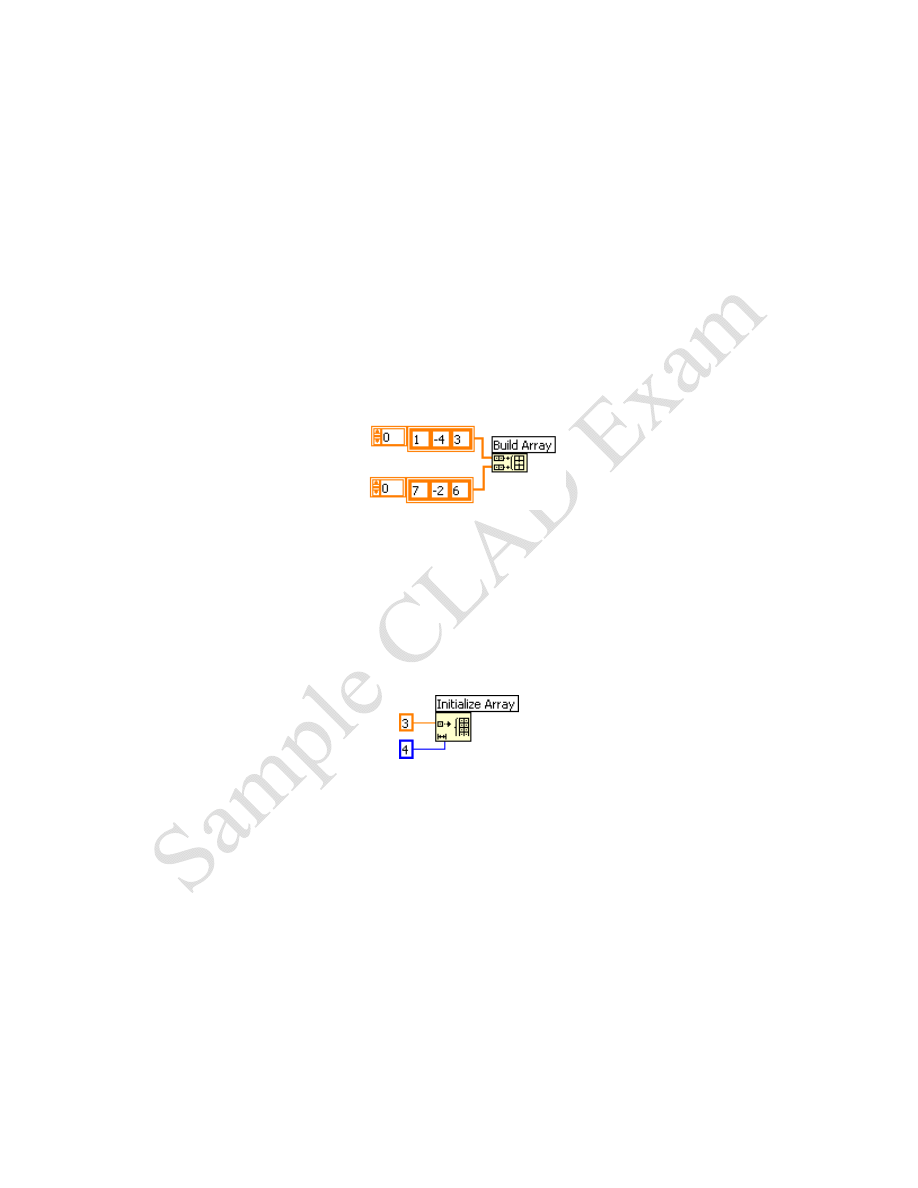
13. What is the output of the Build Array function in the following block diagram when
Concatenate Inputs is selected?
a. 1-D Array of {1, -4, 3, 7, -2, 6}
b. 1-D Array of {1, 7, -4, -2, 3, 6}
c. 2-D Array of {{1, -4, 3, 0}, {7, -2, 6}}
d. 2-D Array of {{1, -4, 3}, {7, -2, 6}}
14. What is the output of the Initialize Array function after the following code has
executed?
a. 1-D Array of {3, 3, 3, 3}
b. 1-D Array of {4, 4, 4}
c. 1-D Array of {3, 4}
d. 1-D Array of {4, 3}

CLAD Sample Exam
Page 6 of 14
15. What is one disadvantage of using the State Machine VI architecture?
a. A State Machine can only traverse states in order
b. If two state changes occur at the same time, only the first state change will be
handled and the second will be lost
c. The diagram becomes significantly larger when changing from a general
architecture to a State Machine
d. State Machines cannot acquire data or use DAQ functions
16. What is the best method to stop a While loop on an error condition?
a. Compare the Status boolean of an error cluster with a constant and wire it to
the Stop terminal
b. Connect the error wire directly to the Stop terminal
c. Create an Event structure to handle the error event
d. Use the Error Handler VI to automatically handle the error
17. What mechanical action of a Boolean would you use to mimic a button on a Windows
dialog?
a. Switch Until Released
b. Switch When Released
c. Latch Until Released
d. Latch When Released
18. Which combination of words correctly completes the following statement?
Unlike __________, which display an entire waveform that overwrites the data
already stored, ___________ update periodically and maintain a history of the
data previously stored.
a. Graphs; Charts
b. Charts; Plots
c. Plots; Graphs
d. Charts; Graphs
19. In what instance would you use the Probe tool rather than Highlight Execution?
a. To see the flow of data
b. To see the value of a wire in real-time
c. To look into a SubVI, as the process is running
d. To slowdown the VI and show data values in wires
CLAD Sample Exam
Page 7 of 14
20. You customize a control, select Control from the Type Def. Status pull-down menu,
and save the control as a
.ctl
file. You then use an instance of the custom control on
your front panel window. If you open the
.ctl
file and modify the control, does the
control on the front panel window change?
a. Yes
b. No
21. You develop a SubVI that only outputs a value and need to use this SubVI in a
(calling) VI. Which of the following is the best way to enforce dataflow to control the
execution of the SubVI?
a. Use the SubVI in a Sequence structure
b. Modify the SubVI to have dummy inputs that can be used from the calling VI
c. Modify the SubVI to have Error clusters that can be used from the calling VI
d. Modify the SubVI to have a global variable and use it from the calling VI
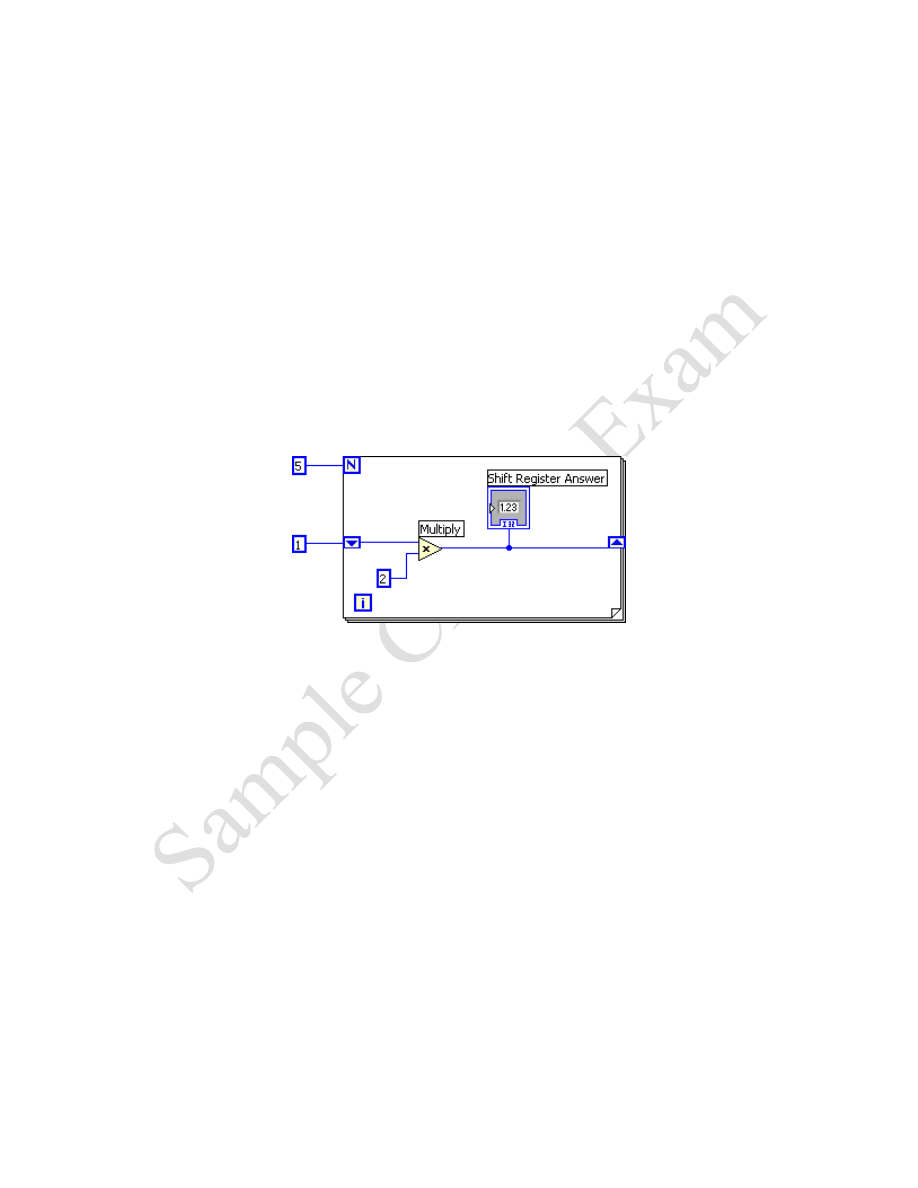
22. What is the value in Shift Register Answer after the following code has executed?
a. 16
b. 24
c. 32
d. 10
23. Which Chart update mode should be used to draw new data from left to right, then
clear the chart and draw new data again from left to right?
a. Strip Chart
b. Scope Chart
c. Sweep Chart
d. Step Chart
24. Which of the following illustrates an advantage of a global variable over a local
variable?
a. A global variable can pass data between two independent VIs running
simultaneously
b. Only the global variable can pass array data, local variables cannot
c. Global variables follow the dataflow model, and therefore cannot cause race
conditions
d. Global variables do not require owned labels to operate
CLAD Sample Exam
Page 8 of 14
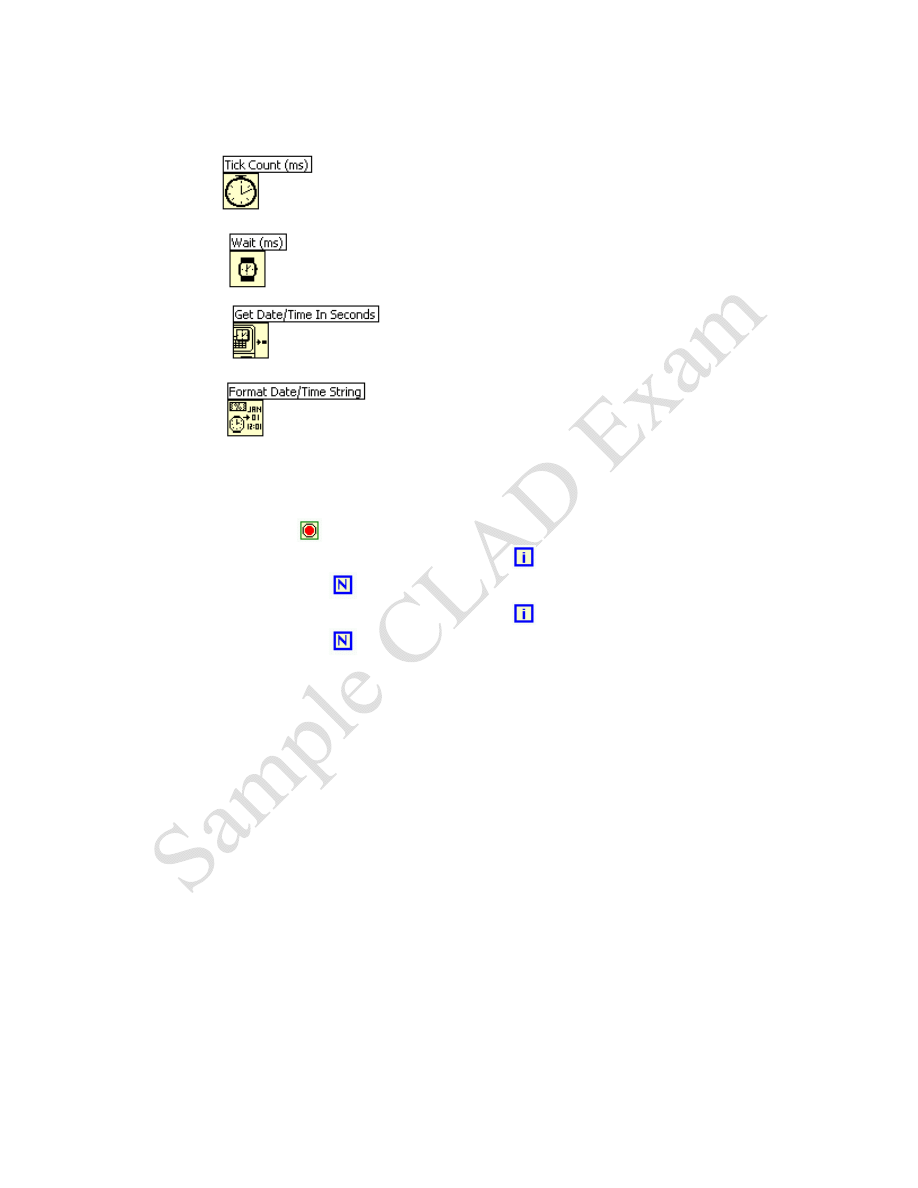
25. Which timing function (VI) is the best choice for timing control logic in applications
that run for extended periods of time?
a.
b.
c.
d.
26. Under which of the following conditions does a For loop stop executing?
a. When a false value is present at the conditional terminal and the conditional
terminal is
b. When the value of the iteration terminal,
, is one less than the value of the
count terminal,
c. When the value of the iteration terminal,
, is one more than the value of the
count terminal,
d. None of the above
27. You are inputting data that represents a circle. The circle data includes an x position,
a y position, and a radius. All three pieces of data are double-precision. In the future,
you might need to store the color of the circle, represented as an integer. How should
you represent the circle on your front panel window?
a. Three separate controls for the two positions and the radius.
b. A cluster containing all of the data.
c. A type definition containing a cluster.
d. An array with three elements.
28. Which of the following will cause an event to be captured by the LabVIEW Event
Structure?
a. Changing a value on a Front Panel control via a mouse click
b. Update of a Front Panel control using a property node
c. Programmatic update of a Front Panel control via a control reference
d. Using VI Server to update a Front Panel control
CLAD Sample Exam
Page 9 of 14
29. Which of the following does not conform to data flow programming paradigm?
a. Shift Registers
b. Tunnels
c. SubVIs
d. Local Variables
30. You must store data that other engineers must analyze with Microsoft Excel. Which
file storage format should you use?
a. Tab-delimited ASCII
b. Custom binary format
c. TDM
d. Datalog
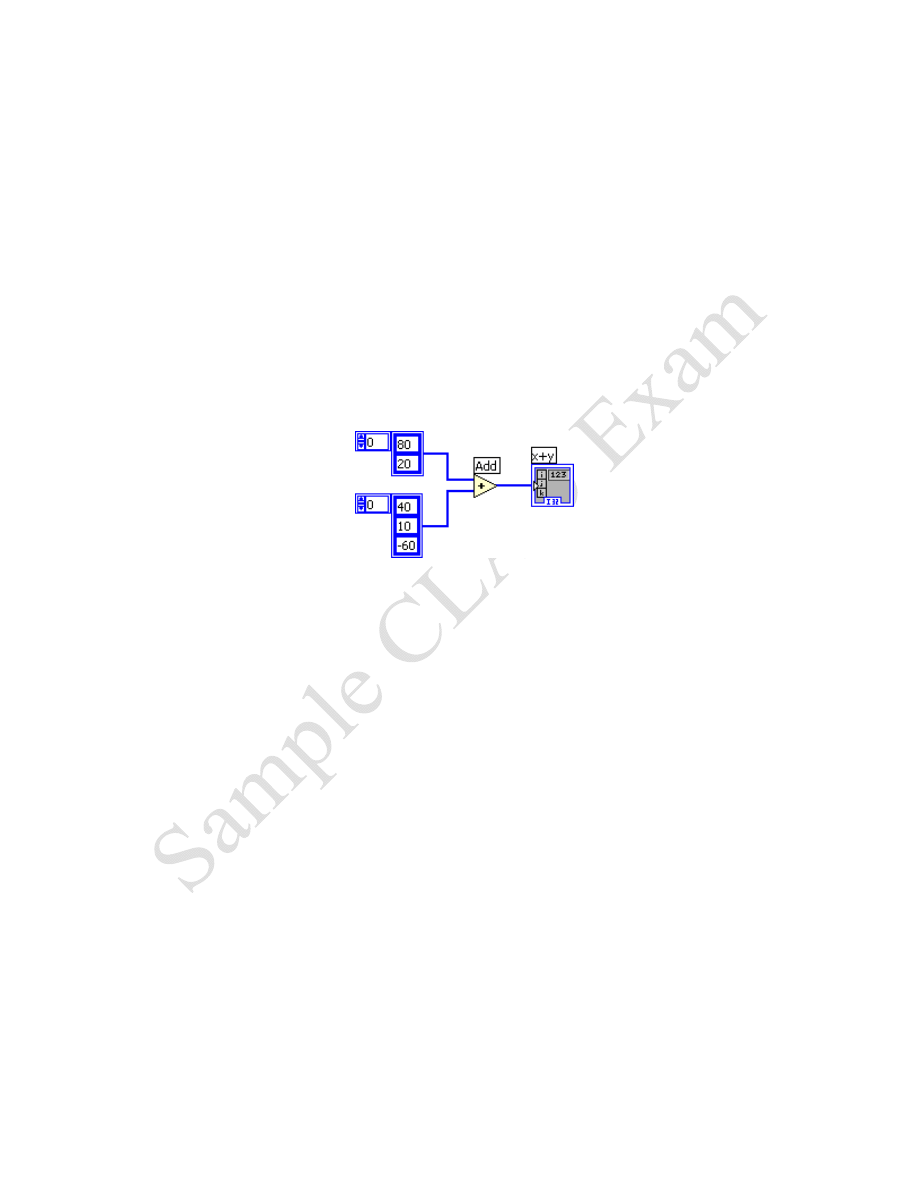
31. What is the result of the following Array addition?
a. 1-D Array of {80, 20, 40, 10, -60}
b. 1-D Array of {120, 30, -60}
c. 1-D Array of {120, 30}
d. 2-D Array of {{120, 90, 20}, {60, 30, -40}}
32. Which of the following statements is false?
a. A SubVI connector pane defines where to wire inputs and outputs
b. The color of a SubVI connector pane terminal matches the data type it is
connected to
c. You must have an icon/connector to use a SubVI
d. A SubVI icon can be edited from the functions palette
33. The most efficient method for creating an array is:
a. Using a For loop with Auto-indexing
b. Placing a build array function in a While loop
c. Initializing an array and then replacing elements in a While loop
d. Using a While loop with Auto-Indexing
CLAD Sample Exam
Page 10 of 14
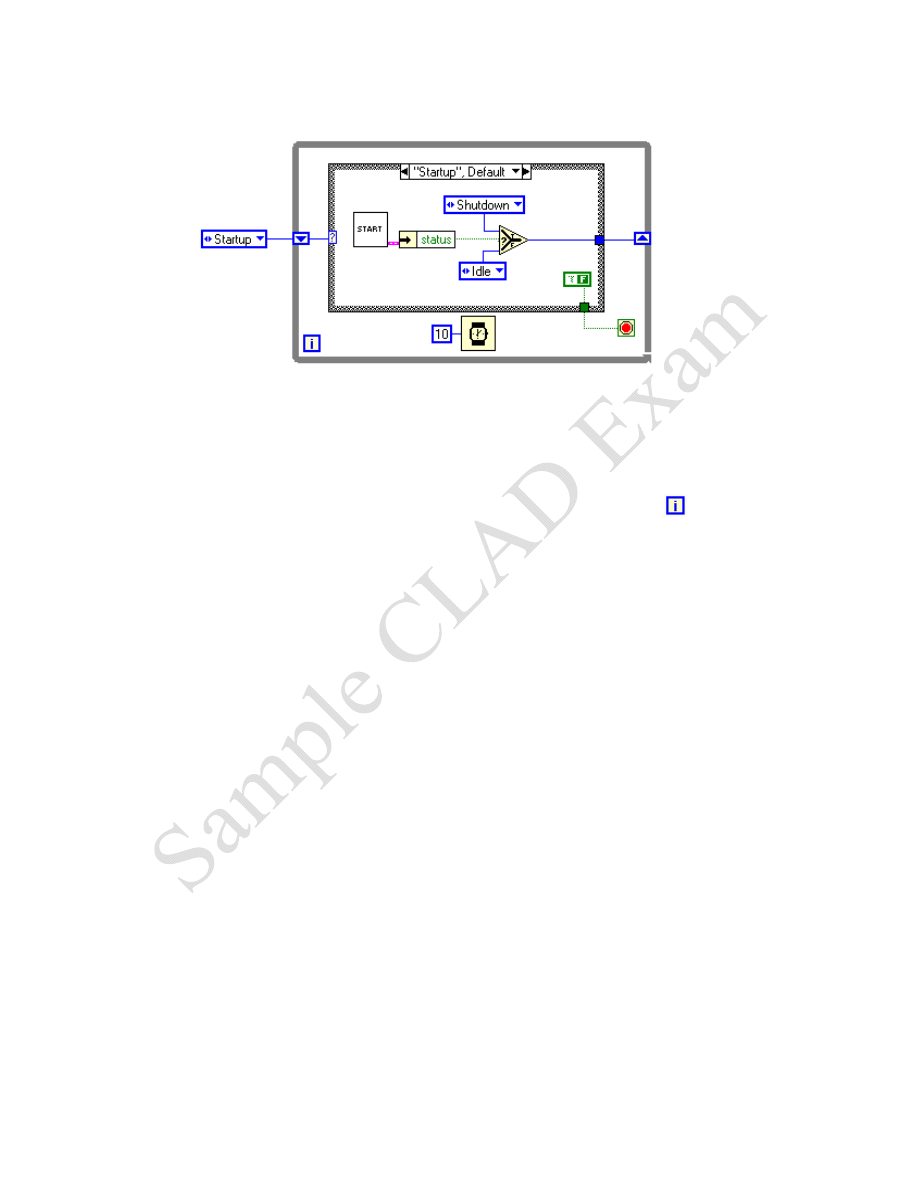
34. The following block diagram represents which common type of VI architecture?
.
a. Multiple Case Structure VI
b. General VI
c. State Machine VI
d. Parallel Loop VI
35. Which of the following statements is true about the iteration terminal
a. It returns the number of times the loop has executed
b. It returns the number of times the loop has executed, plus one
c. It returns the number of times the loop has executed, minus one
d. It returns a constant number
36. For implementing state diagrams that allow future application scalability, the best
choice for a base structure is?
a. Sequence structure
b. Case structure
c. Formula node
d. Object-Oriented structure
CLAD Sample Exam
Page 11 of 14
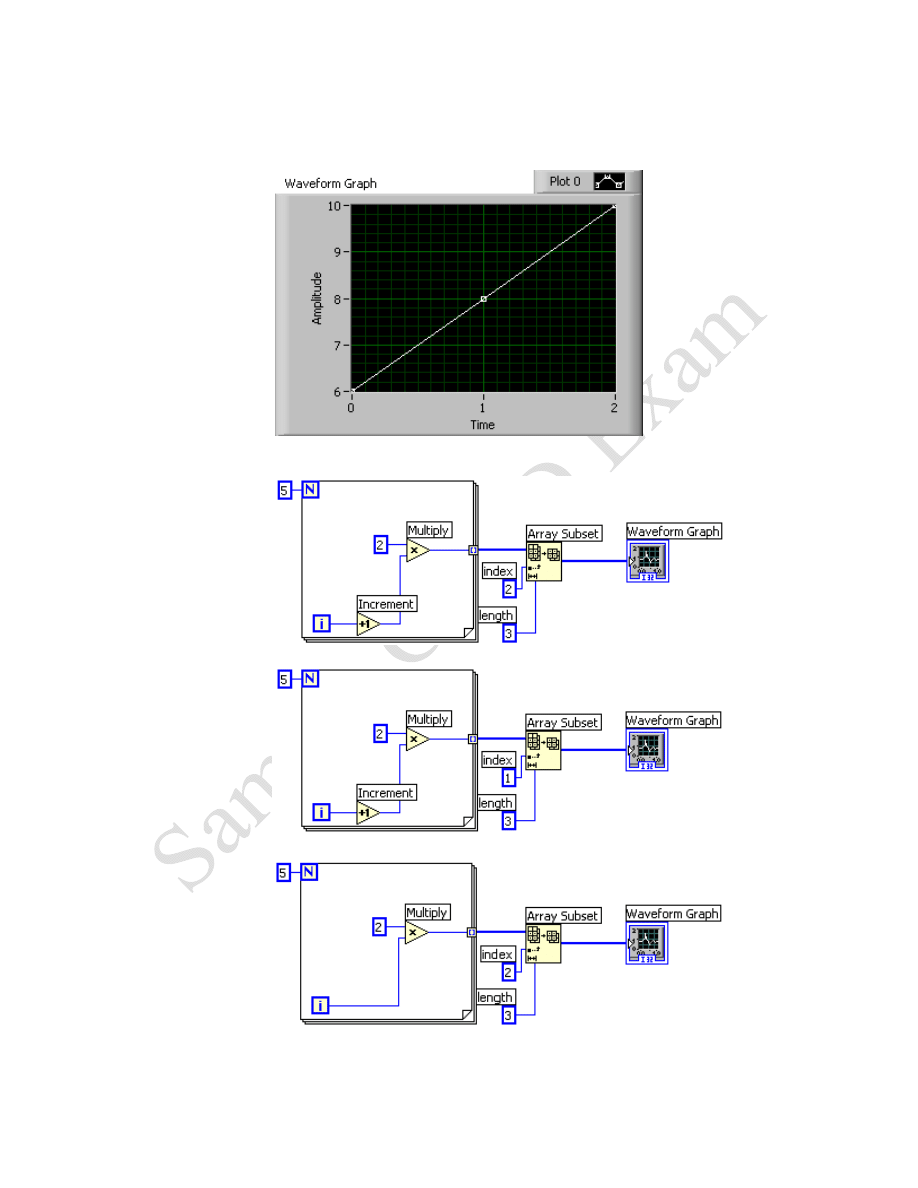
37. Which of the following Block Diagrams could produce this result in Waveform
Graph?
a.
b.
c.
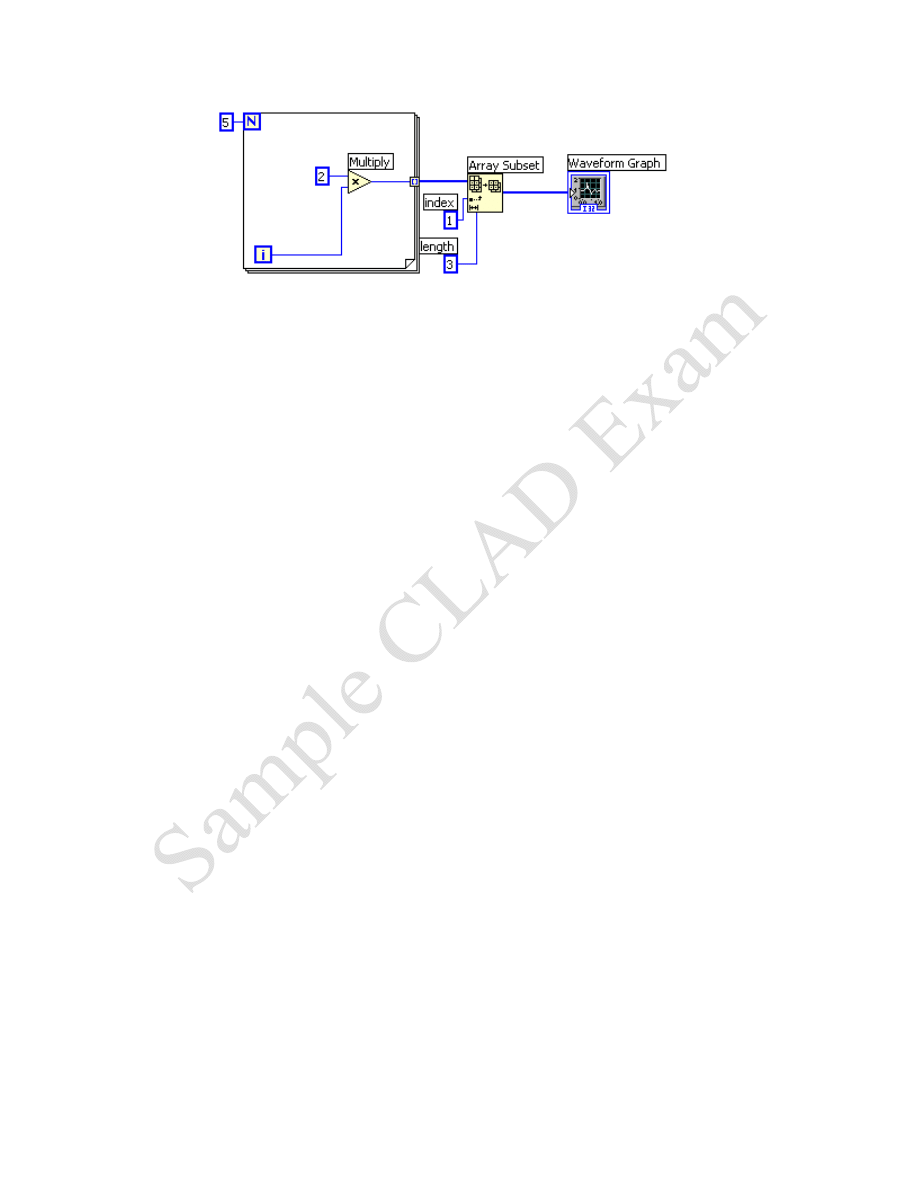
CLAD Sample Exam
Page 12 of 14
d.

CLAD Sample Exam
Page 13 of 14
More than one answer may be correct for these questions. Circle ALL of the correct
answers.
38. If an input name on the Show Context Help window is in bold for a SubVI, which of
the following conditions are true?
a. Input values must be scalar.
b. An input is recommended, but not required.
c. An input is required.
d. A broken run arrow will result unless the input is wired.
39. Which of the following apply to Property Nodes?
a. Property Nodes allow attributes of front panel objects to be programmatically
manipulated.
b. Property Nodes can be used to update the values contained in a front panel
object.
c. More than one Property Node can be used for a single front panel object.
d. Property Nodes contained in a SubVI will always cause the front panel to be
loaded in memory.
40. Which VI memory components are ALWAYS resident for a SubVI?
a. Data Space
b. Front Panel
c. Block Diagram
d. Code

CLAD Sample Exam
Page 14 of 14
Solutions Page:
Below are the solutions to the CLAD Sample Exam. To quickly check your answers, record them on the
Answer Sheet, detach the Answer Sheet, and compare it, side-by side, with the Solutions Page. This
Solutions Page is not included in the actual CLAD exam; it is included here for practice purposes only.
1. a
2. b
3. b
4. a
5. c
6. c
7. a
8. d
9. a
10. c
11. b
12. c
13. a
14. a
15. b
16. b
17. d
18. a
19. b
20. b
21. c
22. c
23. b
24. a
25. c
26. b
27. c
28. a
29. d
30. a
31. c
32. d
33. a
34. c
35. c
36. b
37. a
38. c, d
39. a, b, c, d
40. a, d
Wyszukiwarka
Podobne podstrony:
CLAD Sample Exam 1
CLAD Sample Exam 1
CLAD Sample Exam 3
CLAD Sample Exam 2
CLAD Sample Exam 2
CLAD Sample Exam
CLAD Sample Exam 4
CLAD Sample Exam 1
CLAD Sample Exam 2
CLAD Sample Exam 4
Sample exam
Sample exam ITV3F English A based on syllabus 40 0109
Sample exam ITV23FB English A based on syllabus 4 valid from May 2009 0409
Sample exam ITV3F Polish A 4 valid from July 6 2009 pdf
Sample exam ITV3F English B based on syllabus 40 0109
Sample exam questions
II Biologia sample exam questions
więcej podobnych podstron